


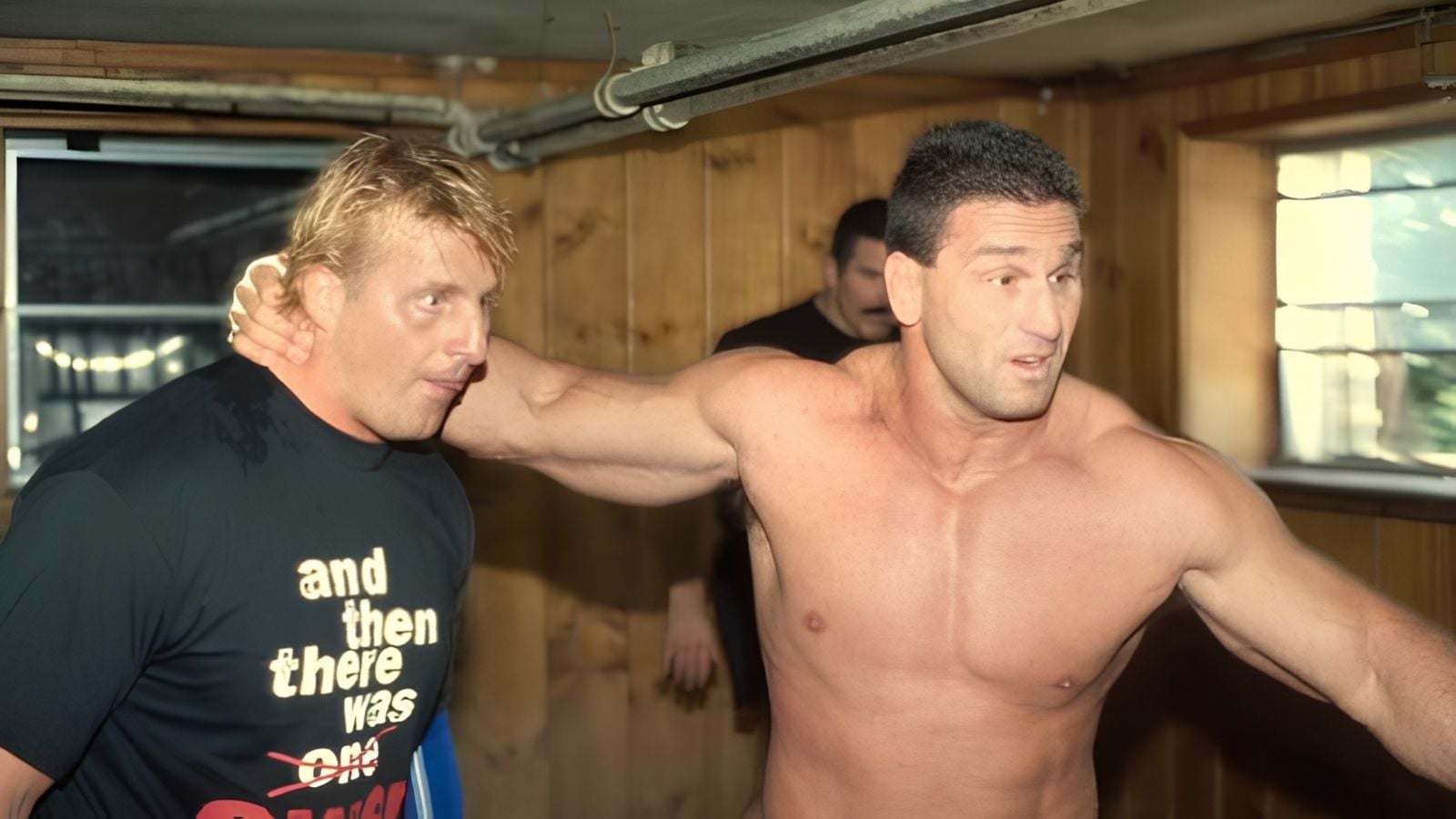
Ken Shamrock and Owen Hart had a feud that worked because both men understood what the other represented. Shamrock was the real-fight outsider with UFC credibility, while Owen was the sharp, underrated pro wrestler who knew how to turn that credibility against him.
Their rivalry began with the kind of subtle resentment and escalation that made sense in the WWF in 1998, then built into a pair of specialty matches that gave the feud its identity.
Ken Shamrock and Owen Hart – How It Started
By 1998, Ken Shamrock had already been positioned as “The World’s Most Dangerous Man,” and the WWF used that aura to put him in combative stories with wrestlers who could test him in a more psychological way.
Owen Hart was a natural choice because he could wrestle at a high level, he was comfortable working technical and submission-based matches, and he had enough wit to make Shamrock look emotionally vulnerable without making the feud feel fake.
Their rivalry developed out of the broader WWF practice of matching Shamrock’s combat-sport image against wrestlers who could expose the limits of that image.
The feud reached another level when the company leaned into its connection to the Hart family. WWF booked a “Dungeon Match” at Fully Loaded, held on July 26, 1998, inside the Hart Family Dungeon in Calgary.
That mattered because it put Shamrock in Owen’s world, not just in a ring, but in the place most associated with Hart family wrestling tradition.
It was a clean way to tell the audience that Owen was not just another opponent; he was the man bringing Shamrock into the deepest part of the Hart legacy.

The Dungeon Match
The Fully Loaded match is the one that gave the feud its most distinct identity. WWE describes it as a Submission Match, and the setting was the entire hook: the Hart Family Dungeon.
That kind of match mattered because it made the feud feel personal without needing a long amount of TV explanation. Shamrock was the fight guy, but Owen was the man who could make the fight feel like it belonged to the Harts.
Bret Hart later explained that he trained Shamrock and saw his wrestling potential early, saying,
“Right from the start I wanted to wrestle Ken [Shamrock], like I would have loved to have worked with him. I got Ken in and trained him”.
He also said he believed Shamrock could have been a much bigger star if the office had fully committed to him. That matters here because it shows Shamrock was not treated as just a stunt casting; he had real support from within the Hart orbit.
Owen then became the perfect foil because he could work the technical struggle while also framing himself as the home-field advantage.

The Lion’s Den Match
The feud moved into a second specialty setting at SummerSlam 1998, where Shamrock and Owen met in the Lion’s Den.
This was the more UFC-coded part of the story, a match type meant to reflect Shamrock’s background and force Owen to adapt to a more enclosed, fight-like environment.
If the Dungeon Match belonged to the Hart family, the Lion’s Den was designed to bring the fight back toward Shamrock’s world.
The match structure made the feud feel balanced: Owen won in the Dungeon, then Shamrock got his win back in the Lion’s Den.
That one-two structure is why the feud still gets remembered as one of Shamrock’s better WWF stories. It gave each man a specialty environment, and both matches felt like legitimate consequences rather than random TV bouts. In both cases, the location was the story, and that is what made the rivalry work.
What the Matches Said
The feud was strong because it allowed the audience to compare two kinds of toughness. Shamrock brought urgency, intensity, and the feel of a man who could hurt you for real.
Owen brought control, timing, and the ability to make a competitive match feel more intelligent than brutal. That contrast is why the feud never came off as one-sided, even when one man was clearly playing to his strengths.
Ken Shamrock later reflected on working with Owen and said he knew him well, noting,
“I mean, we weren’t like best friends, but I was at his house, we worked out together, we trained with the dungeon match”.
He also said he had worked with Owen’s brother, Bret, and had spent time in Calgary in the Hart family environment.
That quote matters because it shows the feud was built on familiarity, not just TV booking. Shamrock was not facing some stranger with Hart family branding; he was stepping into a real relationship with the Harts and a real wrestling culture.
Owen’s Role In It
Owen Hart’s role in the feud was to make Shamrock earn everything. That was always Owen’s strength. He could take a dangerous or physically imposing opponent and force them into a match that had structure, pacing, and enough cleverness to keep the audience invested. The rivalry benefited from that because it gave Shamrock something to chase, not just someone to beat.
Even in the broader discussion of the rivalry, the dynamic is obvious: Shamrock had the real-fight vibe, and Owen was the guy who could make it look like that advantage might not be enough.
One later summary put it simply, saying Shamrock’s explosive edge met Owen’s calm, calculated wrestling IQ. That is why their matches held up better than a lot of the WWF’s special-attraction stories from the period.
How It Ended
The feud did not need an elaborate finale to feel complete. It ended the way good specialty feuds often do in wrestling: one man proved he could win in the other man’s environment, and the rivalry stopped being about who belonged and became about who had already made the point.
Shamrock got the win back in the Lion’s Den after Owen beat him in the Dungeon, and that symmetry gave the story closure. By the end of the summer, both men had protected their credibility, and both specialty matches had value.
In the bigger picture, Shamrock’s WWF run eventually cooled off, and he left in late 1999, but that was not the end of the Owen feud so much as the end of the era it belonged to.
The Shamrock-Owen program remains remembered because it gave Shamrock one of his best character feuds and gave Owen another example of how good he was at carrying a distinctive wrestling idea.
It also showed that WWF could still do a simple feud well when the match types were chosen to fit the people in them.
Why It Still Works
This feud still stands out because it felt tailored instead of random. Shamrock’s background gave the angle legitimacy, Owen’s family legacy gave it texture, and the match types made the storytelling physical.
Bret Hart’s later comments about Shamrock only reinforce how much the company was trying to turn him into more than a novelty. Owen’s job was to push back against that and prove he could control the terms.
The result was one of the better short-form feuds of the Attitude Era. It was not overbooked, it did not drag on forever, and it had a clear beginning, middle, and end.
Shamrock and Owen made specialty matches feel like more than gimmicks by treating them as something worth fighting over.
WWE booked Ken Shamrock and Owen Hart in those stipulation matches because both men fit the idea of a rivalry built around identity, not just wins and losses.
Shamrock had the legitimate fight background, Owen had the Hart family credibility, and the special settings let WWE frame each man in a place where he was supposed to have the advantage.
The short version is that the stipulations made the feud feel personal and specific. Bruce Prichard later said of the Dungeon Match,
“I absolutely loved it because it was different, and it was the guys that needed to be in it doing it”.
Why the Dungeon fit
The Hart Family Dungeon worked because it gave Owen home-field advantage in the most literal sense. Owen could lean on the Hart family legacy, while Shamrock had to enter a place associated with real wrestling toughness and survive it.
That setting also let WWE tap into the long-standing mystique around Stu Hart’s training methods, which gave the match a built-in story before the bell even rang.
Prichard’s comments show that this was not just random stip booking. He said the match was for “the guys that needed to be in it doing it,” which means the setting itself was part of the character work.
Owen was the obvious choice for a Hart-themed match, and Shamrock was the obvious outsider to throw into it because his UFC background made the idea of a submission-heavy fight feel natural.
Why the Lion’s Den fit
The Lion’s Den match was the mirror image of the Dungeon Match. If the Dungeon belonged to Owen, the Lion’s Den was built to pull Shamrock back into something that reflected his combat-sports background.
That was important because Shamrock’s character needed to look dangerous in his own space, not just survive Owen’s.
The larger booking reason
WWE also wanted a feud that could be told with minimal explanation but maximum texture. Shamrock was the real-fight newcomer, while Owen was already established as a smart, technically sharp wrestler who could make that newcomer look dangerous without sacrificing his own value.
Specialty matches made the story clearer because the audience could immediately understand what each environment meant.
This was especially useful during the Attitude Era, when WWE often presented match types as extensions of character. The Dungeon told you about Owen’s world. The Lion’s Den told you Shamrock’s world.
That back-and-forth gave the feud structure and made it feel like a real competition rather than a random television rivalry.

The booking also worked because it balanced the feud. Owen won the Dungeon Match, Shamrock won the Lion’s Den, and both men came out looking protected.
That is usually a sign that the feud was well planned. WWE did not want Shamrock to steamroll Owen, and it did not want Owen to look weak against a UFC-style outsider. So the stipulations became a way to split the difference and keep both men strong.
Shamrock later reflected on Owen with respect, saying,
“we weren’t like best friends, but I was at his house, we worked out together, we trained with the dungeon match”.
That helps explain why the feud came off as grounded. It was not a cartoon grudge; it was built around real familiarity and real wrestling context. WWE booked the matches because the personalities, the locations, and the styles all lined up.
Source Links
-
WWE Fully Loaded Dungeon Match listing: Ken Shamrock vs. Owen Hart – Dungeon
-
Ken Shamrock interview on Owen Hart and the feud: 411 Wrestling interviewyoutube
-
Ken Shamrock reflecting on Owen Hart: Fight Network interviewyoutube
-
Bret Hart on training Shamrock and their connection: ITR Wrestling reportitrwrestling
-
WWE SummerSlam Lion’s Den match reference: 1998 SummerSlam match