By the Summer of 1993, New Japan Pro-Wrestling was effectively a battlefield with teams jockeying to take ontrol of the tag team division: Two of those teams were among the biggest and strongest in wrestling with three of the four combatants being Gaijins (non-Japanese) wrestlers. The two teams were The Jurassic Powers (Scott Norton and Hercules Hernandez) and The Hellraisers (Hawk and Power Warrior).
Each team represented a different philosophy of destruction. The Jurassic Powers were a display of pure, grounded mass, built on the foundation of American-style brawling. The Hell Raisers were the personification of high-octane, apocalyptic energy.
The collision course for August 5th, 1993, at the Sumo Hall in Tokyo, was inevitable, and the IWGP Tag Team Championship division had become the proving ground for both teams. Both squads were locked in an intense fight for supremacy, with the title picture hanging in the balance.
The Jurassic Powers, who had captured the titles the previous year, were viewed by the NJPW faithful as the immovable objects of the division.
The Hellraisers, meanwhile, had spent the preceding months building a trail of broken opponents, turning the promotion’s heavyweight scene into their personal slaughterhouse.
The championship match was booked not as a wrestling contest, but as a definitive test of which team could physically dominate the other, with the titles and their standing in the division on the line.
Powers in Hell:
Jurassic Powers and The Hellraisers Battle for the IWGP World Tag Team Titles
Before reflecting on the match, it is important to understand how three of these four gaijins formed alliances to achieve success in another country. That background explains the path that led them here.
Jurassic Powers
In the late 1980s and early 1990s, the landscape of Japanese professional wrestling was dominated by a specific breed of power.
It was an era where sheer, unadulterated mass was valued above almost everything else, and few teams embodied that philosophy as effectively as “The Jurassic Powers.”
Pairing Scott Norton and Hercules Hernandez was not a delicate stroke of tactical genius; it was a blunt-force decision, a recognition that if you took two of the most imposing physiques in the industry and shoved them into the same ring, the result would be nothing short of catastrophic for anyone standing in their way.
The union was born out of the churn of the American territory system and its inevitable migration toward the fertile grounds of New Japan Pro-Wrestling (NJPW).
By 1992, Scott Norton had already established himself as a terrifying force in Japan, a man whose legitimate strength and rugged aesthetic felt tailor-made for the stiff, unyielding style of the NJPW heavyweights.
Hercules Hernandez, having exited the WWE after years of being a mid-card powerhouse, was looking for a fresh start.
New Japan saw the synergy instantly: two mountain-sized men with an uncanny ability to bully their opposition.
Their pairing wasn’t a long-term plan initially; it was a reactionary measure to bolster the tag team ranks.
However, the chemistry was immediate. They didn’t need to coordinate complex aerial maneuvers or synchronized sequences.
Their game plan was elementary: isolate a limb, overwhelm the senses, and punish the body until the opponent’s spirit broke.
They competed as a unit in Japan from 1992 through the end of 1993, a relatively short window that nevertheless left an indelible mark on the IWGP Tag Team Championship scene. Reflecting on the dynamic, Scott Norton often noted the simplicity of their mission.
“We weren’t there to dance,”
Norton recalled in later interviews regarding his tenure abroad.
“People ask what made it work, and it was just about being the biggest, meanest guys in the building. Herc and I didn’t need a strategy session.
We’d walk through the curtain, and it was understood that we were going to be the ones walking out, or we were going to leave a lot of broken bodies behind us.”
Hercules, a man of fewer words but equal intensity, echoed that sentiment during their time atop the IWGP rankings.
“In the States, you get bogged down by scripts and gimmicks,”
Hercules once remarked during their peak in 1993.
“In Japan, it’s just business. Scott and I, we just clicked because we both hated the same things.
We hated losing, and we loved the fight. When you have two guys who are on the same page about how a fight should look, you don’t have to talk about it. You just do it.”
The Jurassic Powers were a relic of a time when professional wrestling was still trying to maintain the illusion of being a genuine fight. They were a pair of prehistoric predators in a modern ring.
While their time together as an official duo lasted just under two years, they set the standard for the “powerhouse” archetype in Japan.
They didn’t win over fans with charisma or high-flying drama; they earned respect through the brute application of force. In the archives of NJPW history, they remain a case study in how to take two giants and turn them into an immovable object.
Across the ring stood a duo that proved heavyweights were getting bigger, strikes stiffer, and audiences more demanding of intensity that pushed the limits of the human body. That shift set the stage for the Hellraisers.
The Hellraisers
Into this fire stepped “The Hellraisers,” a tandem that felt less like a wrestling act and more like an impending natural disaster.
Pairing Kensuke Sasaki, transformed into the face-painted, apocalyptic “Power Warrior”—with the legendary Hawk Warrior was a masterstroke of violent synergy.
The formation of the team was born of necessity and of the era’s unique chemistry. Hawk, one-half of the Road Warriors, had already conquered the global wrestling scene, but he found a kindred spirit in the young, bruising Kensuke Sasaki.
By 1992, the New Japan brass sought to inject a new layer of chaos into their tag team division. They took the established, terrifying persona of the Road Warrior and grafted it onto the burgeoning, aggressive star power of Sasaki.
It was an intimidating visual: two men with painted faces, spiked shoulder pads, and an unwavering commitment to pure destruction.
The Hell Raisers operated as an official unit in Japan from late 1992 through 1994, a period defined by an unrelenting pace and a complete disregard for their opponents’ well-being.
They weren’t there to showcase technical wizardry; they were there to shorten careers. Their signature move set was limited, brutal, and effective, relying on power slams, clotheslines, and a general attitude of disdain for the “Code of Honor” that governed their contemporaries.
“When I looked across the locker room and saw Hawk, I knew the dynamic had changed,”
Kensuke Sasaki reflected years later on his transformation into Power Warrior through translation.
“It wasn’t just about winning a match; it was about defining a territory. We didn’t want to just beat our opponents; we wanted to leave them wondering if they ever wanted to step into a ring again.
Hawk understood that better than anyone. He didn’t talk about leverage or positioning. He talked about volume and impact.”
Hawk, never one to mince words, viewed the pairing as the ultimate evolution of his career in Japan.
“People always want to talk about the ‘Road Warrior‘ legacy, and that’s fine, but with Power Warrior, it was different.”
Hawk noted that the team was at the height of its power.
“He was a sponge for the intensity I brought to the table. We weren’t a legacy act. We were the new standard.
When we hit that ring, you could feel the floorboards shake. We weren’t playing by the rules of the established stars; we were tearing them up and making our own.”
Their reign was characterized by a legendary back-and-forth rivalry with the Steiner Brothers—a clash of titans that remains etched in the minds of those who witnessed it.
The Hellraisers captured the IWGP Tag Team Championship in December 1992, defeating the Steiners in a match that looked more like a riot than a sporting contest.
By 1994, the demands of the Japanese circuit and internal shifts within New Japan led to the team’s dissolution. Yet, in those two years, they managed to capture the imagination of a nation.
They represented the peak of the “Powerhouse” era, proving that in a ring, a bit of paint and a lot of malice can carry you further than any amount of technical schooling.
They were a violent, beautiful contradiction a team that burned twice as bright and half as long, leaving the Japanese tag team scene irrevocably changed in their wake.
[Photo: njpw1972]
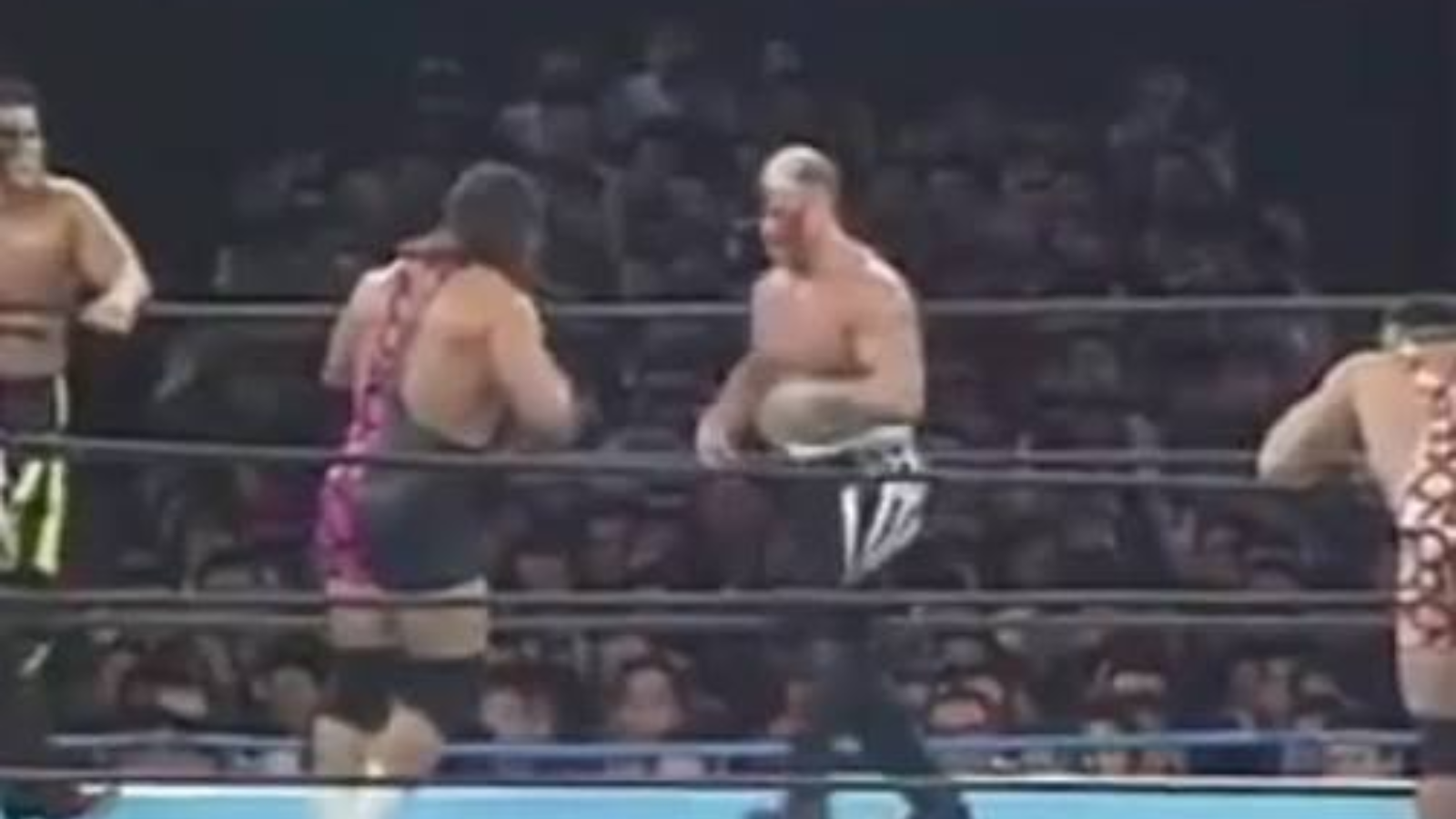
Between these two teams, the IWGP World Tag Team titles were on the line on August 5th, 1993. When the bell rang, the match immediately bypassed the traditional feeling-out process.
The matchup on August 5, 1993, at Tokyo’s Sumo Hall was the culmination of this buildup and the first title collision between the two teams.
The atmosphere in Sumo Hall was visceral, and when the bell rang, the match immediately bypassed the traditional feeling-out process.
The Hellraisers, usually the ones dictating the pace of destruction, found themselves in a rare position: they were being physically overpowered.
Scott Norton and Hercules Hernandez used their superior size to stifle the explosive offence of Hawk and Power Warrior, turning the contest into a slow, methodical grind that favored the Jurassic Powers’ brawling sensibilities.
The turning point occurred when Norton and Hercules managed to isolate one of the champions, successfully neutralizing the tag-team synergy that had made the Hellraisers so dominant.
Through a series of power moves that showcased their raw, heavy-hitting chemistry, the Jurassic Powers systematically dismantled their opponents.
The finish came as a shock to the Sumo Hall faithful: the Jurassic Powers successfully pinned the Hell Raisers, capturing the IWGP Tag Team Championship and ending the Hell Raisers’ reign in one decisive blow.
This victory was a landmark moment for Scott Norton and Hercules Hernandez, cementing the Jurassic Powers as the new kings of the division and shifting the balance of power.
They held the championship for 152 days, during which they successfully defended the gold against the best tandems in the country, proving that their reign was no fluke.
As a wrestling enthusiast for over 30 years, my fondness for professional wrestling explores the irrational in a rational way. I will explore the details inside and outside the ring and hopefully have a laugh with you in the process. I've had the fortune to interview wrestlers from Lucha Underground, TNA, Ring of Honor, GFW, and former WWE talent as well. Feel free to follow me on Twitter @TheMarcMadison