

Cyndi Lauper’s involvement with pro wrestling wasn’t a cute one-off cameo—it was one of the catalysts that dragged the WWF out of smoky arenas and into mainstream pop culture.
Lauper’s run as part of the “Rock ’n’ Wrestling” movement alongside Wendi Richter, Captain Lou Albano, Hulk Hogan, and MTV had helped to set the stage for WrestleMania and, at the time, changed how non-fans looked at professional wrestling.
Below is a sourced, quote-heavy look at what she did, who she did it with, and how those people talk about her impact.

How Cyndi Lauper Got Pulled Into Wrestling
The whole thing starts on a plane.
Lauper and her then‑boyfriend/manager, David Wolff, wound up on a flight with “Captain” Lou Albano in 1983. Wolff was a lifelong WWWF fan who knew exactly who Albano was from his days managing top heels in the New York territory.
That chance meeting led to Albano appearing as Lauper’s overbearing father in the “Girls Just Want to Have Fun” music video. From there, it turned into an on‑screen feud.
Albano parlayed that into a storyline where he claimed he made Lauper a star, leaning into a sexist, boastful persona that clashed with Lauper’s rebellious image. The WWF turned that friction into an angle that would play out on national TV and, most importantly, MTV.

The Birth of Rock ’n’ Wrestling: Albano, Lauper, and MTV
WWF and MTV built an on‑air feud between Lauper and Albano. He bragged he was responsible for her success; she fired back and aligned with the babyfaces. Their “relationship” was used to draw MTV’s young audience into wrestling.
The Rock & Roll Hall of Fame’s own social media now frames it bluntly:
“Make no mistake: WWE’s history changed the moment Cyndi Lauper stepped into the world of professional wrestling.”
– Rock in Roll Hall of Fame
At Madison Square Garden, WWF and MTV staged The Brawl to End It All (July 23, 1984), simulcast live on MTV. Lauper and Wolff were in Wendi Richter’s corner; Albano managed The Fabulous Moolah.
The build-up was pure and simple. The combination of Lauper’s pop‑culture cool against Captain Lou Albano’s old‑school bluster resulted in widespread appeal.
Wendi Richter was the in‑ring beneficiary of Lauper’s presence. Backed by the hottest female pop act in the country, she instantly became a television star. Years later, she recalled how big the numbers were:
“Cyndi Lauper and I drew a 9.0 rating on MTV.”
– Wendi Richter on how well her and Lauper’s MTV appearance did for television ratings.
The match: Wendi Richter (with Cyndi Lauper and David Wolff) vs Fabulous Moolah (with Captain Lou) for the WWF Women’s Championship.
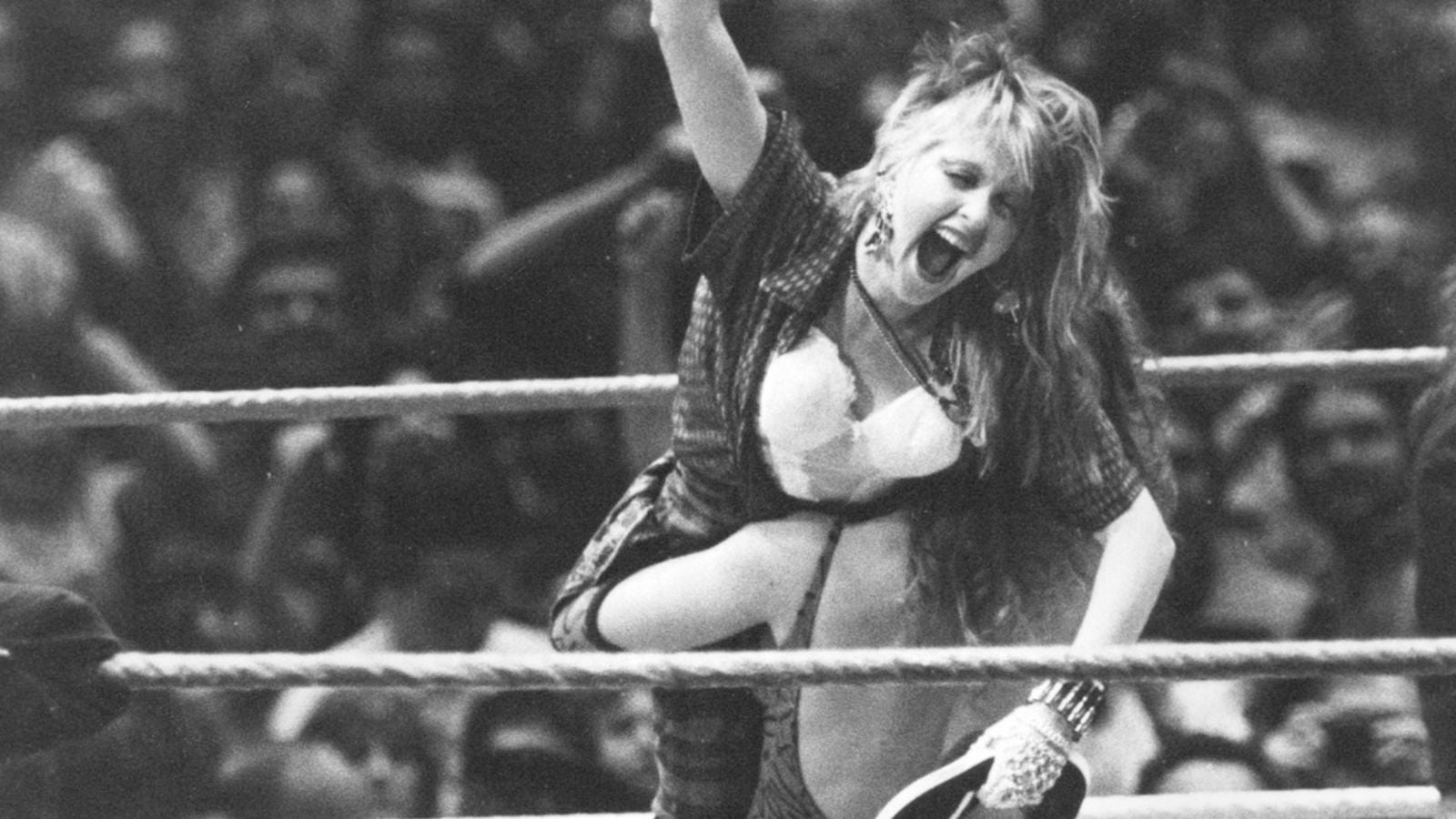
Richter pinned Moolah, ending a heavily billed “28‑year” reign (inflated, but pushed hard), and MTV’s audience saw Lauper celebrating in the ring.
On July 23rd, 1984, Wendi Richter (with Cyndi Lauper and David Wolff) defeated The Fabulous Moolah (c) (with Captain Lou Albano) by pinfall… It was the only match on the night and was for for the WWF Women’s Championship.
Related Reads: Wendi Richter – The Female Face of the Rock N’ Wrestling Era
Lauper wasn’t throwing dropkicks, but she was the hook: the pop star bringing eyes, the manager advancing the plot, and the symbol that women could headline a special.
Fabulous Moolah’s perspective
In a later shoot interview, Moolah (with Mae Young) was asked about WrestleMania and the Richter situation. On Lauper’s involvement, she kept it lukewarm but positive:
“I really enjoyed the little skit that they did, but I never did think Cindy was anything other than…” (trails off, then pivots back to Leilani Kai and the Spider Lady angle.
She did, however, confirm she was deeply involved in the women’s scene WWF built around that era, including recommending wrestlers like Leilani Kai for the Lauper‑linked programs:
“Did you actually recommend Leilani for that?
Moolah: ‘Oh sure I did.’”
Leilani Kai – A Key Adversary in the Wendi Richter/Fabulous Moolah and Cyndi Lauper rivalry.
Leilani Kai worked the Richter/Lauper orbit—she wrestled Richter (with Lauper in her corner) for the Women’s title at WrestleMania I, and was part of the wider “Rock ’n’ Wrestling” push.
In later interviews, Kai has talked far more about Moolah’s politics than about Lauper, but her placement on that stage shows how wide the singer’s shadow was: women’s wrestling was given a serious spotlight because the pop star was attached.
Cyndi Lauper and her role in The War to Settle the Score
Cyndi’s role expanded beyond the women’s division. At a later Garden show to celebrate Albano and Lauper raising over $4 million for muscular dystrophy research, they were being honored by Dick Clark when Roddy Piper crashed the ceremony.
The angle that followed is one of the most replayed moments of the era: Piper smashing a framed gold record over Albano’s head, then attacking Lauper and her manager, David Wolff:
“He smashed a framed gold record over Albano’s head, body-slammed David Wolff, and kicked Lauper, who tried to protect the downed Captain.
Eventually, the trio was saved by Hulk Hogan, setting the stage for another major card on MTV, The War To Settle The Score.”
That show—headlined by Hogan vs Piper with Lauper at ringside—did huge MTV business and directly set the table for WrestleMania I.
Hulk Hogan’s autobiography and numerous retrospectives credit Lauper and Wolff for bringing MTV’s audience in at exactly the right time, giving Hogan’s title run a broader stage.

David Wolff’s Role Behind the Scenes
David Wolff rarely gets mentioned, but he was crucial. As Lauper’s manager and a lifelong WWWF fan, he pushed hard to make the MTV–WWF crossover more than a one‑shot.
Lauper and Wolff were very key in connecting the two audiences through Music Television. Vince McMahon and the WWF saw their fortunes rise…
Wolff also took bumps—Piper slammed him during the gold‑record segment—and stayed visibly part of the presentation, signaling that this wasn’t just a licensing deal; it was an ongoing angle.
Albano’s reputation as a manager long predated Lauper, but Rock ’n’ Wrestling changed how he was perceived. He went from perennial heel mouthpiece to charity‑minded babyface after the Muscular Dystrophy angle and his reconciliation with Lauper.
Albano himself would, in later appearances, lean into the idea that the plane ride and video shoot opened the door to a boom nobody fully saw coming at the time.

Hulk Hogan on Rock ’n’ Wrestling
Hogan’s comments about that period tend to focus on the grind—“400 days a year” on the road, but he consistently acknowledges that Rock ’n’ Wrestling and the MTV specials were the moment wrestling broke out of its bubble.
Hogan was the in‑ring centerpiece, but the visibility in spike came from Lauper bringing an entirely new demographic in.
Decades later, both WWE and the Rock & Roll Hall of Fame frame Lauper as a quiet architect of the national expansion.
The Rock Hall’s official channels pushed her wrestling role in the lead‑up to her 2025 induction:
“WWE’s history changed the moment @CyndiLauper stepped into the world of professional wrestling.”– Rock n Roll Hall of Fame
During the televised induction, Lauper’s full speech focused more on music and activism than a detailed wrestling rundown, but she used language that fit her 1980s WWF role perfectly:
“My shoulders are broad enough to have the women who come after me stand on mine.”– Rock N Roll Hall of Fame
That line was aimed at women in music, but for wrestling fans, it echoes what she did for Wendi Richter and women’s wrestling visibility in 1984–85: lending her platform so they could stand higher than the system would normally allow.
In 1984, WWF’s women’s division was a niche attraction. With Lauper’s involvement, Wendi Richter vs Moolah became the main event of a nationally televised MTV special, and Richter vs Leilani Kai with Lauper in the corner became part of WrestleMania I’s core card.
Moolah, Kai, Albano, Hogan, and Piper were essential wrestling pieces. But none of them were playing on MTV every day between Duran Duran and Madonna.
Cyndi Lauper’s Wrestling Legacy in Plain Terms
From an in‑ring standpoint, Cyndi Lauper never worked a match. She wasn’t a wrestler, and she never tried to be one. Her value was in giving Wendi Richter and the women’s title a pop‑culture co‑sign.
She was also creating a storyline bridge between MTV and WWF through her feud with Albano. Lauper participated in high‑impact angles (Piper’s attack, War to Settle the Score) that translated to buys for WrestleMania I.
Related Reads: Roddy Piper and Greg Valentine – The Epic Odyssey Towards Their Brutal Dog Collar Match
Finally, Lauper lent her mainstream credibility, making pro wrestling feel less like a guilty pleasure and more like part of the 1980s entertainment mix.
The way modern voices talk about her makes the argument clear. Rock Hall social posts insist “WWE’s history changed the moment Cyndi Lauper stepped into the world of professional wrestling.”
Fans and historians point to that chance plane ride with Albano as the butterfly flap that led to MTV specials, WrestleMania, and NBC deals.
And Wendi Richter’s simple, matter‑of‑fact line—“Cyndi Lauper and I did a 9.0 rating on MTV”—is maybe the most honest summary of all.
Without those numbers and without that celebrity association, the Rock ’n’ Wrestling boom doesn’t look the same, and the road to the WWF becoming a pop‑culture powerhouse gets a lot steeper.