

The ongoing history of pro wrestlers at the Olympics is rich and plentiful. The names involved over the past century cross borders, countries and generations. The history continues in the city of angels.
A Brief History of Pro Wrestlers at the Olympics (part 2)

Los Angeles, 1984 –
Hiroshi Hase & Tamon Honda
1984 marked the second time the Olympics had taken place in Los Angeles, the first time being over 5o years earlier in 1932.
In some ways, the situation of the 1984 Olympics mirrored those of the 1932 Olympics. The 1932 games took place during The Great Depression, a worldwide economic crisis that prevented many nations from competing.
Similarly, the attacks on the 1972 games in Munich and the massive financial debt taken on by Montreal after the 1976 games led to a number of boycotts by various National Olympic Committees.
Indeed, there were only two cities able to make a bid for the 1984 games: Los Angeles, California and Tehran, Iran.
Adding further to the fire was the Soviet-backed boycott of the 1984 games, mirroring the US-led boycott of the 1980 games in Moscow. Fifteen countries took part in the boycott, with a further four opting not to compete for other political reasons.
Hiroshi Hase and Tamon Honda both took up wrestling at Senshu and Nihon Universities, respectively. While Hase specialized in Greco-Roman wrestling, Honda wrestled freestyle.
In 1983, Honda participated in the World Wrestling Championships in the USSR, placing seventh. Two months later, Honda competed in the Asian Wrestling Championship in Tehran, where he captured the gold medal.
Neither man would medal in the 1984 games, where Honda placed fifth and Hase placed ninth. However, Hase caught the eye of one Riki Choshu, who would begin Hase’s training before sending him to Carlos Colon’s World Wrestling Council in Puerto Rico, and finally to the infamous Hart Dungeon in Calgary, Alberta.
By 1987, Hase had returned to Japan, wrestling under his own name in NJPW’s Junior Heavyweight division. He would have phenomenal matches against the likes of Owen Hart and Jushin Liger before beginning a transition to Heavyweight.
Meanwhile, Tamon Honda continued to wrestle in international competitions like the World Super Championship, The Asian Games, and the 1988 Olympics in Seoul, Korea.
Indeed, Honda would not debut in the squared circle until 1993. Commentators earmarked him for great success, and while he would become a staple of the undercard, he did not reach the heights believed possible for him.
He would wrestle for NJPW, AJPW, and Pro Wrestling NOAH before retiring in 2019. Hiroshi Hase would step away from the ring in the 1990’s to pursue a career in politics, and is now Governor of Ishikawa Prefecture.

Barcelona 1992 –
Mark Henry, Naoya Ogawa
The 1992 Olympic Games in Barcelona, Spain are considered among the best in the institution’s history. The first Olympics to occur following the dissolution of the Soviet Union, the games also did much to renew Spain’s image following almost 40 years of rule by Fransisco Franco.
The city of Barcelona, along with the greater region of Catalonia, received a much-needed facelift ahead of the games, with much public infrastructure being built around that time.
All of the venues are still active, and many residents think of the 1992 games as the event that made Barcelona what it is today. Notable names who participated at these games are Mark Henry and Naoya Ogawa.
Naoya Ogawa was born in Tokyo Japan and took up judo in high school before going to Meiji University in 1986. In 1988, at the age of 20, he would become a world freeclass Judo champion.
At that point, he was the youngest judoka to reach that accomplishment. He would capture many more championships before graduating with a degree in business administration.
At the World Judo Championships, he would capture 7 medals, setting a new record, before going onto capture another 7 medals at the All-Japan Judo Championships.
His style of Judo was a slow and cerebral one, often spending the opening minutes of a match pressing his opponent instead of scoring, which earned him much criticism.
Despite the critics, he made it to the 1992 Olympic Judo Tournament, capturing the silver medal. He would compete again at the 1996 Olympic Judo Tournament, however this time he would place 5th.
However, the mounting criticism would lead Ogawa to retire from competitive judo. The following year, Antonio Inoki would recruit him for NJPW, which was beginning to incorporate wrestlers from legitimate combat backgrounds.
Mark Henry was born in Silsbee, Texas, and grew very quickly. By the time he was in the fifth grade, he was 5’5″ and weighed 225 pounds.
When he turned 10, his mother bought him his first set of weights, and he began training in weightlifting. When he entered high school, he was already able to squat 600 lbs, blowing away the school’s squat record.
In early 1990, he would enter the National High School Powerlifting Championships, setting new records in the squat (832 lbs) and total (2,033 lbs).
By the time he finished high school, Henry would have set new state and national records in all 4 powerlifting categories.
This brought him nationwide attention, with the LA Times naming him “World’s Strongest Teenager.” Attending the University of Texas at Austin, a kinesiology professor would suggest he begin training in Olympic weightlifting, which centers more on agility, flexibility, and technique than on pure strength.
After 8 months of training, Henry broke four national junior records. At the age of 19, Henry had already qualified for the 1992 Olympics.
However, he would finish in 10th place. He would compete again 4 years later in Atlanta, being voted team captain; however, an injury following his first clean and jerk took him out of competition.
He would step away from the sport due to the rampant use of steroids, signing with the WWF shortly after competing.
Atlanta, 1996 –
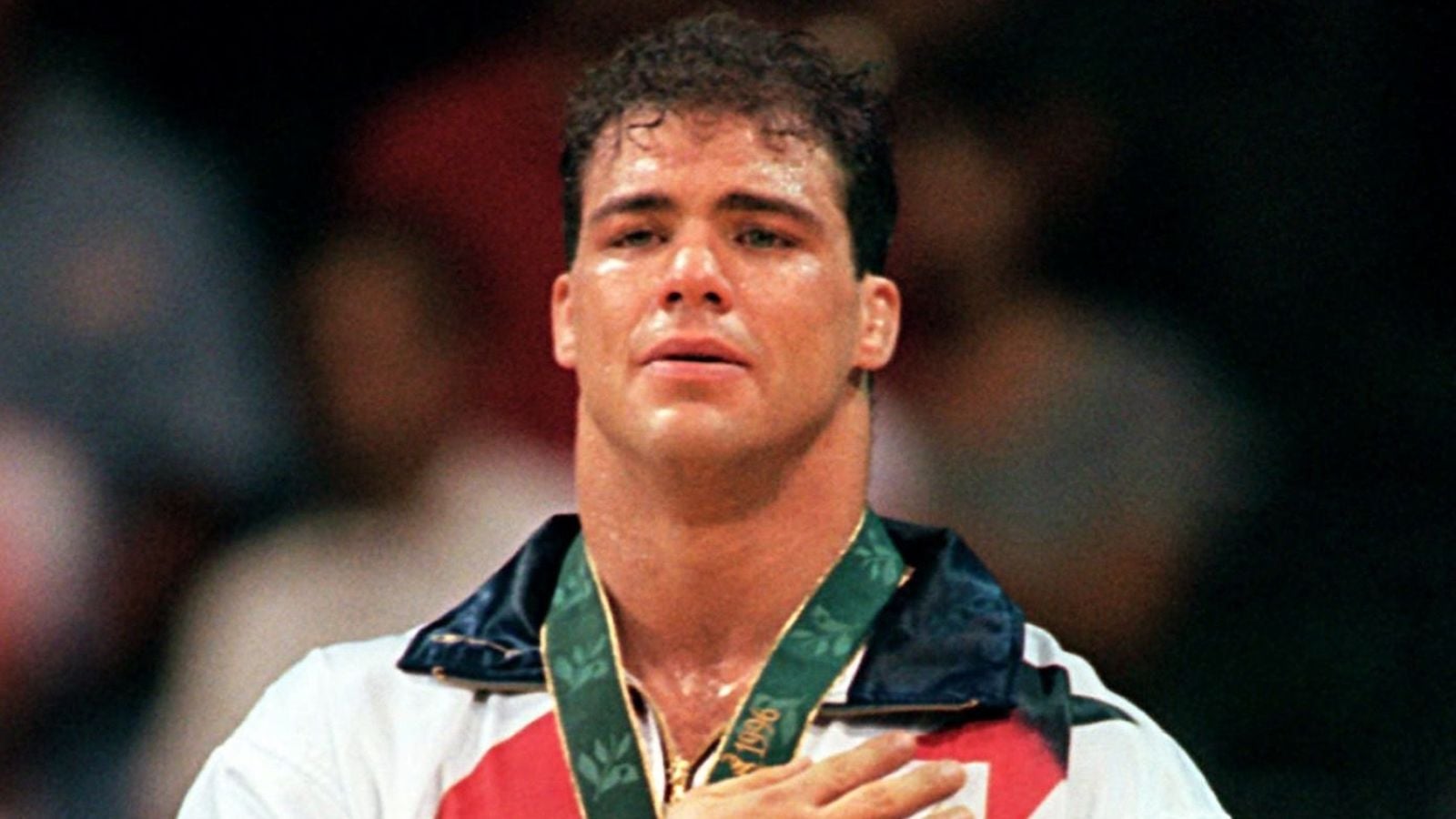
Kurt Angle’s Broken (Freakin’) Neck
American hero and wrestling machine Kurt Angle began wrestling at the age of 7 and seemingly never stopped until his retirement in 2019.
He also took up football in high school, going All-State as a linebacker for Mt. Lebanon High School and earning varsity letters in both football and wrestling.
At Clarion University, he racked up countless accolades in the NCAA and United World Wrestling. After graduating, Angle tried out for the Pittsburgh Steelers as a running back, despite not playing football in college.
In 1995, Angle won the gold medal at the World Freestyle Wrestling Championships in the 100 kg class. Following this victory, Angle began training with the Pennsylvanian Foxcatcher Club under Mark and Dave Schultz.
However, tragedy would strike shortly after Angle joined, as club owner John du Pont murdered Dave Schultz in January of 1996.
Schultz’s widow, Nancy, would establish the Dave Schultz Wrestling Club to train the now displaced athletes from the Foxcatcher club in the lead-up to the 1996 Summer Olympics in Atlanta.
This tragic event played a major role in the narrative leading up to the Olympic games, but there was still more difficulty in store for Angle.
At the 1996 Olympic trials, Angle made it to the semifinals before being dumped on his neck. The ugly bump resulted in two fractured cervical vertebrae, two herniated discs, and four pulled muscles.
He wrestled through the pain, winning a spot in the 100kg freestyle competition, though he had to spend the following 5 months resting and rehabilitating.
Come July, he was cleared to compete, though he required multiple pain-reducing injections in his neck and regular use of prescription painkillers.
All told, Angle competed in four matches, narrowly winning over Dolgorsürengiin Sumyaabazar (Mongolia), Wilfredo Morales (Cuba), and Sagid Murtazaliev (Ukraine), before defeating Konstantin Aleksandrov (Kyrgyzstan) to capture his famous Gold Medal.
Later that year, fellow Yinzer Shane Douglas convinced him to appear for ECW at their High Incident event, giving an interview and providing guest commentary for a match between Taz and Little Guido.
However, he would walk out of the building following Sandman’s crucifixion at the hands of Raven. Angle threatened to sue Paul Heyman if his appearance was ever shown, and he would continue to hold professional wrestling in particularly low regard until he began watching Raw Is War in 1998.
His begrudging admiration for Stone Cold Steve Austin brought him to sign with the WWF later that year and the rest is history.

Athens, 2004 –
Jeff Cobb
The 2004 Summer Olympics featured something of a homecoming, as the games returned to their home nation for the first time in the 21st century.
While Athens had hosted the first of the revival games in 1896, the world wars of the 20th century destabilized the world to such an extent that two Olympiads passed without any games at all.
Athens had made a bid to host the 1996 games, only for Atlanta to beat them out. IOC president Jacques Rogge hailed the event as “unforgettable dream games,” which left the areas around Athens with significantly improved infrastructure including a heavily renovated tram line.
However, the cost of the games may have had knock-on effects on the Greek economy, leading to the debt crisis of the 2010’s. The 2004 Olympic Games featured over 10,500 athletes from 201 nations.
“Mr. Athletic” Jeff Cobb fell in love with pro wrestling during his childhood in Hawaii and Guam. Growing up in the WWF’s Golden Era, he cites his earliest inspirations as Hulk Hogan, Bret Hart, and the Ultimate Warrior.
In high school, he signed up for the wrestling club in the mistaken belief that amateur wrestling was the entry level of professional wrestling.
Despite his initial misgivings, he swiftly became enamored of the original wrestling, becoming a standout on his high school team and continuing to wrestle at Missouri Valley College.
In his freshman year, he was selected as one of only four athletes representing Guam at the 2004 Olympic Games in Athens.
Along with Cobb were two track-and-field athletes and a swimmer. The 22-year old Cobb lead the Guamanian representatives into the stadium during the opening ceremonies.
He participated in the Freestyle Wrestling event, competing in the 84kg division, however he placed dead last at 21st with no victories to his name.
Following his appearance at the Olympics, he finished college before returning to Hawaii to train in professional wrestling.
Nominally, he trained under Oliver John, however he describes it as having a typically laid-back Hawaiian vibe, where everyone helped each other out.

Beijing, 2008 –
Ronda Rousey
In 2001, the IOC elected Beijing, China, to host the 2008 Olympics amid much consternation. Reports from the time suggest Beijing earned broad support after losing their bid for the 2000 Olympics, much of it coming from developing nations who had received much support from China.
Amnesty International and politicians from around the world raised concerns about human rights abuses in the country.
Additionally, many delegates who had previously competed voiced their concerns about the heat and air quality, citing the high levels of air pollution around Beijing.
However, IOC executive Director François Carrard and others countered with the suggestion that hosting the Olympics might lead to an improvement in human rights, and the government of China outlined plans to address the environmental concerns.
In retrospect, the Beijing Olympics are considered a logistical success, with many of the worst fears failing to materialize.
While the air quality was still the worst in Olympic history, favourable weather patterns alleviated the worst of it. Many in China viewed the games as an affirmation of their nationalistic dreams.
Long before she ever stepped into a wrestling ring, and quite a bit before she set foot in a UFC octagon, Ronda Rousey was a judoka.
Her mother, AnnMaria De Mars, is also a decorated judoka, becoming the first American to win a gold medal at the World Judo Championships in 1984.
Rousey began training with her mother at 11 years old, though she entered formal training at Hayastan MMA Academy in Los Angeles after accidentally breaking her mother’s wrist.
Being one of the only women training at Hayastan, she often faced men who were larger than her and became frustrated by her inability to execute throws against them.
Rousey describes the Hayastan house style as one that emphasized brawling over the more technical Japanese style of judo.
In 2004, she qualified to compete at the Olympics in Athens, becoming the youngest athlete to do so at only 17 years old. Competing in the 63 kg bracket, she lost her first match to eventual silver medalist Claudia Heill.
While she failed to capture any medals, she continued competing, winning gold later that year at the 2004 World Judo Juniors Championship in Budapest.
In 2007, Rousey would win a silver medal at the World Judo Championships and a gold medal at the Pan American Games.
This set her up for competition at the 2008 games in Beijing, where she would capture the bronze medal in the 70kg division, becoming the first American to medal in Women’s Judo since it’s inception at the 1992 Olympics.
Following her historic victory, she would retire from judo with a professional record of 56-19. Following her retirement, she worked a number of service industry jobs in Venice Beach, CA, until entering MMA in 2010.

London, 2012 –
Anthony Agogo
In 2005, the IOC chose London over Paris, Madrid, Moscow, and New York City to host the 2012 Olympics. The committee heavily favored Paris, however the representatives visit coincided with a number of worker strikes and student protests.
Not helping matters, French representative Guy Drut was facing corruption charges. Unsurprisingly, the IOC went with their second choice.
The opening ceremonies by Academy Award-winning director Danny Boyle, received wide acclaim, with British newspapers describing it as “a love letter to Britain.”
The Games of the XXX Olympiad marked a number of historic firsts. For instance, London, England became the first city to host the Olympics on three separate occasions, having also hosted in 1908 and 1948, and Women’s Boxing joined the table of events.
However, most impressively, the 2012 Olympics were the first in which every sport had female competitors, with Saudi Arabia, Qatar, and Dubai entering female athletes. Unfortunately, this entry is not about one of them.
Anthony Ogogo was born in Suffolk to an English mother and Nigerian father. He grew up playing soccer and took up boxing at age 12, eventually capturing gold medals at the 2004 Junior Olympics in Texas and the 2005 IABA Cadet World Championship in Liverpool and a silver medal at the 2010 Commonwealth games in Delhi, India.
Ogogo secured his spot on Team GB in April of 2012, however, tragedy struck just four weeks before the games, when his mother collapsed from a brain aneurysm.
He spent those weeks in the hospital with her instead of training, with the anxiety leading to considerable weight loss.
In the round of 16, Ogogo fought to a 52-52 draw with Ukraine’s Evhen Khytrov, then-World Amateur Boxing Middleweight Champion. 3 of 5 judges awarded the match to Ogogo, who would go on to the semifinals to face Brazil’s Esquiva Falcão in a losing effort, earning him the bronze.
While he had dreamed of Olympic gold, the bronze is no mean feat, and Ogogo turned pro shortly after, eventually earning a match with Craig Cunningham for the WBC International Middleweight title in 2016.
However, it was in this match that Cunningham broke Ogogo’s eye socket, leading trainer Tony Sims to pull him from the bout.
Despite undergoing several operations to repair his vision, Ogogo’s eye was damaged so much that he had to register as blind, and announced his retirement from boxing in March of 2019.
However, his impaired vision didn’t prevent him from athletic pursuits. One month before announcing his retirement, he made his pro wrestling debut for Norwich, UK indie promotion World Association of Wrestling.
He soon caught the eye of Cody Rhodes, who signed Ogogo to the new All Elite Wrestling as their first developmental talent.

Tokyo, 2020 –
Gable Steveson, Tyra Mae Steel
The Games of the XXXII Olympiad were initially scheduled to begin in Tokyo, Japan on July 24th, 2020. Nature, however, had other plans, as SARS-CoV-2 broke out in late 2019.
In March of 2020, nations around the world entered an extended quarantine, and the IOC made the difficult decision to postpone the games.
This decision marked the first and only postponement of the Olympics, as the World Wars resulted in the cancellation of the 1914, 1940, and 1948 games.
When the games commenced on July 23rd, 2021, Tokyo became the first country in Asia to hold the Summer games twice, having also hosted the games in 1964. They were also the most expensive games to date, costing an estimated $20 billion.
Gable Dan Steveson was born to a family seemingly obsessed with wrestling. His two older brothers also competed in amateur wrestling, and Gable himself was named after wrestler and Olympic gold medalist Dan Gable.
Allegedly, Gable became interested in wrestling as soon as he could walk, and it shows in his amateur accolades. In the Minnesota State High School League, he racked up a 171 match winning streak, leaving for college with a record of 210-3.
Gable’s winning ways continued into college, until he and a teammate were arrested on suspicion of sexual assault in 2019. Accordingly, the NCAA suspended him from all competitions, however there were never any official charges leveled at him.
When he returned in August, he continued his reign of dominance, capturing the Dan Hodge trophy at the end of the season.
Competing in the US Olympic Trials on April 2nd & 3rd, 2021, he defeated 2019 Pan-American Games champion Nick Gwiazadowski. On the first day of the Men’s Freestyle 125kg event, Steveson defeated 3 highly-ranked opponents with a perfect 23-0 score.
Advancing to the finals, he topped reigning world champion Geno Petriashvili of Georgia on a score of 9-8 to capture gold, becoming the first American superheavyweight to do so since Bruce Baumgartner in 1992.
Later that year, he made an appearance at WWE Summerslam, and shortly thereafter, the company announced him as only the 2nd Olympic Gold Medalist signed to the company.
However, his run was short-lived, as he was released from his contract in 2024. He has since attempted a career in American Football and MMA.
Tamyra Mensah-Stock had initially pursued a career in track-and-field, while her twin sister Tarkiya pursued wrestling.
However, in her sophomore year, Tarkiya and the school wrestling coach persuaded her to join the wrestling team.
She almost quit after her father, her biggest supporter, died in a car accident following one of her matches. Nevertheless, Tamyra persisted, eventually becoming Texas High School Girls Champion and US Junior National runner-up.
She continued wrestling in college, winning the 2014 and 2017 Women’s Collegiate Wrestling Association Nationals Championship.
Despite winning the 68kg class at the US Olympic Trials in 2016, none of the United States athletes secured a spot in the competition, so she spent her time in Rio de Janeiro as a sparring partner for teammates in other weight classes.
In 2019 she won gold in her division at the World Wrestling Championships, and secured a spot on the 2020 US Olympic wrestling team, where she would become the first African-American woman to win gold in wrestling.
Along with Steveson, she also appeared at the 2021 Summerslam, however she wouldn’t sign with the company until 2023.
In 2025, Tamyra joined the inaugural class of WWE LFG, being mentored by The Undertaker and ultimately winning the first season, debuting in NXT later that year under the name Tyra Mae Steele. However, WWE released her from her contract on April 24th, 2026.