


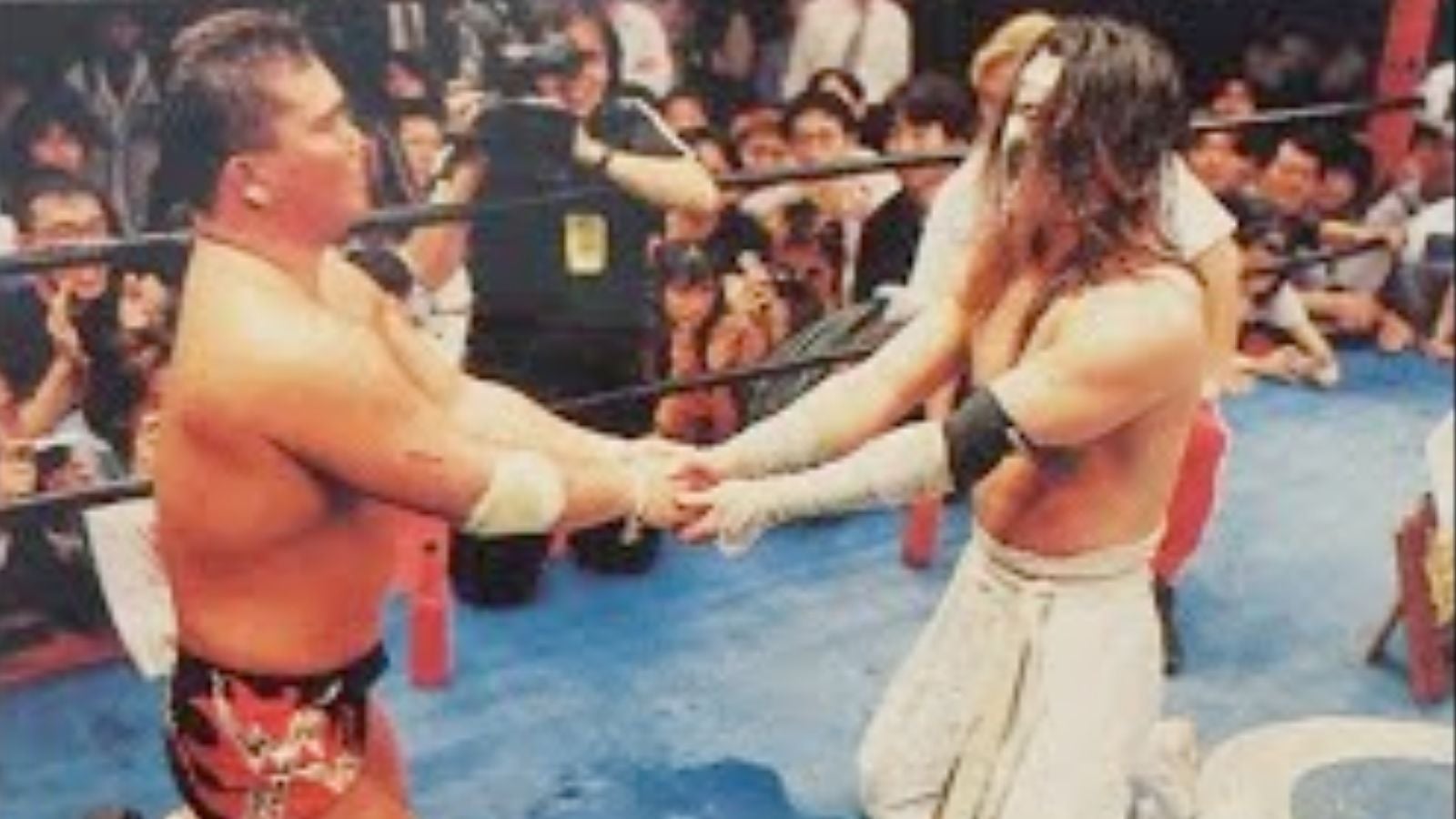
On May 19, 1998, inside Korakuen Hall in Tokyo, two of Frontier Martial-Arts Wrestling’s most important figures stepped into the ring not as enemies, but as something more complicated—partners, rivals, and reflections of each other as Hayabusa and Masato Tanaka would create history for FMW..
Hayabusa, the newly crowned FMW Double Champion, faced Masato Tanaka, his recent tag team partner, in what would become one of the most discussed and debated matches in the company’s history—and, for many, the defining performance of Hayabusa’s career.
The match was not built solely on spectacle. There were no exploding ropes. No barbed wire. No chaos-driven shortcuts.
Instead, it was something far more revealing: two wrestlers proving that FMW could produce elite-level wrestling without its trademark violence.

A Champion and His Mirror
Just weeks earlier, Hayabusa had defeated Mr. Gannosuke to capture the FMW Double Championship, marking the culmination of his rise as the company’s centerpiece performer.
Tanaka, meanwhile, was not just another challenger; he was Hayabusa’s tag partner, a former champion, and a stylistic opposite grounded in stiffness and realism
Their familiarity created a unique tension. This wasn’t a feud built on hatred—it was built on understanding.
That earlier match had already set expectations. What followed exceeded them not through innovation alone, but through escalation.
Hayabusa and Masato Tanaka – The Match That Defined FMW’s In-Ring Identity
The match begins deliberately. No rush. No theatrics. Instead, both men circle cautiously, engaging in a series of tie-ups and counters.
The early minutes establish a clear psychological foundation: Tanaka targets Hayabusa’s leg, and Hayabusa isolates Tanaka’s arm.
This mirrored structure wasn’t accidental—it was strategic. Each man attacked the other’s base.
The crowd inside Korakuen Hall reacts not with explosive noise, but with attentive anticipation. This is not an FMW crowd expecting chaos—they are watching a contest unfold.

The Shift: From Structure to Escalation
At roughly the midpoint, the match changes. The limb work gives way to impact. Hayabusa begins to increase tempo.
Among the moves he hit him with include: springboard offense, sudden aerial counters, and momentum shifts built on speed.
Tanaka responds not with agility, but with force. With stiff forearms, a roaring elbow, and direct, punishing counters, Masato Tanaka showed moments of dominance during this match. This contrast defines the match. Where Hayabusa creates space, Tanaka violently closes it.
The Turning Point: Desperation Sets In
What separates this match from many others of the era is not just the escalation, but the psychology behind it.
This is where the match becomes something more than technically impressive. It becomes urgent.
Throughout the match, near-falls begin to pile up between the competitors. These pinning attempts included pinfalls with the falcon arrow. There were consistent elbow exchanges and high-risk counters by both men.
Each kickout wasn’t just a reaction; it was a statement. Neither man was willing to concede.

The High-Risk Sequence: Redefining FMW Style
Then comes the moment that defines the match. Tanaka executes a reverse superplex from the top rope—a move described in reviews as: ‘crowds erupting’..
This is the turning point where the audience fully commits—not just emotionally, but physically. From this point forward, every move feels like it could end the match. And yet, it doesn’t.
The closing sequence reflects a distinct influence from All Japan Pro Wrestling’s main-event style: a gradual escalation of increasingly dangerous offense culminating in a decisive final blow.
Hayabusa delivers a Tiger Driver ’91, targeting Tanaka’s neck with brutal precision. Then moments later, a Falcon Arrow and pinfall. The momentary silence then gave way to an eruption from the crowd.
The match ends not with chaos—but with clarity.
Crowd Energy: From Observation to Investment
Korakuen Hall crowds are known for their discernment. They do not react immediately—they build.
This match followed that exact pattern: Fans were quietly engaged early on and focused on the competitor’s technique.
Then, as the match went on, a noticeable audible reaction was apparent between both competitors as they showed commitment to the story, indicating the fans’ investment in the match.
As the match would reach his crescendo, there was sustained noise and an emotional release with each near fall. By the finish, the crowd is fully invested—not because of spectacle, but because of progression.
Aftermath: Mutual Recognition
While detailed post-match transcripts are limited, historical accounts emphasize the mutual respect between the two competitors.
Their relationship did not fracture; it deepened. This is critical. Unlike many rivalries, this match did not end a story.
It expanded it. They would continue to face each other repeatedly, building one of FMW’s most consistent in-ring rivalries.
Critical Reception: Divided but Significant
The match has been highly regarded by fans worldwide. While most herald it for its execution, others have criticized its reliance on near falls to build fan anticipation. This divide is important—it reflects the transition in wrestling style during the late 1990s.
By 1998, Hayabusa had become more than a high-flyer. He was a symbol of FMW’s evolution and the bridge between spectacle and technical wrestling. This match reinforced that identity.
Masato Tanaka’s role was equally critical. His style—built on strikes, his durability and realism. He ensured that Hayabusa would be grounded for this match. Together, they created balance.

Historical Significance
This match holds a unique place in wrestling history because FMW was known for: deathmatches, the use of weaponry, and the spectacle of the matches.
This match proved that the roster could deliver traditional main event wrestling, and is an emotional investment that didn’t require gimmicks
For Hayabusa, this match is often cited as the best match of his career.
That distinction matters.
It places this match above his famous deathmatches and international battles. The structure of this match—particularly its escalation and near-fall sequences- would become more common.
From the late 1990s and early 2000s to the present, puroresu and independent wrestling have been influenced by what took place in this battle.
Today, countless modern main-event styles worldwide showcase a high level of execution, as seen in this match.
Legacy: Why This Match Still Matters
More than two decades later, this match remains essential viewing—not because it is perfect, but because it is revealing.
The match shows that FMW is at its most disciplined. It showcased Hayabusa at his most complete, combining all the elements that made him so admired by fans and his contemporaries, and showed that Masato Tanaka was the ideal counterbalance to Hayabusa’s method of wrestling.
It also captures a moment in time when wrestling was evolving rapidly—when promotions were redefining what audiences expected.
On May 19, 1998, Hayabusa and Masato Tanaka did something rare. They stepped away from what defined their promotion—and proved they didn’t need it. No explosions. No shortcuts. No distractions.
Just two wrestlers pushing each other to the limit. And in doing so, they created something that has endured far longer than any spectacle ever could.
To watch the match in its entirety, click the link below.