

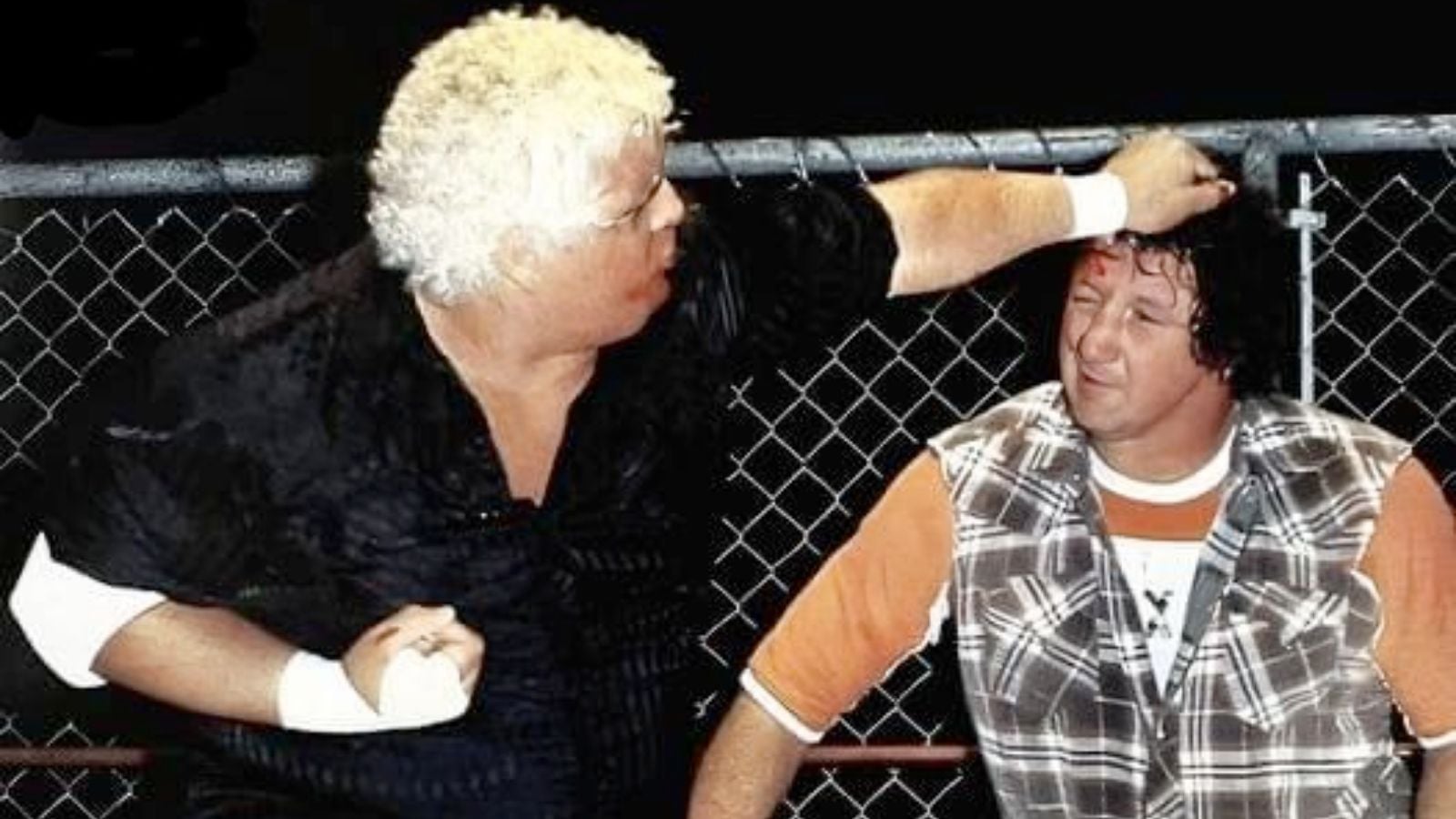
Few rivalries in professional wrestling blurred the line between performance and personal hatred quite like the war between Terry Funk and Dusty Rhodes.
This was more than a feud—it was a collision of philosophies, identities, and eras. Funk, the unhinged Amarillo outlaw, embodied chaos and sadism.
Rhodes, ‘The American Dream,’ stood for working-class pride and connection. Together, they defined the hardcore style before it was named, shaped early merchandising, and delivered some of wrestling’s most visceral matches.
Terry Funk and Dusty Rhodes –
Origins: Two Texans, Two Worlds
By the late 1970s, both men were already established stars—but from vastly different traditions. This backdrop set the stage for their explosive conflict.
Terry Funk, a second-generation wrestler from Amarillo, was raised in the Funk family system, emphasizing realism and toughness. Already a former NWA World Heavyweight Champion, he was known for pushing physical limits.
Dusty Rhodes was a charismatic anti-hero who connected deeply with blue-collar audiences. He became a multi-time NWA World Champion and one of wrestling’s greatest talkers.
Their rivalry intensified from the late 1970s into the early 1980s, especially in Florida and other NWA territories, where stipulation matches became their battleground.

Chaos vs. Connection
At its core, this feud worked because it wasn’t just about wins and losses. Rather, Terry Funk represented nihilism. He didn’t just want to beat Dusty; he wanted to humiliate and break him.
In comparison, Dusty Rhodes represented resilience—he absorbed punishment and turned it into emotional fuel. The need to embarrass or humiliate Funk would be a retaliatory motive, never an initial motivating factor.
The promos between the two weren’t scripted speeches; they were confrontations. Funk repeatedly referred to Rhodes as an “egg-suckin’ dog,” a phrase that would become synonymous with the rivalry. The insult wasn’t random—it was rooted in Southern vernacular, implying cowardice and worthlessness.
Rhodes, in response, often leaned into his signature emotional cadence, framing Funk as a deranged threat not just to him, but to the fans themselves.
The Matches: Violence Before “Hardcore” Existed
Before ECW popularized extreme wrestling, Terry Funk and Dusty Rhodes were already doing it.
Their Texas Bullrope matches became the most iconic stipulation of their feud. Both men fought while tied together with a rope and a cowbell.
The focal point of the match was the bullrope and what it represented, as well as the punishment that could be administered with it. For as much pain and suffering could be inflicted with the bullrope, it also eliminated escape.
With every strike, screams of anguish reverberated through both competitors. During these matches, blood was not uncommon; it was expected.
These matches reinforced the feud’s brutality: there was no running, no hiding, just endurance. A second series of matches was their Bunkhouse brawl matches.
The Bunkhouse matches emphasized realism. Fighters wore jeans, boots, and T-shirts instead of traditional gear. It was as reflective of a barroom battle as it was a fight in an alleyway behind a venue.
This choice blurred the line between fiction and reality, making the violence feel genuine rather than performed.
The rivalry thrived in this setting, where Funk’s wild unpredictability clashed with Rhodes’ ability to rally the crowd.
If the first two didn’t shock fans enough, the Lights Out matches were equally dangerous. Presented as unsanctioned, anything could happen. Weapons, interference, and chaos were not just allowed; they were encouraged.
The storytelling here was simple in these matches. Terry Funk’s actions towards Dusty would escalate. In turn, Rhodes would ultimately survive these matches. In the end, the audience was once again convinced of the hatred between these two men.

The “Dusty Sucks Eggs” Shirt: Heat You Could Wear
One of the most enduring images from the rivalry isn’t a move or a match—it’s a T-shirt. At the height of their feud, Terry Funk appeared wearing a bright orange shirt with bold lettering:
“Dusty Sucks Eggs”
The origin traces directly back to Funk’s repeated promos calling Rhodes an “egg-suckin’ dog.” The phrase evolved into visual storytelling. The shirt became a weapon—psychological, not physical.
According to historical accounts of wrestling merchandise culture, the shirt emerged during their intense late-70s/early-80s feud and became a defining visual tied to their violent encounters.
This mattered more than it might seem: The shirt was revolutionary. What has been described as ‘proto-merchandising psychology’ didn’t promote the talent positively; rather, it conveyed hate.
It was also a character extension of Terry Funk. He didn’t just want to say what he thought of Dusty, he wanted audiences to all know what he felt about the American Dream tool. Having it memorialized in a t-shirt truly brought home the insults Funk shared towards Rhodes.
The shirt generated immediate heat from fans. Fans didn’t just boo Funk—they despised him. Decades later, the influence remained so strong that WWE referenced it in a modern parody (“Cody Sucks Eggs”) during Kevin Owens and Cody Rhodes’ 2024 feud. This was directly tying it back to the original Funk–Rhodes feud and Cody’s father, Dusty.
The Promos: Where the War Became Personal
If the matches were violent, the promos were psychological warfare. Funk’s interviews felt unstable, like he might snap at any moment.
He often delivered threats in a calm, almost detached tone, making them more unsettling. His repeated use of ‘egg-suckin’ dog’ highlighted Rhodes’s weakness and included even more personal insults.…turned Dusty into a target rather than just an opponent.
While Dusty Rhodes didn’t match Funk’s madness in his responses, he did counter with emotion. His promos elevated the feud into a moral struggle.
Rhodes would put himself forward as a champion of the people (not unlike his feud with Ric Flair) and turn his pain into a narrative that would have people get behind him and find hope.
Whereas Funk dehumanized Dusty, Dusty humanized Funk in his responses. That contrast is why the feud worked.
As the feud progressed, matches grew increasingly brutal. Blood, weapons, and chaotic brawling were not rare; they were the selling point. This escalation redefined acceptable in-ring violence and influenced future hardcore wrestling styles.
Crowds didn’t just watch, they reacted viscerally. Funk’s cruelty drew real anger. Dusty’s comebacks triggered explosive cheers. The emotional swings became the backbone of the feud.

The Blurring of Reality
The rivalry often blurred lines with promos referencing real animosity, matches lacking traditional structure, and full commitment to their roles. Fans weren’t sure where performance ended, and reality began.
The Terry Funk and Dusty Rhodes rivalry didn’t just succeed; it changed wrestling. Well before ECW, they used weapons, bled regularly, and wrestled in a state of chaos. Funk later brought this philosophy to ECW, influencing a new generation.
Rhodes proved that you didn’t need a perfect physique, but you did need to connect with the audience. His ability to rally crowds became a template for babyfaces for decades.
Even after their peak rivalry, the two men’s careers remained intertwined. Both continued wrestling for decades. Rhodes competed in major promotions such as WWE and WCW, while Funk wrestled worldwide, including WWE, WCW, ECW, and TNA.
Both influenced future stars—Rhodes as a booker and trainer, Funk as a pioneer of hardcore realism. Before his passing, Rhodes mentored talent in WWE’s NXT developmental program. Funk and his Funkin’ Dojo also trained emerging wrestlers.
Their feud was revisited in later promotions and referenced across generations. The last being as part of Major League Wrestling, when legends once again let their longstanding disdain for one another play out in the ring.
Towards the latter part of their careers, both men’s styles echoed in ECW’s violent storytelling, whether working with talent like Steve Corino or Tommy Dreamer, or having their intense fighting spirit showcased by a younger generation.
While the booking status in promotions, World Championship Wrestling would showcase emotionally charged main events that mirrored their feud.
It should be noted that many of WWE’s character-driven rivalries owe much to Terry Funk and Dusty Rhodes, who blazed a trail years earlier and helped pave the way for WWE’s success today.
Why This Rivalry Still Matters
Modern wrestling often separates storytelling and spectacle. Terry Funk and Dusty Rhodes did not. This feud combined realistic violence, emotional depth in character and in responses to one another, and character-driven conflict.
And it did so decades before those elements became industry standards. Both men remained as committed to subjecting themselves to the same amount of violence as they would administer.

More Than a Feud
The rivalry between Terry Funk and Dusty Rhodes wasn’t just historic—it was foundational. It gave wrestling a new level of physical intensity.
Both men, filled with pride and certain in their own emotions, were willing to bludgeon the other just to sustain their own supremacy.
The feud also had a deeper emotional connection. Fans would cheer Rhodes while vehemently jeering Funk. It felt as though each act on the second-generation star was more ruthless than the previous one.
It also gave a glimpse into the power of character-driven storytelling. In an era when keeping kayfabe was crucial, Dusty Rhodes and Terry Funk were as committed to telling the story convincingly to their audience as anything else.
And in one of its most enduring images—a simple orange shirt reading “Dusty Sucks Eggs”—it proved that sometimes the smallest details can define the biggest rivalries.
Because in the end, this wasn’t about wins or losses between Terry Funk and Dusty Rhodes.
It was about hate you could feel.
And in wrestling, that’s what lasts forever.