

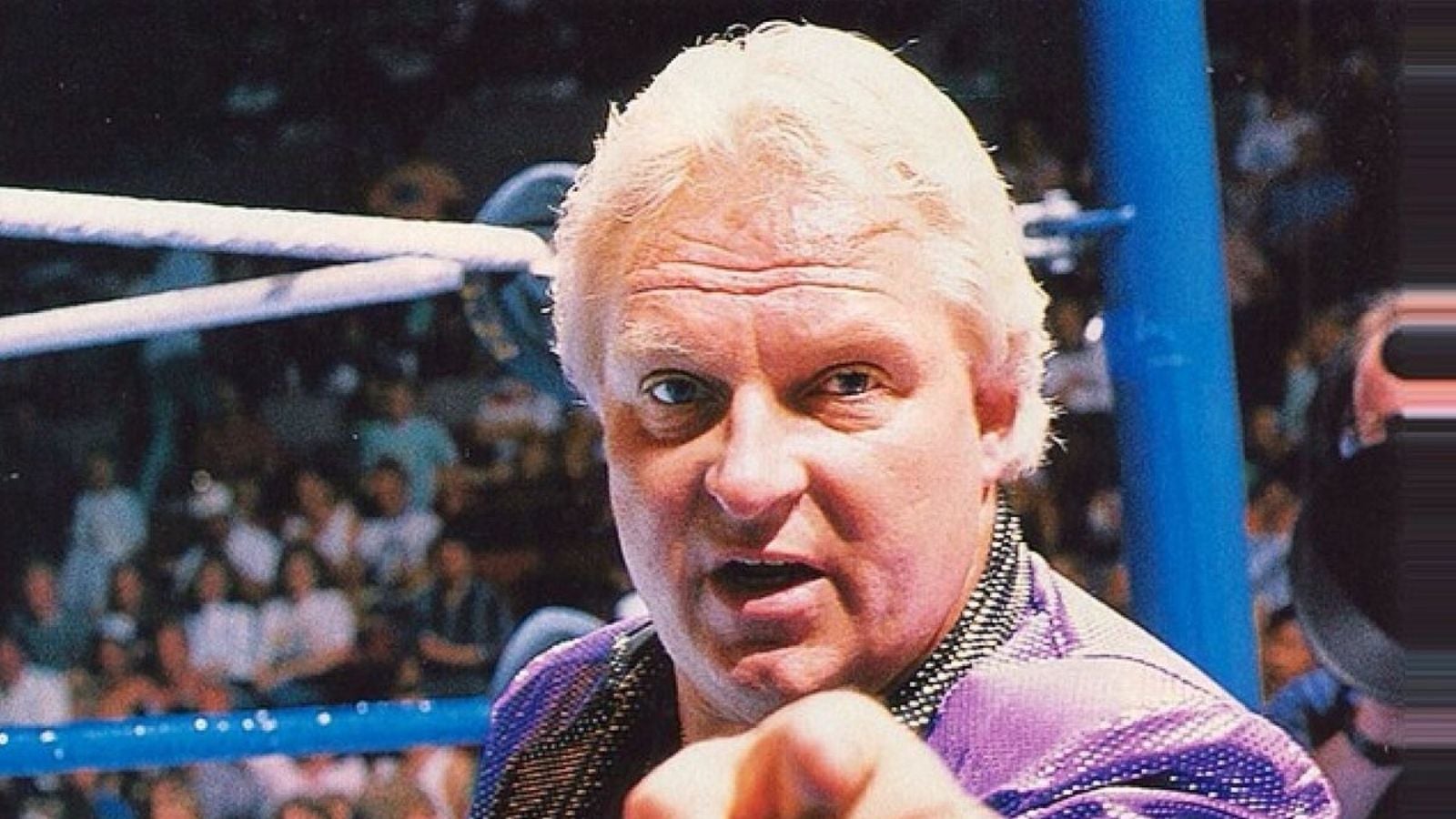
Ask longtime fans to name wrestling’s greatest manager, and Bobby Heenan wins more often than not. Ask them to name the best color commentator, and there’s his name again.
That’s the strange part. Almost nobody gets to be genuinely great at two completely different jobs in the same career.
Heenan pulled it off twice, decades apart, and stayed hilarious the entire way through. Fifty years in the business. First as a manager who could turn a packed arena against his own guy just by opening his mouth.
Then as a broadcaster who somehow made a match you already knew the outcome of feel like it could go either way.
“I started wrestling right away in addition to managing, because the promoters saw that I could take bumps.
I just knew how to work – like some people knew how to play the piano. Some people can write. I can’t do anything but wrestle. It came natural to me.”
– Bobby Heenan, page 15. Bobby the Brain: Wrestling’s Bad Boy Tells All”

Starting Out as “Pretty Boy” Bobby Heenan
Raymond Louis Heenan was born November 1, 1944, and he got into wrestling as a teenager — first as a valet, then eventually stepping into the ring himself as “Pretty Boy” Bobby Heenan.
His in-ring debut came in 1965, against a guy named Calvin “Prince” Pullins. He was never going to make it as a wrestler, though, and deep down he probably knew it.
His gift was in his mouth, not his moveset. By 1969 he’d found what he was actually built for, debuting as a manager in the American Wrestling Association under a nickname that would stick for life: The Brain.

The Original Heenan Family
His first real success came managing Nick Bockwinkel and Ray “The Crippler” Stevens to the AWA World Tag Team Championship.
That run also handed him the other nickname he’d carry forever — Dick the Bruiser, sick of Heenan’s ringside theatrics, started calling him “The Weasel.” Rival fans loved it. It never went away.
Out of that stretch came the original Heenan Family: Bockwinkel, Stevens, Blackjack Lanza, Bobby Duncum Sr. In 1975, Heenan led Bockwinkel to his first AWA World Heavyweight Championship, ending Verne Gagne’s seven-year reign.

Bockwinkel kept the title running into the early ’80s, defending it in 1983 against a rising challenger nobody had fully clocked yet: Hulk Hogan.
That same year, on tour in Japan, Heenan took a serious neck injury in a match against Atsushi Onita. It limited what he could physically do in the ring for the rest of his career.
It also pushed him further into pure management — which, in hindsight, is exactly where he needed to be. He also spent this stretch managing the strongman Ken Patera, who returned to the AWA in 1982.

The Move to the WWF
Vince McMahon poached Heenan away from the AWA in 1984, originally planning to pair him with Jesse “The Body” Ventura.
Blood clots in Ventura’s lungs ended that idea before it started, forcing an early retirement, so Heenan pivoted to managing Big John Studd against André the Giant instead — and from there, rebuilt the Heenan Family from the ground up on national television.
What followed reads like a Hall of Fame roster on its own: King Kong Bundy, Harley Race, “Ravishing” Rick Rude, “Mr. Perfect” Curt Hennig, the Brain Busters (Arn Anderson and Tully Blanchard), Haku, the Barbarian, Hercules, Paul “Mr. Wonderful” Orndorff.
Heenan apparently hated the word “stable” — thought it undersold the whole operation. He once compared it to a place where you keep a bunch of fly-infested horses, insisting his group was better than that.
Andre, Hogan, and the Biggest Stage in Wrestling
His signature WWF moment landed at WrestleMania III in 1987, leading André the Giant into the main event against Hogan’s WWF Championship, in front of what was then the biggest crowd in company history.
André lost that night. But it was Heenan who’d talked him into turning heel on Hogan in the first place — one of the more consequential heel turns of the whole decade.
A year later, André finally beat Hogan for the belt, in a controversial finish that saw him align with “Million Dollar Man” Ted DiBiase — a storyline Heenan himself had set up by selling André’s contract to DiBiase.
While his longstanding on-screen feud with Hulk Hogan was long documented, he couldn’t deny what he was watching with the rise of Hulkamania.
I’ve been watching pro wrestling for 46 years, and I have never seen people react to anybody the way they did to Hulk Hogan.
I’ve never seen anything like the control he had over them – the way they dressed like him. The way people cut their hair like him.
People made themselves bald to look like him. The amount of merchandise this man sold was unreal.
I saw people crying at ringside when Hogan was in trouble. I’ve seen kids look at him like an idol, somebody they thought they’d never get to see.
I’ve never seen an athlete like that in my life. Sure, it’s acting, but still he’s an athlete. A lot of people say he’s not a good athlete, but he’s a very good one.
He puts a lot of asses in a lot of seats, and that’s how I judge how good of a guy he is.
– Bobby Heenan, page 64. Bobby the Brain: Wrestling’s Bad Boy Tells All
He’d also managed King Kong Bundy against Hogan the year before that, at WrestleMania 2, giving him the rare distinction of leading two straight years of WrestleMania challengers for the same title.

He put a public $50,000 bounty on Orndorff’s head during that same stretch, because why not, and guided Harley Race to a King of the Ring win that August.
But the single most memorable moment of his WWF managerial run didn’t involve any of his own guys at all. When Ric Flair jumped to the WWF from the NWA in 1991, it was Heenan who delivered the news — gleefully waving Flair’s NWA title belt around on WWF television, announcing he’d brought the company the real world champion.

Heenan called it from the booth instead of ringside, and his frantic, panicked commentary as Flair kept dodging elimination is still held up as one of the best call jobs in wrestling broadcast history.
Making the Switch to the Booth
That Royal Rumble call was a preview of where his whole career was headed. He’d already started transitioning into commentary alongside Gorilla Monsoon, and the two of them became one of the defining broadcast pairs of the era.
Monsoon: exasperated, straight-laced, forever trying to rein Heenan in.
Heenan: off on some tangent, taking cheap shots, inventing entire fabrications about matches happening right in front of him.
One retrospective on the duo zeroed in on Monsoon’s go-to line during Heenan’s ramblings — a simple, weary “Will you stop?” — so closely associated with the pair that fans still quote it decades later.
Jim Ross, who joined the WWF around this stretch after a high-profile WCW run, later credited both men for how they treated him on day one.
The only two people at the company, he said, who treated him well from the start, despite a cold reception from much of the rest of the roster over his WCW background.
“The Weasel” — or “Wease” as we called him — had as good natural timing as any performer with which I’ve ever worked.
He was naturally funny (never took a note, by the way) and enhanced every single talent, including the heroes, even though Bobby did not support the fan favorites as the bad guy announcer.
Bobby Heenan did what every announcer should strive to do and that is to make talent bigger stars than they are and to embellish every talent’s TV persona.
Jim Ross on Bobby Heenan, Gorilla Monsoon
Moving to WCW
Heenan left the WWF in 1993 for World Championship Wrestling, working mostly as a color commentator this time rather than stepping back into full-time management, largely alongside Tony Schiavone.
That run lasted until 2000 and marked the end of his full-time broadcasting career. It wasn’t always smooth — by his own account and that of those around him, he grew increasingly frustrated with how management ran World Championship Wrestling in its final years.
Even so, he had moments that stuck. When Gorilla Monsoon died in 1999, Heenan paid tribute to him on air, visibly fighting back tears for his old broadcast partner.
Health Battles and the WWE Hall of Fame
He popped back up on WWE programming occasionally after WCW folded, including a brief commentary spot at WrestleMania X-Seven in 2001.
In 2004, Blackjack Lanza inducted him into the WWE Hall of Fame. His speech turned emotional fast — he choked up talking about Monsoon again, telling the crowd,
“I wish Monsoon were here.”
He went on to induct several of his own former clients and colleagues over the years that followed: Paul Orndorff in 2005, Nick Bockwinkel in 2007, the Blackjacks in 2006.
In January 2002, he announced he was battling throat cancer — a fight that would shape the rest of his life. His first response to it became one of his most quoted lines outside of any wrestling storyline:
“If the late, great Gorilla Monsoon couldn’t shut me up, cancer isn’t going to either”.
The recovery cost him plenty — dramatic weight loss, permanent changes to his voice and appearance — and complications kept stacking up for years after: reconstructive jaw surgery and a medically induced coma in 2007, a broken hip and pelvis from a fall in 2011, more tongue cancer treatment in 2013.
Jim Ross told fans afterward that Heenan was “hanging in there,” even with speaking growing harder by the year.
His Death and What People Said
Bobby Heenan died on September 17, 2017, at home in Largo, Florida, from complications of his throat and tongue cancer.
He was 73. Jim Ross broke the news on Twitter, writing that it had gutted him, adding that nobody ever did the job better than “the Wease”.
Ric Flair — one of the last men Heenan famously called to a title win from the announce table — posted his own tribute soon after.
Bubba Ray Dudley said the last words he’d ever spoken to Heenan in person were,
“I love you, Bobby”
WWE’s own statement didn’t hedge. It called him the greatest manager in sports-entertainment history — a title, by most people’s estimation, that’s never seriously been up for debate.

The Legacy of The Brain
Heenan’s career is hard to sum up cleanly, because he actually succeeded at two entirely different disciplines. As a manager, he was the connective tissue behind some of wrestling’s biggest storylines across three decades — Bockwinkel’s AWA reigns, André’s heel turn and title win, Flair’s WWF jump, plus a couple dozen undercard heels he turned into legitimate box-office threats just by talking about them on television.
As a broadcaster, his chemistry with Gorilla Monsoon still gets mentioned in the same breath as Jim Ross and Jerry Lawler when people argue about the best announce team the business ever had.
Very few performers leave behind one first-ballot-worthy career. Bobby Heenan left behind two, inside a single lifetime — and the industry still hasn’t stopped quoting him.
There is always the ongoing argument as to who the greatest performer in the history of the business is and there will never be a definitive answer because the question is too subjective.
However, for my money, as an in-ring talent, a manager, an interviewer, and a broadcaster NO ONE has done it all BETTER than Bobby “The Brain” Heenan. I can make a valid argument that Bobby Heenan is pro wrestling’s great performer.
Jim Ross on Bobby Heenan, Gorilla Monsoon
Sources