Some of wrestling’s stranger matches start with a genuine disagreement rather than a scripted angle, including the match between Will Ospreay and Vader.
That’s exactly what happened in the summer of 2016, when a decades-long WCW and WWF legend picked a public fight with a 23-year-old British high-flyer over what a wrestling match is even supposed to look like.
The argument was settled the old-fashioned way, in a London boxing hall, before a crowd that had no idea what they were about to watch on August 12, 2016.
Where Both Men Stood in 2016
Will Ospreay was exactly the kind of wrestler Big Van Vader’s complaint targeted. He had spent years building a reputation on the British independent scene, Progress Wrestling, and Revolution Pro Wrestling as one of the most gifted high-flyers in the country.
He was known for a fast-paced, acrobatic style built around dives, flips, and moves most heavyweights of Vader’s generation would never have attempted.
That reputation was starting to grow: after impressing Kazuchicka Okada in a 2015 match at RevPro’s Global Wars UK show, Ospreay was recommended to New Japan Pro-Wrestling by Okada himself, with endorsements from AJ Styles and Hiroshi Tanahashi soon after
He officially signed with NJPW that April, challenged for the junior heavyweight title against KUSHIDA, and joined Okada’s CHAOS stable — a 23-year-old on the verge of a much bigger stage.
Vader, by contrast, was 61 years old with his best years of in-ring competition behind him. He had been one of the most dominant big men of the late ’80s and ’90s, a three-time WCW World Heavyweight Champion and a three-time IWGP Heavyweight Champion during a legendary run in Japan.
He also had a memorable, if injury-shortened, run in the WWF feuding with Shawn Michaels and Undertaker. By 2016, he made occasional appearances rather than a regular schedule, and his health had started to decline. He wrestled only sporadically before retiring the following year and dying in 2018.
The two men had crossed paths earlier as well. Ospreay had competed against Vader in a prior UK independent bout before the Ricochet match or the Twitter fight.
It was one of a handful of appearances Vader made touring British promotions in his later years alongside spots against AJ Styles and Okada.
That prior history partly explains why RevPro’s booking made sense on paper — the two already had a working relationship, even if the actual chemistry between them was more complicated than the storyline suggested.
Will Ospreay and Vader –
When a Twitter Argument Became a Wrestling Match
The Twitter/X Fight
The spark came from a match that had nothing to do with Vader directly. On May 27, 2016, Ospreay faced Ricochet during NJPW’s Best of the Super Juniors tournament, and the two put on a dazzling, high-speed sequence of dives and counters.
A match that immediately became one of the most talked-about matches of the year, drawing praise from figures like William Regal.
“I generally had no idea it was going to happen because we’d done, I’m not going to say a similar style match, but we’d done some of the stuff we did over in Evolve.
And it was just one of those matches where, like, once again, me and Ricochet have been working each other, like, five times now.
We know each other’s style…we know each other’s s–t, so yeah, we just went out there, and as soon as we had done the double handspring backflip, man, we just [knew] the crowd came on fire. It was like, ‘alright, we’ve got something here’.
But for some strange reason, the internet [has] just gone nuts over this one particular match.”
Vader wasn’t impressed. He took to Twitter and, according to multiple contemporary reports, compared the match to blatant acrobatics with no story, arguing that modern wrestling was drifting too far from genuine physical struggle and storytelling turning into pure choreography.
The reaction was prompt and loud. Ospreay pushed back, and for weeks afterward the argument played out publicly on Twitter, with wrestling journalists, veterans, and fans picking sides.
In what became a genuine referendum on the direction of the sport’s in-ring style: old-school stiff, structured psychology versus the newer, faster, more gymnastic approach that wrestlers like Ospreay and Ricochet represented.
It wasn’t staged promotion. It was a real generational argument playing out between two wrestlers who hadn’t previously had any reason to interact.
Booking the Match
Revolution Pro Wrestling, the UK promotion with close ties to NJPW, saw an opportunity and booked the two men to face off directly.
The match was set for RevPro’s Uprising event on August 12, 2016, at York Hall in Bethnal Green, London. This historic boxing venue had already hosted marquee RevPro main events.
It was billed as the blow-off to the Twitter war, promoted around settling a creative argument inside the ring rather than in replies and quote-tweets.
[Photo: Cageside Seats]
The Match Itself
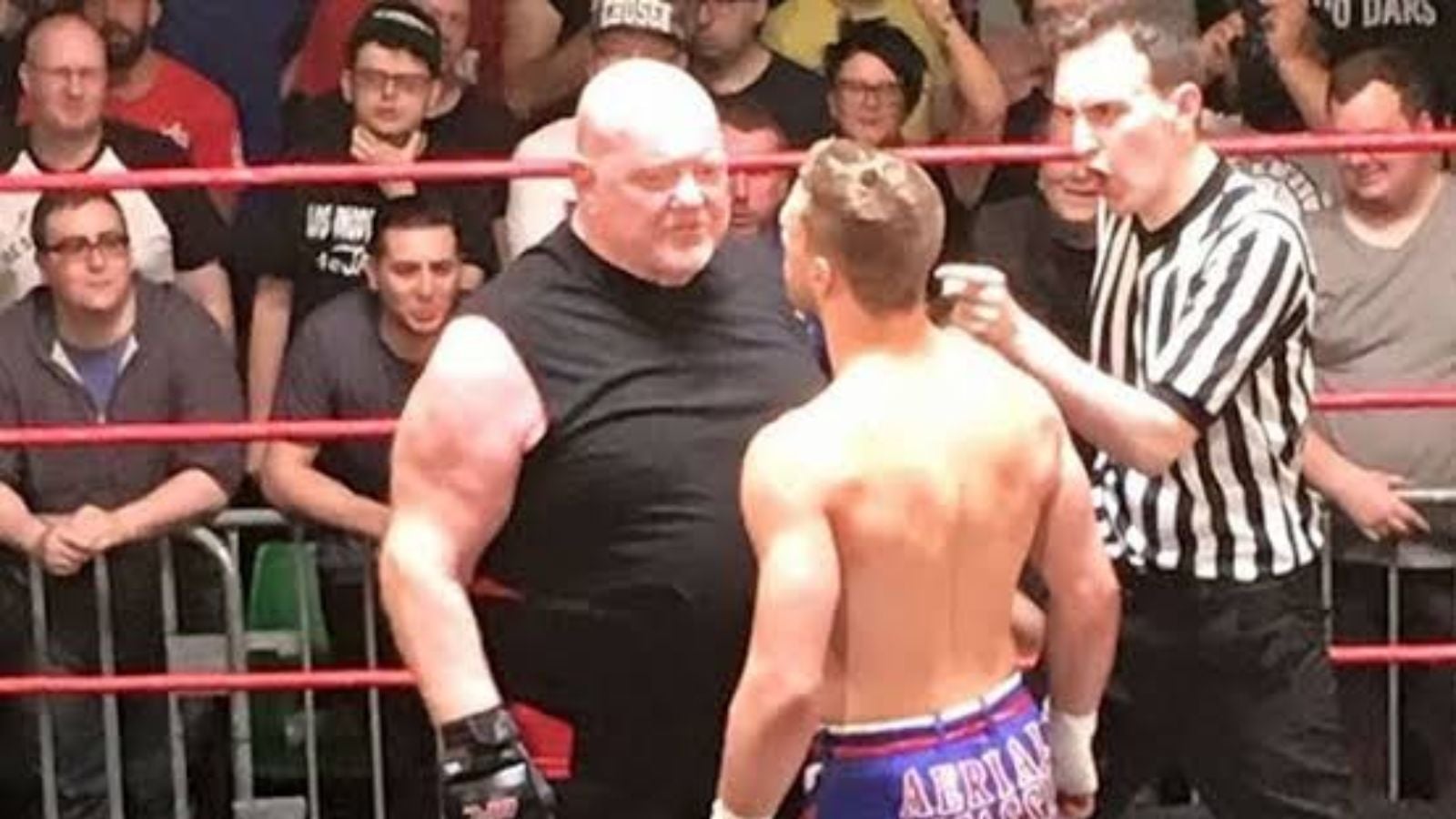
What plaWhat played out at York Hall was not a conventional wrestling match but a spectacle built around Vader’s aura and Ospreay’s willingness to bump for a much older, physically limited legend.
Vader attacked Ospreay before the bell rang, taking out referee Chris Roberts in the process. The two brawled up the entrance ramp as security got involved, presented deliberately as if Vader might be shooting on the officials for real.
The crowd, by every account, bought into it completely. The heat in the building was scorching hot by the time Vader chokeslammed Ospreay through the ringside announce table.
Ospreay sold the impact for a long stretch before finding a burst of momentum, diving off the ramp onto Vader and the security team restraining him.
[Photo: Revolution Pro Wrestling]
It looked like Ospreay might complete the underdog comeback and pick up the win, but Pete Dunne, Ospreay’s rival at the time over the RevPro British Cruiserweight Championship, ran in and interfered, costing Ospreay the match and allowing Vader to score the pinfall
Reviewers who broke the match down afterward were split on how well it actually worked as wrestling. Opinions ranged from ‘not bad to ‘awful’. The match’s success was tied to Vader’s limited mobility.
The Fallout
The most memorable long-term account of the match came years later, when Ospreay looked back on the experience.
Ospreay was candid that working with Vader had not been pleasant behind the scenes. He recalled the build to the match as tense enough that he was unsure what to expect walking in: he said it was a horrible experience for him because Vader wasn’t the nicest person.
However, he was careful to add he didn’t want to speak ill of him once he’d passed, since Vader was someone’s father.
“So it was great, but then it just became too much to basically be like, I thought he actually wanted to fight me, so I was like, ‘What is going on?’
And then we got into a group conversation and basically sorted out the match. For me, it was a horrible experience because he is not the nicest chap in the world, but I don’t want to speak ill because he’s passed on now, and he’s someone’s dad. All the best to the family, but he wasn’t very nice to me.”
This is a rare, blunt account from Ospreay about a match that, on its surface, had been sold as a fun and mutually respectful spectacle.
Two days after the York Hall match, Vader made a separate appearance for the XWA promotion in Colchester, England, beating “Savvy” Sid Scala.
This small coda showed that, whatever the Twitter argument had been about, it also served as a way to get one more paying booking for a wrestling legend past his prime touring internationally.
[Photo: Handwerk Reviews]
After the loss, Ospreay agreed to give Pete Dunne a rematch for the RevPro British Cruiserweight Championship, tying the angle into his other ongoing program rather than treating it as a standalone one-off.
Ospreay’s career, of course, kept climbing from there. He went on to win the 2016 Best of the Super Juniors tournament that same year, eventually became a three-time IWGP Junior Heavyweight Champion, and years later moved up to New Japan’s heavyweight ranks before signing with AEW in 2023 and becoming a genuine main event star in the U.S.
Vader, for his part, wrestled only sporadically after 2016 and passed away on June 18, 2018, at age 63, from complications of pneumonia.
Tributes came in from across the wrestling world afterward, Ospreay among those who paid their respects despite the behind-the-scenes reality of their match.
[Photo: Reddit]
Why It’s Remembered
The Will Ospreay and Vader match isn’t remembered today as a great piece of in-ring wrestling. It’s remembered as one of the odder collisions of wrestling generations the sport produced in the 2010s.
A legitimate stylistic argument that got resolved, however messily, in front of a live crowd, between a wrestler who represented one era’s idea of psychology and struggle and a rising star who represented where the industry’s in-ring style was actually heading.
Within a few years, the very style Vader had written off as “gymnastics” had become a popular approach across New Japan, AEW, and much of the wrestling world, making the entire Twitter argument, in hindsight, look less like a genuine referendum and more like one of the last loud objections before that shift became permanent.
As a wrestling enthusiast for over 30 years, my fondness for professional wrestling explores the irrational in a rational way. I will explore the details inside and outside the ring and hopefully have a laugh with you in the process. I've had the fortune to interview wrestlers from Lucha Underground, TNA, Ring of Honor, GFW, and former WWE talent as well. Feel free to follow me on Twitter @TheMarcMadison