
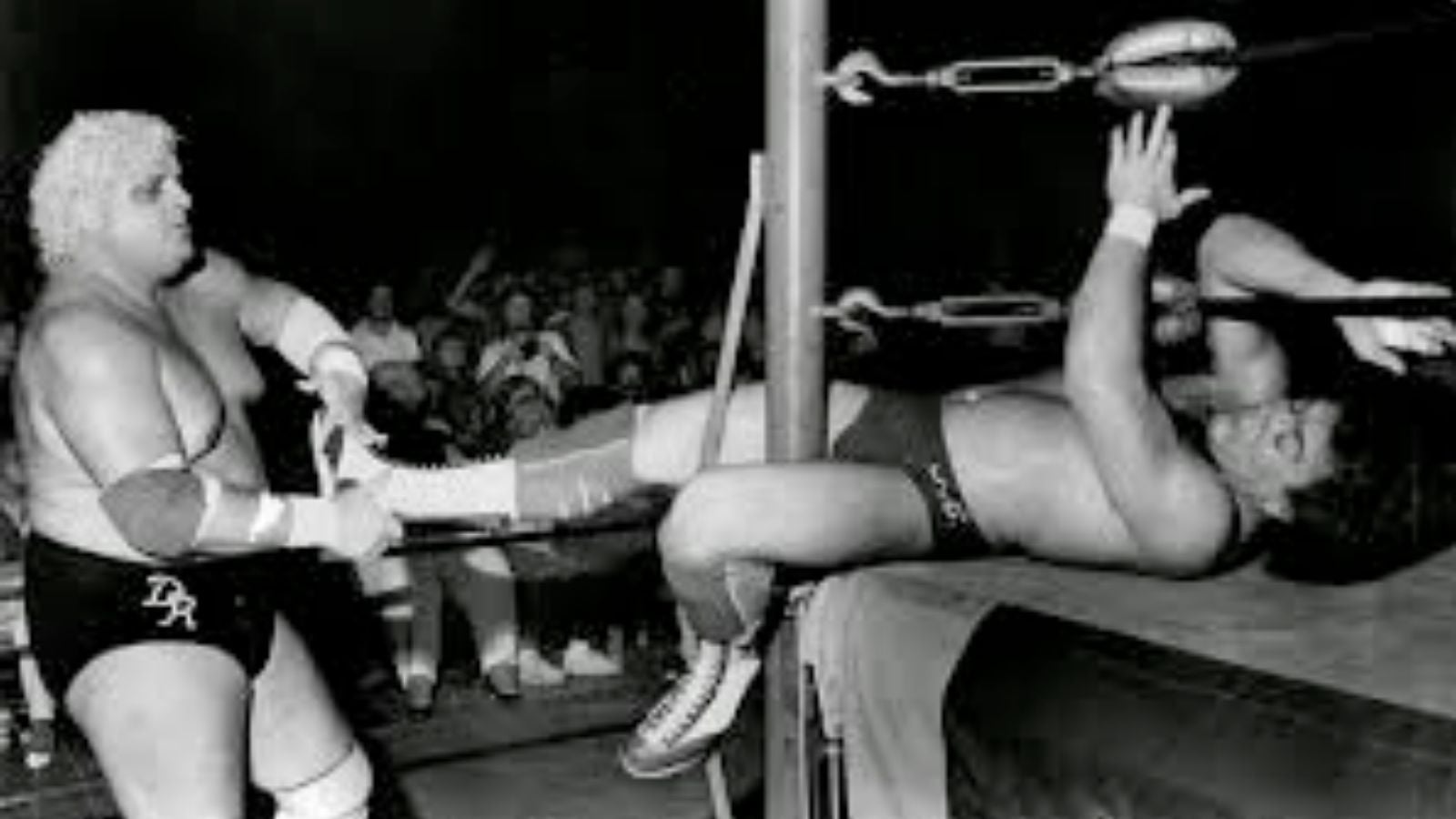
Few rivalries in professional wrestling history embodied the collision of ideology, class warfare, and pure brutality quite like the feud between Tully Blanchard and Dusty Rhodes.
It wasn’t simply a battle between two men; it was a war between the working-class hero and the arrogant elitist, fought in steel cages, soaked in blood, and amplified through some of the most compelling storytelling of the 1980s National Wrestling Alliance (NWA).
This was not a rivalry built on a single match or moment. It was layered—personal, political, and psychological—woven into the broader dominance of The Four Horsemen and Dusty’s crusade as the embodiment of the American Dream.

The Animosity between Tully Blanchard and Dusty Rhodes
By 1984, both men were central figures in Jim Crockett Promotions. Dusty Rhodes had already become the promotion’s emotional centerpiece a charismatic everyman whose connection to audiences was unmatched.
Tully Blanchard, meanwhile, was ascending as one of wrestling’s most naturally gifted antagonists—technically sharp, arrogant, and ruthlessly intelligent.
Blanchard captured the NWA Television Championship in 1984 and embarked on a dominant reign that lasted 353 days, one of the longest in the title’s history
His persona—a wealthy, smug competitor who flaunted success—stood in direct contrast to Dusty’s blue-collar identity.
The feud ignited in early 1985 when Dusty challenged for Blanchard’s Television Championship. What followed was a series of title changes and escalating violence, establishing the rivalry as one of the promotion’s central narratives.
On March 16, 1985, Dusty defeated Blanchard for the title. The following month, Blanchard regains the title from Dusty, and then, early in the Summer of 1985 (a few months later), Dusty wins it back again in a steel cage match at The Great American Bash.
But the matches were only the surface.

Baby Doll, Ego, and Humiliation: Storytelling at Its Peak
– Tully Blanchard and Dusty Rhodes
Central to the feud was Baby Doll, Blanchard’s valet. In a now-legendary stipulation, she would be forced to serve Dusty Rhodes if Blanchard lost.
When Dusty won, the angle shifted from physical conflict to psychological warfare.
Dusty paraded Baby Doll during his presentation, airing vignettes in which he attempted to transform her into a “real lady.”
For Blanchard, this wasn’t just defeat—it was emasculation.
And when he later attacked and fired Baby Doll in a fit of rage, Dusty stepped in once again, reigniting their feud with even greater emotional stakes.
While it may seem simplistic by modern standards, in the mid-1980s, during the territorial era, this was nuclear heat.
The phrase itself tapped into a raw, almost childish insult—but that was precisely its brilliance. It felt unscripted, personal, and dismissive. Blanchard weaponized it to mock Dusty’s appearance, persona, and connection with the fans.
“At the start of 1985 we got Baby Doll and went forward with it and that was all Dusty. He wanted me to have a female manager and they were looking for Sunshine (who worked for Dallas) for quite awhile and they actually couldn’t find her.
We were working during Christmas week for Eddie Graham and did some shots to help the territory down there and Nickla Roberts was wrestling on one of the cards and I told Dusty that she has got to be Baby Doll.
In fact, he and I saw her and we went and had a meeting and nearly said it simultaneously.
It was a huge boost to the territory, a huge boost to Nickla and certainly a huge boost to the Dusty Rhodes/ Tully Blanchard feud that was just getting started.”
The Tully Blanchard and Dusty Rhodes feud was not confined to standard matches. It escalated into increasingly violent stipulations, hallmarks of NWA storytelling during the era.
Dusty’s victory in the cage match wasn’t just about winning the title—it was about survival. Cage matches in this era were designed to contain chaos, not prevent it. Interference still happened. Blood was expected.
At Starrcade ’86, on November 27th, 1986 took place. The event was subtitled Skywalkers for the scaffold match that would be a featured match later in the event. It was the First Blood match that fans still talk about today.
During that contest. Tully Blanchard defeated Dusty Rhodes in a brutal First Blood match, reclaiming the Television Championship. Despite the match lasting less than ten minutes in length
This stipulation flipped the psychology: No pinfalls, no submissions. A victory came only by making your opponent bleed. It perfectly suited Blanchard’s calculated cruelty and reinforced the feud’s brutality.
The Four Horsemen Factor
The rivalry cannot be understood without the looming presence of The Four Horsemen, Blanchard’s faction, alongside Ric Flair. Arn Anderson and Ole Anderson, while managed by J. J. Dillon
Formed in 1985, the Horsemen dominated the NWA, holding multiple championships and systematically dismantling babyfaces
Dusty Rhodes became their primary target. The group’s attacks often included: gang assaults, injury angles (including breaking Dusty’s ankle), and interference-heavy finishes.
Tully Blanchard, as the Television Champion, functioned as the workhorse antagonist, frequently engaging Dusty in televised bouts while Flair occupied the world title scene.
Dusty’s allies and the expanding war against Blanchard and the Four Horsemen.
The feud extended beyond a one-on-one rivalry into a broader war involving multiple top stars: Dusty’s closest ally, Magnum T. A., became deeply entangled in Blanchard’s orbit.
After Magnum’s career-ending car accident, Dusty shocked audiences by teaming with Nikita Koloff, forming the Super Powers—a Cold War-defying alliance that continued the fight against the Horsemen.
Also, tag teams like the Rock ‘n’ Roll Express and/or Road Warriors were drawn into multi-man matches against the Horsemen, further expanding the feud’s scope.
Blanchard, in contrast, delivered cold, cutting promos rooted in superiority and disdain.
Where Dusty spoke with the audience, Blanchard spoke at them.
Despite the on-screen hatred, both men understood the value of what they were creating.
Blanchard later reflected on the rivalry as one of the most important of his career, emphasizing the effort to make every match and angle meaningful
“When Dusty first took the book and was the booker, he came in and went on television and was beating people in six seconds.
I told him (I was the TV Champion at the time) that he and I need to go out on some of these shows and go twenty minuets and show the people that he can go for twenty minuets because they (the fans) don’t think that he can.
That turned out to be money in the bank because that changed everybody’s image of him of being able to go and put the time in the ring.”
Dusty, as both performer and booker, crafted the feud with long-term storytelling in mind—layering angles, integrating allies, and ensuring each match escalated stakes.

Legacy: Why It Still Matters
The Tully Blanchard and Dusty Rhodes rivalry stands as a blueprint for professional wrestling storytelling. It involved character-driven conflict over simple wins/losses, faction integration between the four Horsemen and Rhodes’ allies, stipulation escalation to maintain interest, and promo-based emotional investment.
The rivalry between Dusty Rhodes and Tully Blanchard wasn’t just about championships—it was about identity. Dusty represented hope, resilience, and the common man. Blanchard embodied arrogance, privilege, and calculated cruelty.
Together, they created something timeless. In an era before social media, before global television deals, and before scripted promos became overly polished, they made audiences believe.
That emotional connection was raw, unfiltered, and unforgettable. This is why this rivalry remains one of the greatest in wrestling history.