
On July 23, 1984, the World Wrestling Federation (WWF) put on a one-hour, nationally televised event that would help usher professional wrestling further into the mainstream. The event took place at the mecca, Madison Square Garden in New York City.
Known as The Brawl to End It All, the special aired live on MTV on the USA Network, capitalizing on the booming popularity of both rock music television and the WWF’s growing reach under Vince McMahon’s national expansion plan.
The Brawl to End It All: WWF’s Pop Culture Power Play of 1985
This wasn’t just another wrestling show — it was a carefully crafted pop culture spectacle designed to draw in young viewers, introduce new audiences to the WWF’s colorful characters, and strengthen the partnership with MTV.
The Road to the Brawl
In the early 1980s, the WWF was undergoing a massive transformation. Vince McMahon had bought the company from his father and embarked on an aggressive national expansion, signing top stars from rival territories and securing national TV exposure.
A key element of this strategy was the so-called Rock ‘n’ Wrestling Connection — a synergistic mix of pop music and professional wrestling that made the WWF feel young, relevant, and mainstream.
Enter Cyndi Lauper, one of the biggest pop stars in the world at the time, thanks to her breakout album She’s So Unusual (1983).
Lauper and her manager, David Wolff, began working with Captain Lou Albano in a series of comedic skits and music videos. Lauper famously cast Albano in her Girls Just Want to Have Fun video, portraying her father.
What started as a light-hearted celebrity crossover evolved into a full-blown storyline on WWF programming. Albano claimed credit for Lauper’s success, insulting her and women in general, which led Lauper to challenge Albano’s sexism and vow to back a female wrestler to beat Albano’s protégé.
The feud crystallized around WWF Women’s Champion The Fabulous Moolah, a long-reigning, controversial figure who managed rising star Leilani Kai. Lauper aligned herself with Wendi Richter, a young and energetic challenger eager to dethrone Moolah’s camp.
The WWF and MTV struck a deal to air the climax of this rivalry live in prime time, branding it The Brawl to End It All.
The Event
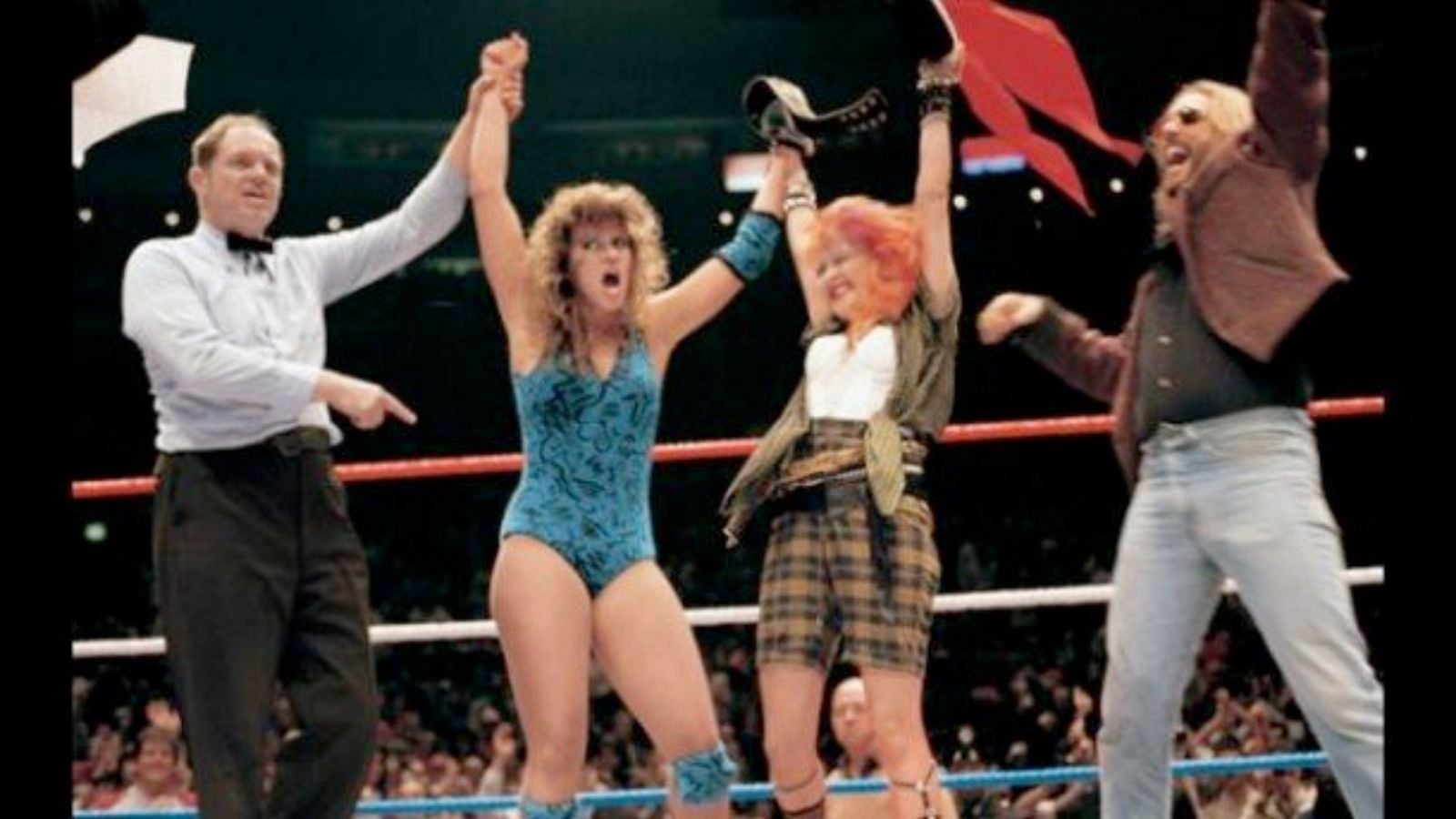
On July 23, 1984, Madison Square Garden hosted a full card of matches, but only one bout aired on MTV: Wendi Richter (with Cyndi Lauper) challenging The Fabulous Moolah (with Leilani Kai) for the WWF Women’s Championship.
The Garden was packed, and MTV’s cameras were rolling. The hype had paid off — an estimated 10.8 rating on MTV made it the most-watched program in the network’s history up to that point.
The match itself was spirited, if sloppy at times, given the stakes and the limitations of Moolah’s in-ring style by that point in her career.
Albano and Lauper frequently interfered, with Lauper even climbing on the apron to prevent Albano from meddling.
Ultimately, Richter rolled up Moolah for the pin and captured the WWF Women’s Title, igniting a wild celebration in the Garden as Lauper and Richter embraced.
Wendi Richter, in a later interview with Slam! Wrestling, reflected on what it meant to be in that moment:
“That was one of the biggest nights of my career. We had MTV, Madison Square Garden, the world watching. It felt like something bigger than wrestling.”
— Wendi Richter, Slam! Wrestling interview, 2005
Other Matches on the card that didn’t air
Though MTV only aired the women’s title match, the Garden hosted a full card, featuring several notable bouts: Hulk Hogan successfully defended the WWF World Heavyweight Championship against Greg Valentine.
A second match featured Tito Santana taking on Cowboy Bob Orton Jr for the WWF Intercontientnal Championship, Sika facing Ron Shaw, The Iron Sheik taking on Tony Garea, Bob Backlund facing Butcher Vachon, “Mr. Wondeful” Paul Orndorff squaring off against Chief Jay Strongbow, Afa facing Rene Goulet and The North-South Connection (Adrian Adonis and Dick Murdoch) taking on the Cobra Corps (Terry Daniels and Sgt Slaughter)
These matches played out in front of the live crowd but were not televised. Still, the event demonstrated WWF’s ability to package a single story and present it as must-see television.
Why It Mattered
The Brawl to End It All wasn’t just a storyline payoff — it was a watershed moment for the Rock ‘n’ Wrestling Connection.
The WWF proved it could draw mainstream media coverage, deliver record-breaking cable ratings, and attract young viewers who might not otherwise care about pro wrestling.
Rolling Stone later called the Rock ‘n’ Wrestling era “the WWF’s slickest marketing gimmick,” and The Brawl to End It All was arguably its pinnacle moment. Source: Rolling Stone, 2015 retrospective.
For Cyndi Lauper, it cemented her as more than just a pop star — she became part of a cultural movement. In an interview with Billboard in 2014, she said:
“At the time, everyone thought I was crazy for working with wrestling. But it was about standing up to bullies, showing girls they could be just as tough. I don’t regret it for a second.”
— Cyndi Lauper, Billboard interview, 2014
Full interview here
The WWF capitalized on this momentum, following up with The War to Settle the Score on MTV in February 1985 and eventually culminating in WrestleMania in March 1985, which became the company’s signature event.
The Fallout
Wendi Richter’s title reign didn’t last long; she famously lost the championship to The Fabulous Moolah in the infamous “Original Screwjob” at Madison Square Garden in 1985.
But for one night, Richter was the face of women’s wrestling, and her victory over Moolah was a symbolic passing of the torch, at least temporarily, from the old guard to the next generation.
The WWF’s partnership with MTV would continue, but tensions would eventually lead the two entities to part ways as the WWF created its own pay-per-view and syndication platform.
Even so, The Brawl to End It All remains a fascinating snapshot of a time when wrestling, music, and pop culture collided to create something bigger than the sum of its parts.
Legacy of The Brawl To End It All
The Brawl to End It All is remembered as a trailblazing event that helped bring professional wrestling to a broader audience.
It marked one of the first times that women’s wrestling headlined a nationally televised special and showed the power of integrating wrestling with mainstream celebrities.
This event was a crucial moment during what would become the Rock n Wrestling era in the WWF. It was then, during the 1980s, that wrestling experienced regular cross-promotion with the mainstream music and entertainment industries.
Wendi Richter summed it up well in her Slam! Wrestling interview:
“For one night, we showed the world that wrestling — and women’s wrestling — could be just as big as anything else on TV. That’s what I’m most proud of.”
To once again reiterate, this event was a pivotal moment during the Rock n Wrestling Connection era, which was a period in wrestling during the 1980s where there was regular cross-promotion between pro-wrestling and the mainstream music and entertainment industries
Sources:
- Wendi Richter interview, Slam! Wrestling, 2005
- Cyndi Lauper interview, Billboard, 2014
- Rolling Stone retrospective on Rock ‘n’ Wrestling
- MTV event ratings reference (Wikipedia)