




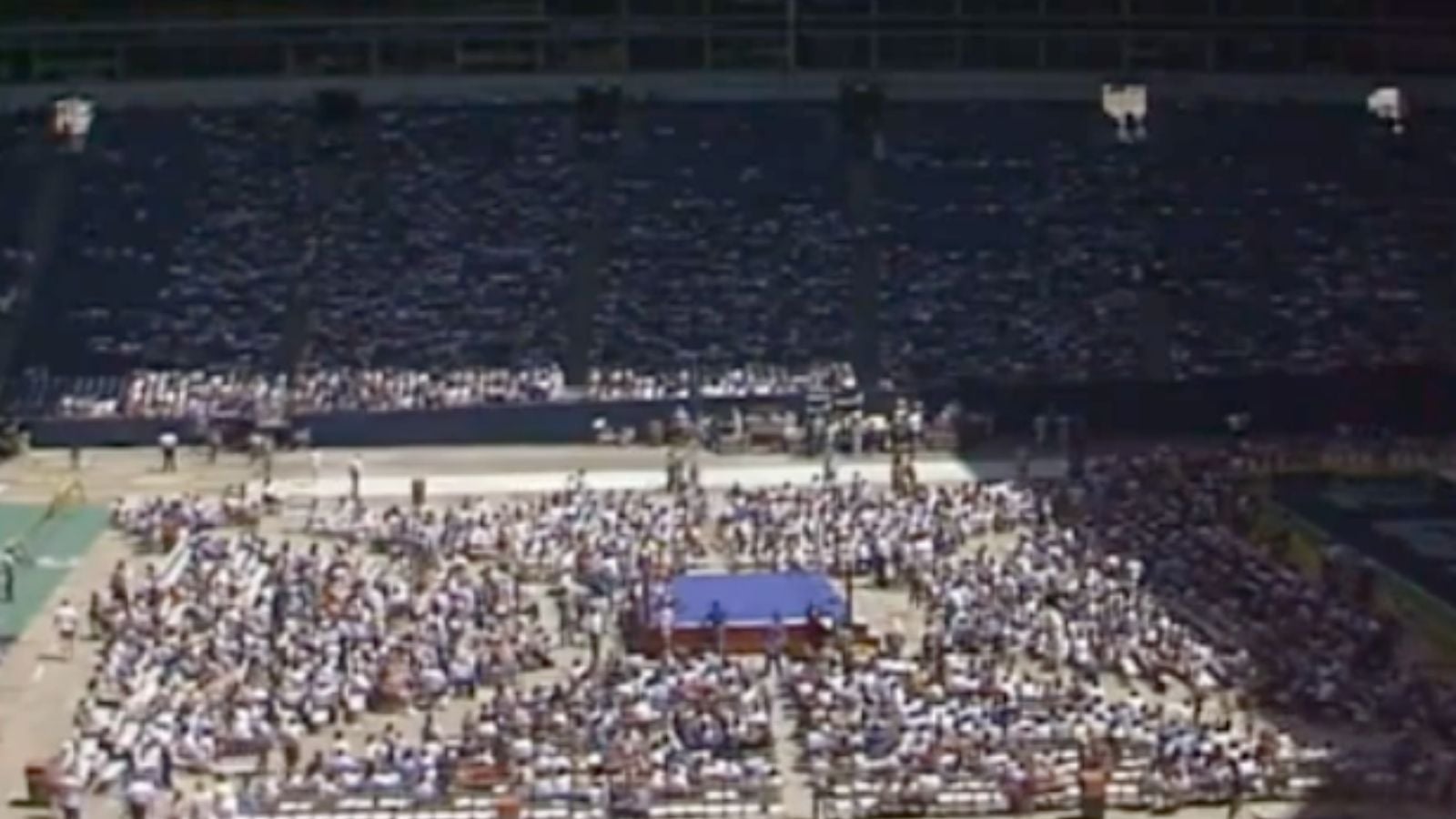
On May 4, 1986, more than 24,000 fans filled Texas Stadium in Irving, Texas, not just for a wrestling show, but for a tradition rooted in loss.
The event was promoted by Fritz Von Erich. Parade of Champions III carried the weight of his son David Von Erich’s death two years earlier, a loss that still shaped every major event in World Class.
By night’s end, the familiar battle lines were drawn once again: Kerry Von Erich, Lance Von Erich, and Steve Simpson stood opposite the Fabulous Freebirds, Buddy Roberts, Michael Hayes, and Terry Gordy.
In a chaotic six-man lumberjack strap elimination match, the Von Erich side regained the six-man tag titles, giving the crowd the ending it came for; one more moment where the family’s fight, and David’s memory, felt like it still mattered.
Parade of Champions III – In Memoriam of David Von Erich
Legacy, Decline, and the Last Echo of Texas Stadium Glory
The 3rd Von Erich Memorial Parade of Champions was a supercard that served as both a tribute and a transition.
With an announced attendance of 24,121 fans, the event stood as a significant draw in a rapidly shrinking territorial landscape, yet also quietly reflected the fading dominance of World Class wrestling.
Two years removed from the sudden death of David Von Erich, the promotion continued to build its annual May supercard around his memory, but by 1986, the tone had shifted.
What began as a raw, emotional tribute in 1984 had become something more complex: part memorial, part spectacle, and part survival strategy.
David Von Erich: The Absence That Defined Everything
David Von Erich’s death in Tokyo in February 1984 remains one of the most consequential turning points in wrestling history.
At just 25 years old, he was widely expected to become NWA World Heavyweight Champion, with insiders suggesting plans were already in motion for him to defeat Ric Flair.
This sentiment is echoed across multiple interviews with industry professionals at the time.
Gary Hart (Book: My Life in Wrestling)
“David had the respect of the dressing room in a way that few second-generation wrestlers ever achieve.”
The loss wasn’t just emotional; it was structural. David was the centerpiece of WCCW’s future, and his death forced a complete recalibration of both creative direction and business strategy.
The Birth of the Parade of Champions
In response, Fritz Von Erich created the Parade of Champions as an annual memorial event held each May.
The first show in 1984 drew over 30,000 fans and culminated in Kerry Von Erich defeating Ric Flair for the NWA World Heavyweight Championship—a moment widely interpreted as both tribute and compensation for David’s lost opportunity.
Ric Flair (WWE retrospective interview)
“That night wasn’t about me losing the title. It was about honoring David. Everybody understood that.”
By 1985, the second Parade of Champions remained strong, but subtle cracks had begun to show. By 1986, those cracks were undeniable.
WCCW Becomes WCWA: Independence and Isolation
Parade of Champions III marked a critical turning point: the promotion was no longer WCCW within the National Wrestling Alliance—it had become the World Class Wrestling Association (WCWA).
This shift had major consequences. These consequences included loss of NWA talent-sharing agreements, reduced access to top-tier challengers, and diminished national prestige.
While Fritz Von Erich sought independence, the move isolated the promotion at a time when competition—especially from Vince McMahon’s expanding WWF was intensifying.
But attendance tells the real story. The steady decline reflects not just market saturation, but a promotion losing its foothold in a changing industry.
The Card: Controlled Chaos and Evolving Taste
The 1986 event featured a 10-match card blending traditional wrestling with increasingly gimmick-heavy attractions. But a number of other memorable names and faces filled the card with matches that were notable on this night.
The Bruiser Brody & Terry Gordy barbed Wire Match epitomized the era’s shift toward spectacle and violence. Barbed wire matches were still relatively rare in the U.S., making this attraction a major selling point.

It was a finish that was reflective of protecting both performers, extending feuds, and avoiding decisive outcomes in major matches
The Von Erichs & Steve Simpson vs. The Fabulous Freebirds
It was a Six-Man Tag Team Championship Lumberjack-Strap Match. The emotional core of the show remained the Von Erichs vs. Freebirds rivalry, one of the most successful feuds in wrestling history.
Michael Hayes said during an edition of Kayfabe Commentaries.
“We weren’t just heels. We were the guys who broke the Von Erichs’ world. The fans never forgot that.”
The lumberjack strap stipulation added chaos and ensured crowd engagement, with wrestlers surrounding the ring armed with leather straps.
Perhaps the most controversial element of the card, the mudpit match, reflected a shift toward spectacle-driven attractions. This would be between Missy Hyatt and Sunshine.
While it drew interest, it also signaled a move away from the sports-based presentation that had defined WCCW’s peak.

The Crowd: Still Loyal, But Changing
Despite declining numbers, over 24,000 fans still attended—an impressive figure for a regional promotion in 1986.
This subtle shift in audience energy is critical. The emotional investment that once defined World Class was beginning to erode.
By 1986, the memorial aspect of the Parade of Champions had evolved into a more structured event. What was once raw emotion had become a ritual with an annual remembrance, symbolic matches, and repeated narratives
This duality of mourning and celebration remained central to the event’s identity. Parade of Champions III, despite its scale, could not escape these broader industry shifts.
David’s legacy loomed over every aspect of the event. Why did his memory remain so powerful? He was positioned as the future NWA Champion.
Fans believed in him—not just as a performer, but as a person. David Von Erich’s sudden death created a lasting emotional imprint.
Gary Hart once said;
“David became bigger in death than he ever could have been in life—and that’s saying something.”
Within just one year, the 1987 Parade of Champions would draw under 6,000 fans, a dramatic collapse. Despite being overshadowed by the 1984 event, the 1986 show holds lasting significance.
It was the final Parade of Champions to draw over 20,000 fans. It captures wrestling at a crossroads: territorial storytelling and pressures from national expansion. The blending of tribute and spectacle would influence future wrestling events worldwide.
Parade of Champions III was not the peak of World Class wrestling—but it may be its most revealing moment.
It showed a promotion trying to preserve its identity, a family continuing to honor a fallen son, and an industry shifting faster than anyone could fully adapt
In Texas Stadium that night, the memory of David Von Erich still filled the building for Parade of Champions III.
But the future of World Class wrestling was already beginning to slip away.
Sources & Further Reading
- Wrestling Observer Newsletter archives (1984–1987) – Dave Meltzer
- Gary Hart, My Life in Wrestling
- WWE.com – Ric Flair
- ProWrestlingHistory.com
- Texas Stadium event archives