

June 26, 1976, stands out as one of the most chaotic nights in combat sports history. At the Nippon Budokan in Tokyo, Muhammad Ali, the heavyweight boxing king, faced Antonio Inoki, Japan’s top pro wrestler, in a match billed as “The War of the Worlds.”
What was supposed to settle the debate between boxing and wrestling ended in a 15-round draw, leaving everyone confused and frustrated.
Inoki spent nearly the entire fight on his back, kicking at Ali’s legs, because rules banned him from using throws, suplexes, or submissions. The buildup was massive, the execution was bizarre, and the fallout lasted years in arguments.
Muhammad Ali and Antonio Inoki –
The Tokyo Experiment That Backfired
This wasn’t just a sideshow. It was a high-stakes clash between two global icons, with national pride on the line. Ali was at the peak of his fame, fresh off beating Joe Frazier and George Foreman.
Inoki was New Japan’s founder and a legitimate draw who wanted to prove wrestling wasn’t fake. The fight drew 14,500 fans live and millions on closed-circuit TV across Japan. But the restrictions turned it into a tactical mess that nobody enjoyed in the moment.
How it all came about…
The idea started with Inoki. He saw Ali as the ultimate challenge, a way to put Japanese wrestling on the world map. Ali, always up for publicity, agreed during a 1975 tour of Japan.
Promoter Nippon TV sweetened the deal with $6 million—huge money back then. Talks dragged on for months over rules. Boxing reps pushed for standard gloves and a ring.
Wrestlers wanted no-holds-barred. They compromised on a weird hybrid: 5-ounce gloves, no wrestling moves for Inoki, kicks allowed only from a sitting position, and three judges, including judo legend Gene LeBell.
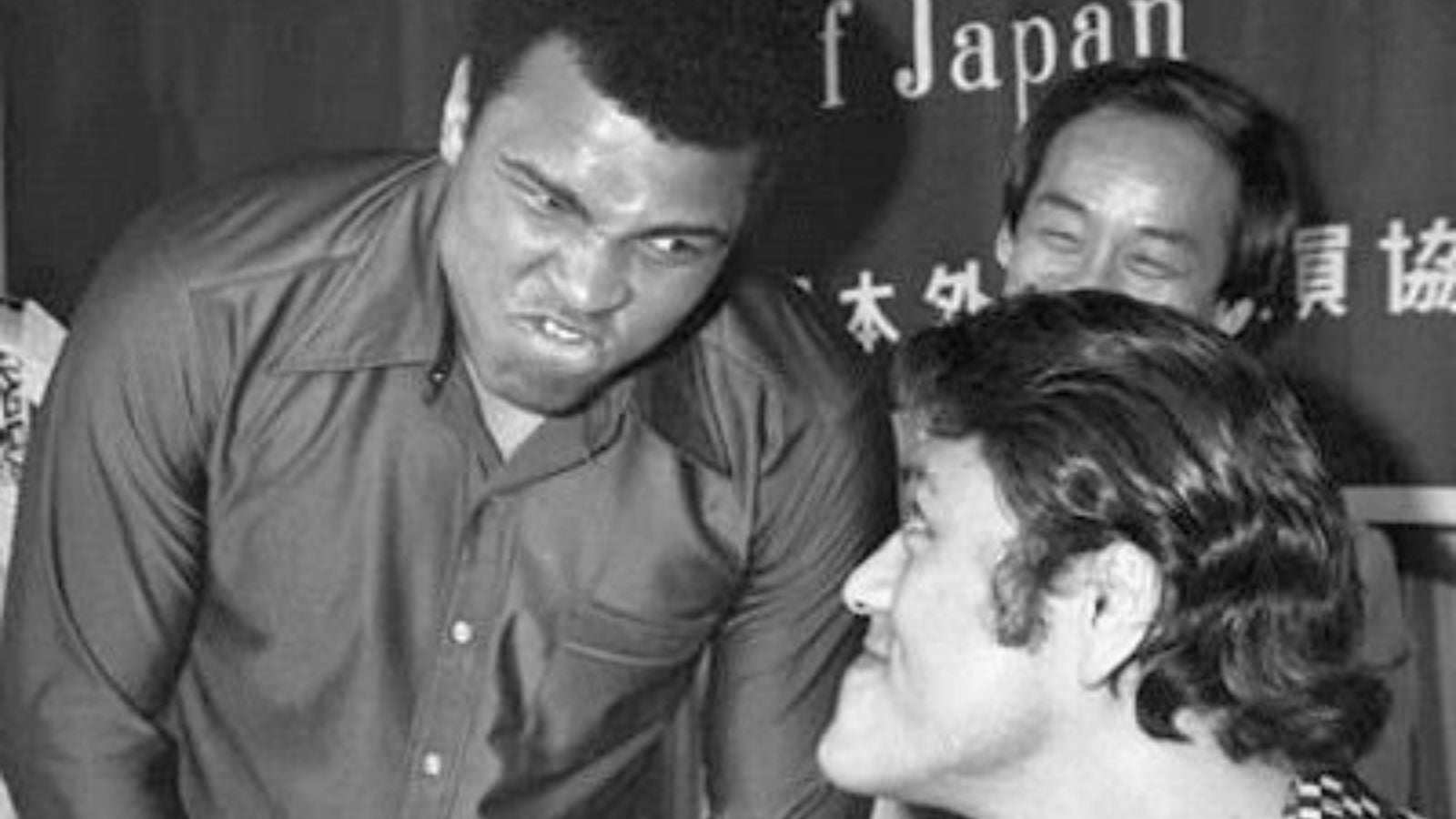
Press conferences were pure theater. Ali trash-talked relentlessly.
“Inoki is a wrestler. Wrestlers take dives. I will knock him out in three,”
He predicted. Inoki stayed cool but fired back through interpreters:
“Ali thinks wrestling is fake. I’ll show him real fighting.”
Tensions boiled over when Ali slapped Inoki during a staredown, drawing blood. Security had to separate them. Japanese fans ate it up, selling out Budokan in hours. The American press mostly mocked it as a circus, but curiosity drew a packed house.
The build-up
The buildup relied heavily on hype and bravado, and Ali was the loudest voice in the room. At the press conference, he told Inoki,
“Be serious tomorrow. Be serious. You’re meeting Muhammad Ali. The gloves will be small and I will be dancing. I will be dancing. I don’t like you. I don’t like you”.
He also told the Japanese audience,
“I love Japan. I love the Japanese people. But there’s only one Japanese I don’t like, and that’s Inoki”.
That kind of talk was standard Ali theater, but it also set the tone for how personal and public the event felt.
Inoki answered in a much colder way. According to later reporting, he openly criticized the rule changes that limited what he could do and made it difficult for him to attack Ali on his terms.
He also reportedly predicted that by the end of the 15th round, Ali would be broken down and unable to leave the ring unscathed.
That was the essential tension in the promotion: Ali sold confidence, Inoki sold danger, and the public was told that both men believed they could win.
There was also a larger cultural angle to the buildup. Ali was a global superstar, and Inoki was a major figure in Japanese combat sports, so the match became more than a novelty.
It was framed as East versus West, boxing versus wrestling, and celebrity versus national hero. The marketing worked because the matchup sounded impossible, and impossible matchups are what sell tickets.
The Rule Trap
The fight’s rules stripped away most of what would have made the contest work as either boxing or wrestling. Inoki was barred from using throws, suplexes, and submissions, leaving him with very few options once the bell rang.
On top of that, he could not attack from a normal upright wrestling stance, which forced him to adopt an awkward, floor-based strategy almost immediately. It was legal, but it looked absurd to spectators who had expected something more direct.
That did not mean Inoki had no plan. He simply had a plan that made the fight nearly impossible to enjoy as a traditional contest.
He spent much of the match on his back, scooting and kicking at Ali’s legs from the mat. It was the most efficient strategy available under the rules, but it also made the spectacle look like a tactical dead end.
Ali, meanwhile, was stuck trying to box a man who wasn’t really fighting like a boxer, which caused constant stoppages and visible frustration.
Fight Night Rules and Reality
Round 1 set the tone. Inoki shot for a takedown but hesitated, remembering the no-grappling rule. Ali circled, jabbing lightly.
Inoki dropped to the mat and started kicking Ali’s lead leg over 100 times by the fight’s end. Ali couldn’t close the distance without eating shins.
Referees constantly warned Inoki about illegal strikes and docking points. Ali landed maybe two clean punches all night. He slipped repeatedly on the bloody canvas from Inoki’s leg gashes.
Inoki scooted backward on his butt, firing kicks like a crab. Ali yelled at refs, paced the ring, and shadowboxed to kill time. The crowd chanted “A-li! A-li!” early, then grew restless.
By round 10, trash flew into the ring—cushions, programs, cups. Japanese media called it a disgrace on the spot. Ali looked bored and frustrated, towel-whipping Inoki from afar.
Inoki bled from the mouth but kept kicking. The final bell rang at the 15-round limit. Judges scored it all over: one for Ali, one for Inoki, and one draw after deductions.
Stats tell the story: Inoki threw 130+ leg kicks, zero punches. Ali landed 12 jabs, no power shots. Fight time: 60 minutes of stalls and single-leg abuse.
Doctors treated Ali’s leg after the fight; it swelled significantly. He needed crutches to leave Japan.
The match itself
The action never really changed in a meaningful way. Inoki stayed low, Ali stayed cautious, and the crowd watched a strange, grinding fight that seemed to get less exciting with every round.
Even when Inoki landed kicks that knocked Ali off balance, the match did not accelerate into the kind of dramatic finish the promotion had promised. It just kept going, round after round, until the final bell arrived and the bout was officially ruled a draw.
“He Fought Like a Coward”
Ali vented immediately after.
“I’ve never fought anyone like that. He didn’t stand up and fight like a man. If he’d come close, I’d have destroyed him.”
He called Inoki a “coward” for staying low, saying wrestlers proved inferior. Later, admitting the pain, Ali said,
“I didn’t show it, but those kicks hurt badly. If I admitted weakness, he’d have rushed me.” In a 1976 interview, he laughed it off: “It was the pits. But I got paid.”
Ali’s camp blamed the rules protecting Inoki. His trainer, Drew Bundini Brown, yelled at ringside,
“This ain’t fighting!”
Cornerman Sandy Saddler claimed Inoki greased his legs for slips. Ali toured Japan on crutches for sympathy, signing autographs. Back home, he dismissed it: “Wrestling belongs on TV with clowns.”
“Rules Killed Me”
Inoki saw it differently.
“The rules were changed at the last minute to favor Ali—no grabs, no real wrestling. I had to kick or lose standing.”
He sued Ali for $3 million afterward, claiming non-payment and rule tampering. Inoki told the Japanese press, “I hurt Ali’s legs badly. He couldn’t walk after. Boxers can’t handle real fights.” Fans rallied around him; attendance at NJPW events spiked.
Inoki milked the controversy. He replayed kicks on TV, calling it proof that wrestling works. Giant Baba, All Japan’s booker, backed him:
“Inoki proved grapplers beat strikers if smart.”
But Japanese media trashed the fight, calling it embarrassing. One paper headline: “Inoki’s Kicks, Ali’s Walk—National Shame.”
Inoki’s comments after the match were shaped by the rule restrictions and the fact that he believed the conditions had made it harder for him to perform properly.
Reporting from the period described him as angered by the changes and feeling that they were designed to protect Ali.
That is an important part of the story, because it explains why the fight looked so strange: Inoki was fighting in a format that discouraged the full range of wrestling offense.
He was also carrying the burden of being the man expected to represent Japanese fighting spirit on a massive stage.
A later report summed it up by saying Inoki was frustrated that the rules limited his ability to attack the lower body and that he felt he had no choice but to disappoint fans.
Even if the match looked passive, Inoki’s position was that he was working within a system stacked against him. That does not make the fight exciting, but it does explain why he wrestled the way he did.
Immediate Fallout
Budokan fans rioted after the bell, pelting the ring. Police cleared 14,500 in chaos. Ticket refunds hit 20%. Ali flew out bandaged, vowing never again.
Inoki’s popularity soared domestically he beat Andre the Giant in front of 90,000 fans. NJPW used “Ali revenge” angles for years.
Globally, it bombed. U.S. papers called it “The Tokyo Travesty.” Boxing ignored it; wrestling embraced the legitimacy. Promoter fallout: Nippon TV lost millions. Ali/Inoki rematch talks fizzled. Inoki tried boxing later, KO’d in one.
Wrestlers were split on this match and the altercation between the two.
Bruno Sammartino laughed:
“Inoki made us look stupid. Stay on your back? That’s bush league.”
The late Gorilla Monsoon had once said,
“Ali toyed with him. Wrestlers need mats, not rules.”
Freddie Blassie, Ali’s heel manager during the buildup, bragged:
“I told Muhammad it’d be a joke. He listened.”
Boxers piled on in comparison to their wrestling counterparts. ‘Smokin’ Joe Frazier:
“I’d have rushed him, grabs or not.”
Ken Norton shared:
“Inoki ran scared.”
Japanese stars like Mitsuharu Misawa later credited Inoki:
“He showed MMA potential before MMA.”
Time recast the flop as pioneer work. Pride FC’s Nobuhiko Takada called it MMA’s godfather. UFC’s Dana White name-dropped it. Inoki died in 2022; tributes highlighted the fight as a bold failure. Ali, pre-Parkinson’s, shrugged it off in bios.
It is now considered a cult classic—YouTube clips get millions. The highlights: Inoki’s kicks bloodying Ali’s shin, slips, and crowd riots. It exposed style clashes need unified rules. Modern MMA fixed that with no-holds, gloves, and cages.
The fight grossed $10 million but lost on entertainment. Ali earned $6M, Inoki $2M. Legacy: the first boxer-wrestler PPV experiment was ugly but also historic. June 26, 1976, proved that combat sports evolution demands better refereeing, not egos.
Why it still matters
Muhammad Ali vs. Antonio Inoki matters because it was bigger than the fight itself. It was one of the earliest global crossover combat events built around the idea that two different fight worlds could collide on equal terms.
The event did not deliver a thrilling sporting classic, but it did create a template for future cross-disciplinary spectacles. It also proved that the rules matter as much as the names attached to them.
More than anything, the match remains famous because it left everyone with a story to tell. Ali had his complaints, Inoki had his grievances, and the crowd had its disappointment.
But history kept the date, June 26, 1976, because the spectacle was too strange to forget. The night was messy, the action was limited, and the legacy remains alive because no one who saw it could quite believe what they had witnessed.