
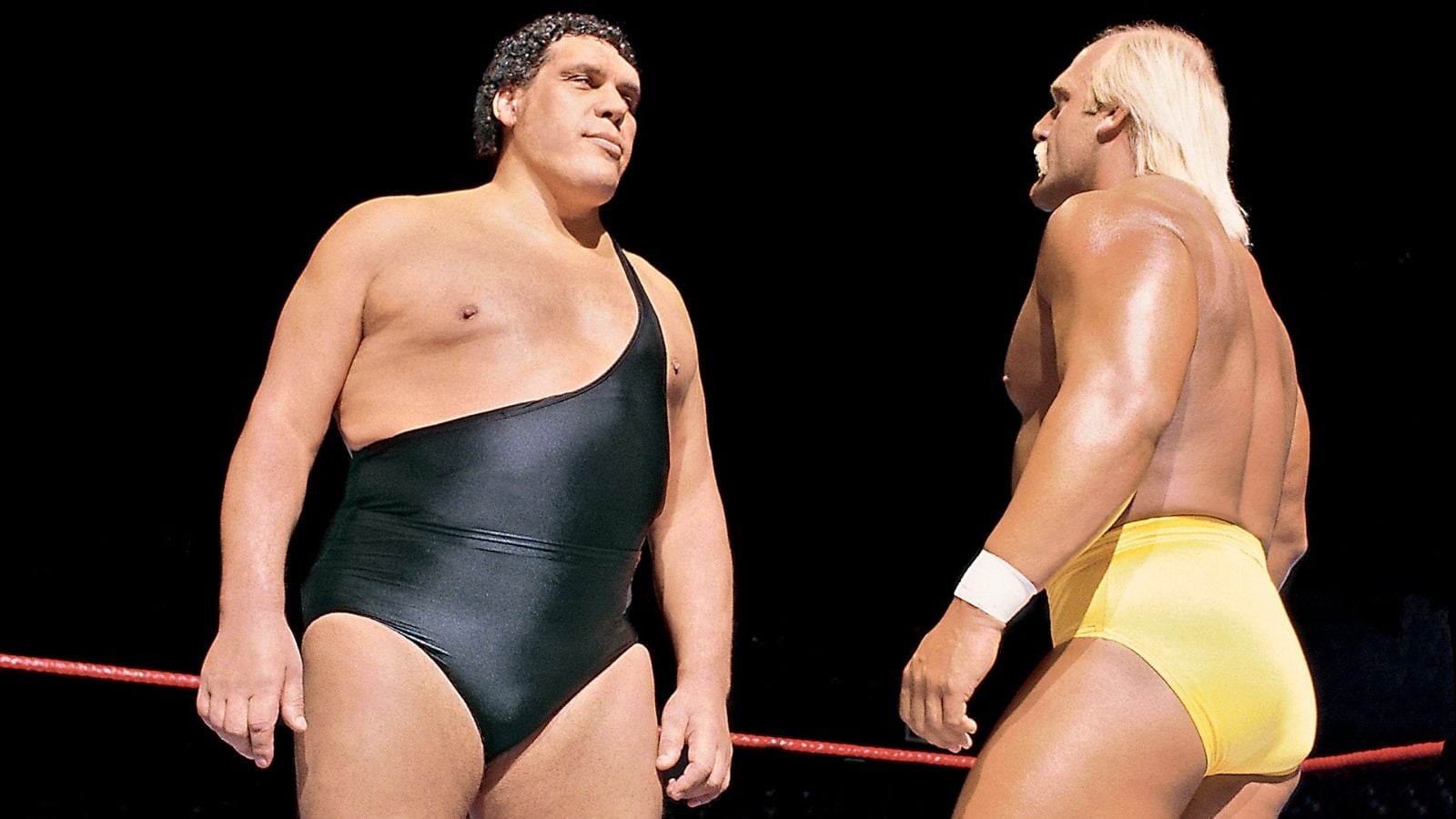
The story of Hulk Hogan and Andre the Giant isn’t as simple as their 1987 WrestleMania III story may suggest. The two men were friends and allies prior to this.
Together, they battled the likes of Bobby “The Brain” Heenan and the Heenan family. Before the quest to become World Wrestling Federation champion, Andre the Giant was a beloved figure whose life and times have since reached mythological proportions.
So in order to tell their feud and rivalry that led to their historic match in the Pontiac Thunderdome, it is key to revisit the history together prior.

Hulk Hogan and Andre the Giant –
A Giant Friendship Takes Shape
Hulk Hogan and André the Giant first crossed paths in the late 1970s. André already dominated territories across North America.
He held the WWWF World Tag Team Championship alongside Tony Garea and remained undefeated in singles competition for years.
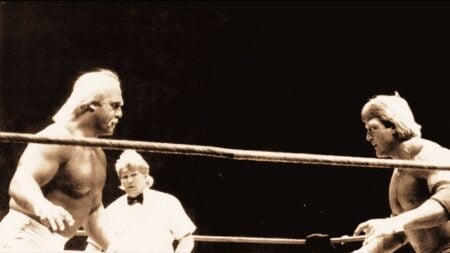
In fact, the two men fought each other in 1978 and 1979, well before there was even a World Wrestling Federation. Hogan, at the time, competed as Terry Boulder, worked preliminary matches, and occasionally faced André in New Japan Pro-Wrestling.
Their battles were largely considered low-profile in the pre-cable television era as neither man knew they would eventually headline the biggest wrestling event in history.
By 1984, Vince McMahon transformed the WWF into a national promotion. Hogan won the WWF Championship at Madison Square Garden and became the company’s top star. André served as his ally.
WWF billed André as undefeated for 15 years straight, conveniently ignoring count-outs and disqualifications. During this time Andre’s most notable feud was against Big John Studd. The feud saw Andre’s hair cut and the once prominent head of hair was reduced a manageable one.
To further assert himself, Studd would claim he couldn’t be body slammed. In fact, Studd’s manager, Bobby ‘The Brain” Heenan, had a $15,000 prize to anyone who could slam Studd.
Andre eventually slammed Studd during their match at WrestleMania I, but Heenan stole the money before Andre could claim it and share it with those in attendance.
Hogan and Andre teamed up against King Kong Bundy and Big John Studd on multiple occasions. André’s intimidating size complemented Hogan’s larger-than-life charisma. Hogan reportedly carried André’s bags. André stood beside Hulkamania at every turn.
Fans believed their friendship was genuine. They felt a connection with these two prominent figures in the WWF. This bond peaked at WrestleMania II in 1986, where both competed in separate high-profile matches and solidified their status as the WWF’s two biggest attractions.
Andre the Giant went on to win a 20-man over-the-top-rope battle royal, and Hulk Hogan successfully defended his title against King Kong Bundy in a steel cage.
Related Reads: WrestleMania 2

The Betrayal on Piper’s Pit
The turn happened suddenly. On an episode of Piper’s Pit in February 1987, WWF President Jack Tunney awarded Hogan a trophy celebrating three years as champion.
André walked onto the set carrying his own plaque recognizing his “undefeated” streak. Instead of congratulating his friend, André turned his back and walked away mid-ceremony. The snub shocked audiences who had watched these men fight side by side for years.
The following week, Bobby “The Brain” Heenan appeared alongside André. Heenan had spent years as Hogan’s nemesis, managing every villain who challenged Hulkamania.
Now he represented André. The Giant challenged Hogan for the WWF Championship at WrestleMania III. André ripped Hogan’s shirt and tore the cross necklace from his neck. Hogan accepted immediately. He simply said: “YES!”
WWF promoted the match relentlessly. Hogan cut emotional promos about betrayal. He said André was his giant, his friend, and questioned how this could happen.
André remained silent and menacing while Heenan trash-talked on his behalf. Vignettes showed Hogan training and hulking up against practice dummies.
Ratings soared. The Pontiac Silverdome sold 93,173 tickets, establishing an indoor attendance record that stood for decades.

WrestleMania III: The Bodyslam Heard Around the World
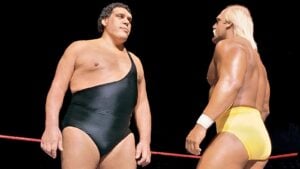
On March 29, 1987, WrestleMania II took place. With a reported crowd of 93,000 plus people in Detroit, Michigan the focus was build on this feud and the animosity that existed between Andre and Hulk leading up to their match up.
As the two men starred each other down in the center of the ring it was clear that it was built on being a monumental meeting. After early punches by Hogan and an attempt to pick Andre up and slam him, Hulk fell down and was nearly pinned.
Gorilla Monsoon called it on commentary:
“The irresistible force meets the immovable object!”
Jesse Ventura added that he had never seen Hogan crawling on the mat before. The champion appeared beaten down and vulnerable.
André applied a bearhug that seemed to drain Hogan completely. The referee checked on the champion repeatedly.
Then Hogan began shaking. His arms trembled. He broke the hold and began firing back with punches. He whipped André into the corner and delivered multiple shots. The crowd exploded.
Hogan lifted the 520-pound Giant onto his shoulders and slammed him to the mat. He bounced off the ropes and dropped the leg for the 1-2-3. Hogan retained his championship.

Hogan tore muscles in his back during the slam. He later explained the moment in detail on the Full Send Podcast:
“André came to me and said, ‘Tonight’s the night… pass the torch.’ I didn’t even know what he was talking about at first.
I figured if we really screwed this up, this was WrestleMania 3, and everything was on the line. And so I sat next to André all day.”
– Hulk Hogan on Andre before their match
The main event lasted approximately 12 minutes. It featured methodical pacing with André controlling early through chops and forearm shots.
Hogan also reflected on André’s sacrifice:
“He didn’t have to do that. I mean he did that for the wrestling business to basically give me the rub and pass the torch.”
Bobby Heenan later noted that André knew his time was ending. He wanted Hulkamania to shine brighter than ever before.

The Twin Referee Controversy: The Main Event
The feud did not end at WrestleMania III. On Saturday Night’s Main Event XI in May 1987, Heenan claimed André actually won at WrestleMania via bodyslam pinfall. He demanded a rematch based on a supposed fast count. WWF denied the claim but kept the rivalry simmering.
The rematch aired live on NBC’s The Main Event I on February 5, 1988. It drew 33 million viewers, making it one of the most-watched wrestling broadcasts in American history.
Ted DiBiase, “The Million Dollar Man,” had aligned with André after failing to purchase the WWF Championship from Hogan. DiBiase’s wealth became central to the storyline.
The match ended in controversy. André locked Hogan in a bearhug. Hogan appeared to pass out but then recovered. Upon pinning Hogan, referee Dave Hebner counted Hogan’s shoulders down for the pinfall despite Hogan clearly kicking out before the referee’s hand hit the mat for a third time.
André won the WWF Championship. Chaos erupted immediately. A second referee entered the ring who looked identical to Dave Hebner.
It was his twin brother Earl. The storyline that had unfoled was that DiBiase had bribed/paid off Earl Hebner to impersonate his brother and deliver a fast count.
Related Reads: The Main Event featuring Andre The Giant and Hulk Hogan
Related Reads: Million Dollar Purchase – Ted DiBiase ‘Buys’ the WWF Title
Earl Hebner later explained the moment:
“Vince told me exactly what to do before going live. When André made the cover, I counted fast. Hogan’s shoulders were clearly off the mat, but that was the plan. The whole thing broke down perfectly.”
– Earl Hebner on what Vince McMahon explained to him prior to the match
Hogan grabbed both referees and threw one into the other. He demanded answers while DiBiase celebrated with the belt.
André immediately surrendered the championship to DiBiase. WWF President Jack Tunney vacated the title and announced a 14-man tournament at WrestleMania IV to crown a new champion.

WrestleMania IV: Tournament Collision
On March 27, 1988, WrestleMania IV took place at Trump Plaza in Atlantic City. Hulk Hogan entered the tournament as the number one seed. André the Giant entered as the number three seed in the tournament.
They met in the quarterfinals. The match disappointed compared to their WrestleMania III confrontation. Both men moved slowly. André’s health had visibly declined.
The match resulted in a double disqualification after interference from Virgil and Bobby Heenan. Both men were eliminated from the tournament.
Randy ‘Macho Man’ Savage won the tournament and became the new World Wrestling Federation Champion. Hogan assisted Savage in the finals against DiBiase.
Their alliance formed the foundation of “The Mega Powers.” André aligned permanently with DiBiase. They became known as “The Mega Bucks.”

SummerSlam 1988: Mega Powers vs. Mega Bucks
At the inaugural SummerSlam, which took place on August 29, 1988, at Madison Square Garden, the main event featured The Mega Powers (Hulk Hogan and Randy Savage) against The Mega Bucks (André the Giant and Ted DiBiase).
Jesse ‘The Body’ Ventura served as special guest referee. WWF President Jack Tunney selected Ventura as the only person capable of handling such a volatile match. Miss Elizabeth accompanied Hogan and Savage as their manager.
The Mega Powers controlled the early portion of the match. Hogan attacked André on the ring apron. The Mega Bucks regained control through brawling and double-team tactics.
André knocked both Hogan and Savage out of the ring at one point. All four men eventually fought simultaneously inside the ring.
The finish became legendary. Miss Elizabeth climbed onto the apron and began arguing with Ventura. She then removed her skirt to reveal a one-piece swimsuit underneath. André and DiBiase froze. Ventura stared.
Savage immediately capitalized by hitting the flying elbow drop on DiBiase. Hogan followed with his signature leg drop. Ventura counted slowly, reluctantly. Savage grabbed Ventura’s hand and slammed it down for the three count. The Mega Powers won.
Hogan later said about André at SummerSlam:
“André looked rough, but that Madison Square Garden pop… electric.”
Aftermath and Final Encounters
The Mega Powers continued teaming after SummerSlam. On October 16, 1988, Ted DiBiase defeated Randy Savage in the finals of the King of the Ring tournament.
The alliance between Hogan and Savage eventually fractured. Savage grew jealous of Hogan’s attention toward Miss Elizabeth.
He also resented feeling like the second-billed member of the Mega Powers despite being WWF Champion. This jealousy led to the Mega Powers exploding at WrestleMania V, where Hogan defeated Savage for the WWF Championship.
André’s health continued declining. His final singles match against Hogan took place at a house show in Toronto on May 27, 1988. Hogan pinned André clean with the leg drop. No cameras captured the moment. No fanfare accompanied it. It simply ended.
André shifted to feuding with Jim Duggan and Jake Roberts. He worked tag team matches with Haku as “The Colossal Connection.” His mobility decreased visibly. He made sporadic appearances through the early 1990s before retiring.
Reflections on the Rivalry
Hulk Hogan grew emotional discussing André’s death in 1993. He said on Saturday Night:
“When André was buried, I felt part of me was buried with him.”
– Hulk Hogan on the passing of Andre the Giant
Mean Gene Okerlund recalled André’s private struggles:
“André confided in me, ‘You know, people think that I have a great life… but I see them when they point at me… little kids laugh and say…'”
André’s physical condition caused constant pain. Acromegaly ravaged his body throughout his career. He wrestled through agony that few understood.
Vince McMahon credited the rivalry as pivotal to WWF’s expansion. He said Hogan was their guy, but André made him immortal.
The WrestleMania III bodyslam became the defining image of 1980s professional wrestling. It validated McMahon’s gamble on national expansion and celebrity crossover appeal.
The rivalry between Hulk Hogan and André the Giant transcended professional wrestling. It combined genuine friendship, calculated betrayal, physical spectacle, and emotional storytelling.
André chose to elevate Hogan at his own expense. That decision shaped professional wrestling for generations. The torch passed at the Silverdome continues burning decades later.