


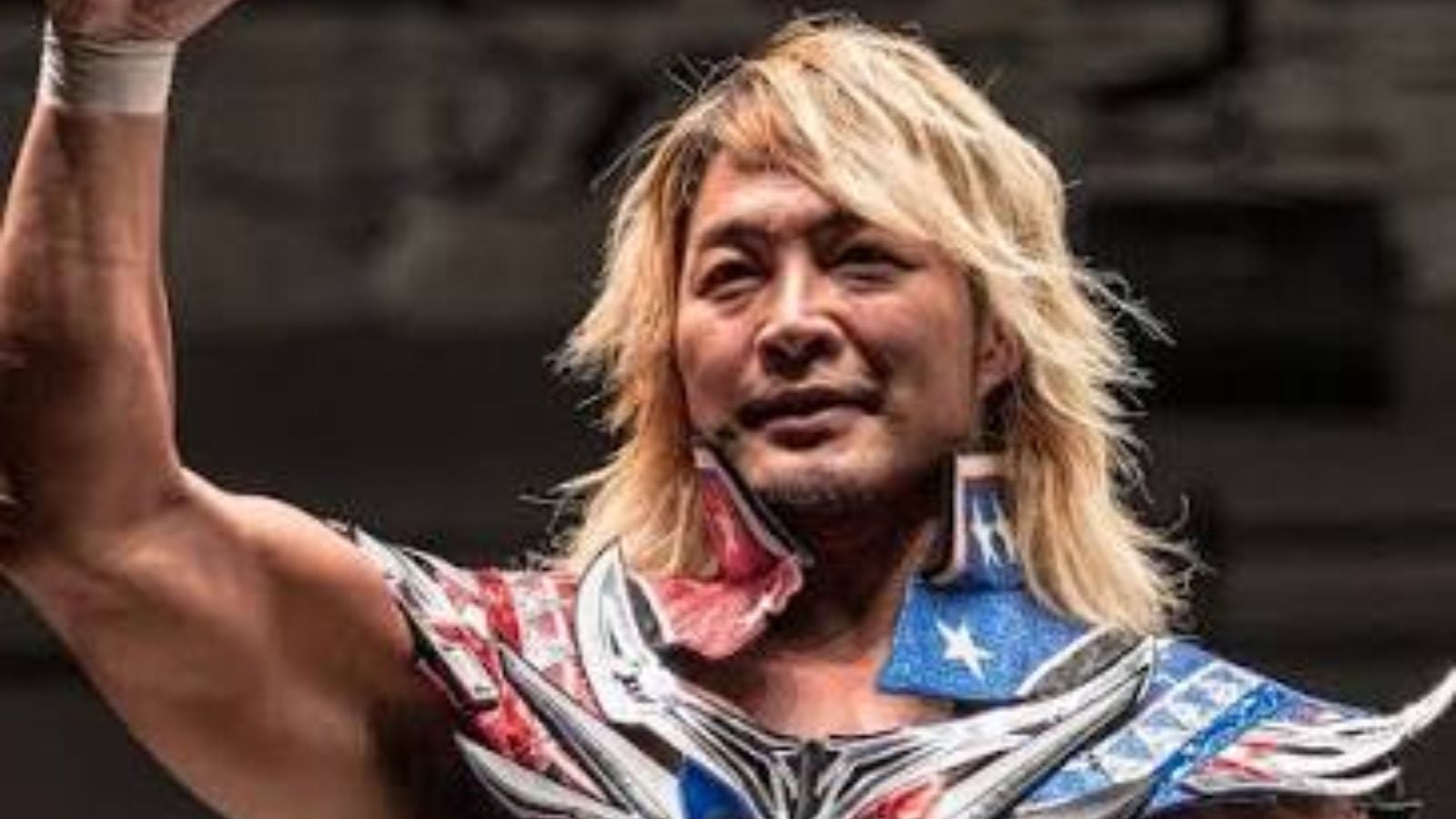
There’s a word puroresu fans reach for when they talk about Hiroshi Tanahashi, and it isn’t “champion” or “legend.” It’s “Ace.”
In New Japan Pro-Wrestling, that title means something specific: the wrestler a promotion is built around, the one who has to draw money and tell the truth in the ring at the same time.
For a quarter century, that wrestler was Tanahashi. He debuted in a company nobody wanted to watch, dragged it out of a genuine business crisis on the strength of his own drawing power, and retired in January 2026 as the man who still holds the record for IWGP Heavyweight Championship reigns.
In between, he built two of the greatest rivalries pro wrestling has ever seen, spent stretches of his prime wrestling in the United States and Mexico, and ended up running the whole company.

Hiroshi Tanahashi – From Ritsumeikan to the Dojo
Tanahashi wasn’t a childhood wrestling obsessive. He played baseball in high school and studied law at Ritsumeikan University in Kyoto, where he also picked up freestyle wrestling.
NJPW scouts noticed him there. His February 1998 tryout for the company’s dojo, the traditional brutal training ground for nearly every homegrown NJPW star, went well enough to bring him on as a trainee.
He debuted on October 10, 1999, losing to Shinya Makabe, and was grouped with two other rookies, Katsuyori Shibata and Shinsuke Nakamura, under a nickname borrowed from history: the new Three Musketeers.
Tanahashi’s climb wasn’t instant. He spent his first several years working his way up the card and, along the way, survived something unrelated to wrestling.
In November 2002, he was stabbed by a woman he’d briefly dated, a TV Asahi reporter, and hospitalized. It was a genuinely frightening moment and, strangely enough, it also raised his public profile before his comeback the following February, when he returned to a sold-out crowd in Tokyo.
From there, his career accelerated fast: the IWGP U-30 Openweight Championship by mid-2003, a G1 Climax final appearance in 2004, and a headline slot at the Tokyo Dome against Nakamura in January 2005.

Becoming Ace: The First Title Reign
Tanahashi won his first IWGP Heavyweight Championship in July 2006, beating Giant Bernard (Matt Bloom) in a tournament final for the vacant belt, and held it for 270 days before losing it to Yuji Nagata.
He got it back that same year by beating Nagata in the 2007 G1 Climax final, then lost it again in a rematch that October.
During this period, Tanahashi made his American wrestling debut at TNA’s Final Resolution in January 2006, facing AJ Styles in a fourteen-minute match. Shannon Moore interfered, enabling Styles to secure the win with the Styles Clash.
He returned to TNA in late 2008 for a short stint, working a ten-man X Division elimination match and a tag bout, before cutting the run short once NJPW booked him in a milestone match against his own trainer.
That match came on January 4, 2009, when Tanahashi defeated Keiji Mutoh — the Great Muta himself — to become the fiftieth IWGP Heavyweight Champion, a symbolic changing of the guard from teacher to student.
Later that year, he beat Nakamura to open his third reign, then defended successfully against a returning Olympic gold medalist, Kurt Angle.
The Record Run and a Second Trip Abroad
Tanahashi’s fifth title reign, running from August 2011 to June 2012, became the defining stretch of his prime. He teamed with Hirooki Goto as “The Billion Powers” in that year’s G1 Tag League, made the semifinals, and kept defending his singles title against the likes of Toru Yano, Nagata, and eventually Minoru Suzuki, whom he beat at
Wrestle Kingdom VI on January 4, 2012, to set a new record of eleven consecutive defences.
During these years, Tanahashi also toured Mexico’s Consejo Mundial de Lucha Libre repeatedly, wrestling in the CMLL World Tag Team Championship alongside Jushin “Thunder” Liger and taking part in the promotion’s Universal Championship tournaments, eventually winning that title as a rudo in 2013.
The Rainmaker Arrives
New Japan’s business had been in a genuine slump through the mid-2000s, and it’s not an exaggeration to say Tanahashi’s drawing power single-handedly kept the promotion afloat during those years.
So when a new challenger showed up in 2012, it mattered. Kazuchika Okada returned from his own excursion, beat YOSHI-HASHI at Wrestle Kingdom VI, and immediately challenged Tanahashi for the title he’d just defended a record eleventh time.
On February 12, 2012, in a match still remembered as “The Rainmaker Shock,” the 24-year-old Okada beat Tanahashi cleanly. This ended Tanahashi’s reign and started a rivalry that would define the next decade of the promotion.

What followed was one of the most decorated feuds in wrestling history — eighteen singles meetings by most counts, several of them rated among the best matches ever wrestled by the Wrestling Observer Newsletter.
Hiroshi Tanahashi got the record back before losing it again. The two traded the title and the unofficial “Ace” designation back and forth for years, and their series produced three separate Wrestle Kingdom main events.
Hiroshi Tanahashi described what made that first run of matches feel different:
“From the very first matchup with him [at The New Beginning], Okada had a stable mindset,…He was a different person altogether. I felt him getting stronger every time I fought with him.”
In comparison, Okada’s initial perspective on their rivalry was different.
“I didn’t feel much of a chemistry at New Beginning 2012…perhaps because the hall was filled with boos against me by fans who didn’t expect that Okada would win.”
Their rivalry also produced one of Tanahashi’s most quoted lines. After losing to Okada at Battle in the Valley in February 2019, when Okada successfully defended the IWGP world heavyweight title. Tanahashi could see that time was no longer on his side.
“It had been a long time since I wrestled Okada, and I definitely felt a big gap between me and him..
Okada wasn’t blown up at all during the match; I couldn’t drive him into the wall like I had been able to in the past. That’s what I remember the most from the match.”
Life Beyond the Belt
By early 2015, Tanahashi’s last reign as champion had ended at the hands of AJ Styles, and while he’d never again be a full-time top champion, he remained one of the busiest and most decorated wrestlers on the roster.
He kept adding to a championship résumé that eventually included the IWGP Intercontinental Championship, the NEVER Openweight Championship, three reigns each with the IWGP Tag Team and IWGP United States Heavyweight titles, and three total G1 Climax wins (2007, 2015, and 2018).
He also made appearances in Ring of Honor as part of NJPW’s American co-promoted shows, and briefly returned to Impact Wrestling (TNA’s later branding) in 2023, facing Mike Bailey and then challenging Alex Shelley for the Impact World Championship at Multiverse United events.
Hiroshi Tanahashi was named Tokyo Sports Wrestler of the Year four times across his career — 2009, 2011, 2014, and 2018 — recognition that closely tracked his biggest arcs against Nakamura and Okada.
Running the Company
In 2023, Tanahashi was named president and representative director of NJPW, taking on the company’s top office job while continuing to wrestle part-time.
That dual role made his eventual retirement announcement, delivered at King of Pro-Wrestling in October 2024, land differently than a typical farewell tour.
Marking his 25th anniversary in the ring, Hiroshi Tanahashi told the crowd the finish line was in sight and confirmed his final match would come at Wrestle Kingdom 20 on January 4, 2026
House of Torture immediately jumped him afterward, with EVIL declaring that he, not Tanahashi, would decide when the Ace’s career actually ended one last angle in a career full of them.
The obvious opponent for that final match was the one rivalry that had never really stopped mattering.
Okada, by then wrestling full-time for AEW, returned to NJPW to accept the challenge, telling the promotion that everything about the Rainmaker character started with Tanahashi, so it made sense that his career should end there too
“Everything about the Rainmaker started with Tanahashi, so it makes sense to end Tanahashi’s career.. Talking about it that way sounds a little self-centred (laughs) but in the end, I feel this is a repayment in a way,”
Asked to sum up what Hiroshi Tanahashi meant to him after all those years, Okada did not give a tidy answer. He called him a rival, a friend, and a senior all at once, someone he had hated and admired equally.
“Summing it up is hard. He’s a rival, a friend, a senior, all those. Is it a cop out to say the one word is “intangible?”He’s a rival in so many ways, but he was a senpai who looked after me, who had kind big brother vibes about him, but someone I’ve hated, someone who frustrated me with how good he was.There’s just so much you can’t contain it in a couple of words, you can’t put your finger on it in that sense.”

The Last Match
At Wrestle Kingdom 20 on January 4, 2026, in front of a sold-out Tokyo Dome, Tanahashi and Okada wrestled for the eighteenth and final time.
The match lasted 33 minutes and hit nearly every landmark of their shared history. There were duelling Rainmakers, a tribute Bomaye honoring Nakamura, and a piledriver on the ramp that almost ended the match early by countout. Okada eventually won with a Rainmaker off a top-rope elbow drop.
What came after mattered just as much as the match itself: a retirement ceremony that brought out Keiji Mutoh, Tatsumi Fujinami, Katsuyori Shibata, Jay White, Will Ospreay, Kenny Omega, and Tetsuya Naito, spanning nearly every era Tanahashi had competed through.
Backstage, Tanahashi allowed himself something he said he’d been holding in for over a decade.
He shouted that he was tired, admitting he’d been saving up fourteen years’ worth of exhaustion since 2012.
“I think if I don’t say this now, I’ll never be able to say it for the rest of my life, so I’ll say it [in a loud voice] Ahh, ahh, I’m tired!..From 2012, for 14 years, I haven’t said I’m tired, so I’ve been stocking up on 14 years’ worth of ‘I’m tired.’ Hah, I’m tired [applause in the venue]. Thank you very much.”
Where He Stands Today
Tanahashi’s in-ring career is over, but he hasn’t gone anywhere. He remains NJPW’s president and representative director, a role he’s expected to hold indefinitely, running the promotion he spent more than 2,800 matches building into something worth inheriting.
He also continues to host his long-running Podcast Off program, in which past guests have included Mutoh, Fujinami, and other figures from across NJPW’s history.
By the numbers, it’s hard to find a comparable career anywhere in the sport: a record eight reigns with the IWGP Heavyweight Championship, three G1 Climax wins, more than thirty Tokyo Dome appearances, and two rivalries — with Nakamura in the 2000s and Okada in the 2010s — that each defined an era of the company on their own.
Tanahashi’s own framing of it, offered to NJPW’s in-house media just before his final match, is as good a summary as any: rivalries are what fans remember most, and his career happened to produce two of the best.
Sources