
Ray Traylor spent nineteen years in professional wrestling playing some version of an authority figure — a bodyguard, a prison guard, a corporate enforcer, a SWAT-clad hired gun, known as the Big Bossman. It made sense.
Ray Washington Traylor Jr. was born on May 2, 1963, in Marietta, Georgia. He then attended Paulding County High School and graduated in 1982.
What is interesting to note is that he would later work as a corrections officer for the Department of Corrections in Cobb County, Georgia.
A profession that would later prove that art would imitate life. It would be a background that became the foundation of one of the most recognizable characters of the 1980s and ’90s.
He worked for the biggest promotions in the country under half a dozen different names, feuded with Hulk Hogan and The Undertaker, and became, by most measures, one of the better in-ring big men of his generation. He also died young, at 41, in 2004, a loss that landed hard on a locker room that genuinely liked him.

From Jim Crockett Promotions to Becoming Jim Cornette’s Midnight Express’ Bodyguard
His transition from corrections officer to wrestler came in 1984. Traylor made his wrestling debut in 1984, working enhancement matches under his real name for Jim Crockett Promotions, the NWA’s flagship territory.
His first notable assignment reportedly had him opposite NWA World Television Champion Tully Blanchard, a deliberate test of the newcomer’s size and toughness.
It was then that head booker at the time, Dusty Rhodes, took notice of him and repackaged him as Big Bubba Rogers.
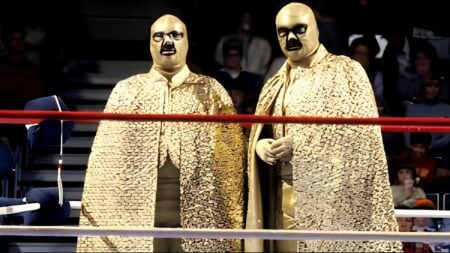
The character would wear a fedora, a suit, glasses, and act as a bodyguard for one of wrestling’s most important teams of the 1980s.
“He was one of the fastest learners and if you go back and look through recent wrestling history over the past fifty years I think he was probably the quickest main event star, even quicker than The Rock.
The quickest main event star in professional wrestling at that level, literally three months after he debuted on television, he was main eventing with Dusty Rhodes, and in six-mans with The Midnight Express against guys like The Road Warriors and The Rock N’ Roll Express.
He set an attendance record in Pittsburgh in February of 1987. He hadn’t even been a pro for a full year yet and set an attendance record in Pittsburgh at the Civic Arena with Dusty….
He picked things up incredibly quick he had the advantage of working with, you know, the best in the business at the time but Dusty saw something in him on that original time he came to TBS and did jobs as Ray Traylor one time and he took him off TV three months and brought him back as Big Bubba Rogers and he told him what has gimmick was and then let Bubba figure out how to portray it in the ring, I mean obviously gave him advice but you know Bubba figured that sh** out, and he figured out how to be that mysterious bad man that never spoke and he would sell but nothing could hurt him.”
At 6-foot-6 and roughly 300 pounds, Traylor had the frame promoters wanted. What ultimately happened was that he became the unofficial ‘fourth member of the Midnight Express’.
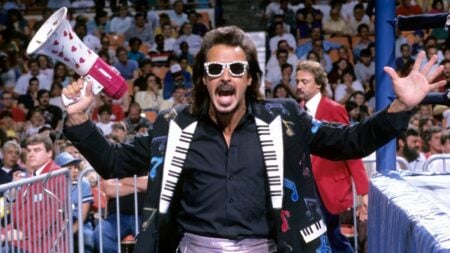
As Big Bubba Rogers, Traylor would project a silent presence as a sunglasses-and-fedora bodyguard for manager Jim Cornette and align with The Midnight Express.
Bubba would ultimately feud with Dusty Rhodes, and this produced one of the promotion’s more memorable non-selling moments:
Rhodes shattered a wooden chair over Traylor’s head during an angle involving Baby Doll, and Traylor didn’t so much as flinch, calmly starting to remove his jacket to fight back instead.
Bubba turned heel outright and became a legitimate main-event threat, working the 1986 Bunkhouse Stampede series against Dusty Rhodes and competing as “The War Machine” for the Four Horsemen at the second WarGames.
He also picked up his first singles championship in Bill Watts’ Mid-South territory, by then rebranded the UWF, beating One Man Gang for the UWF World Heavyweight Championship on April 19, 1987, and running through a string of successful defences against Barry Windham, Michael Hayes, and others.
He did this before dropping the belt to “Dr. Death” Steve Williams that July. A pay dispute with Crockett’s NWA eventually pushed him elsewhere.
In the Spring of 1988, Traylor would compete for All Japan Pro Wrestling but did so only under the name “Big Bubba” during the promotion’s Champion Carnival series.
It was there that he would work with Bruiser Brody and against the likes of John Tenta, who would later be known as Earthquake in the WWF/F.

Becoming the Big Bossman
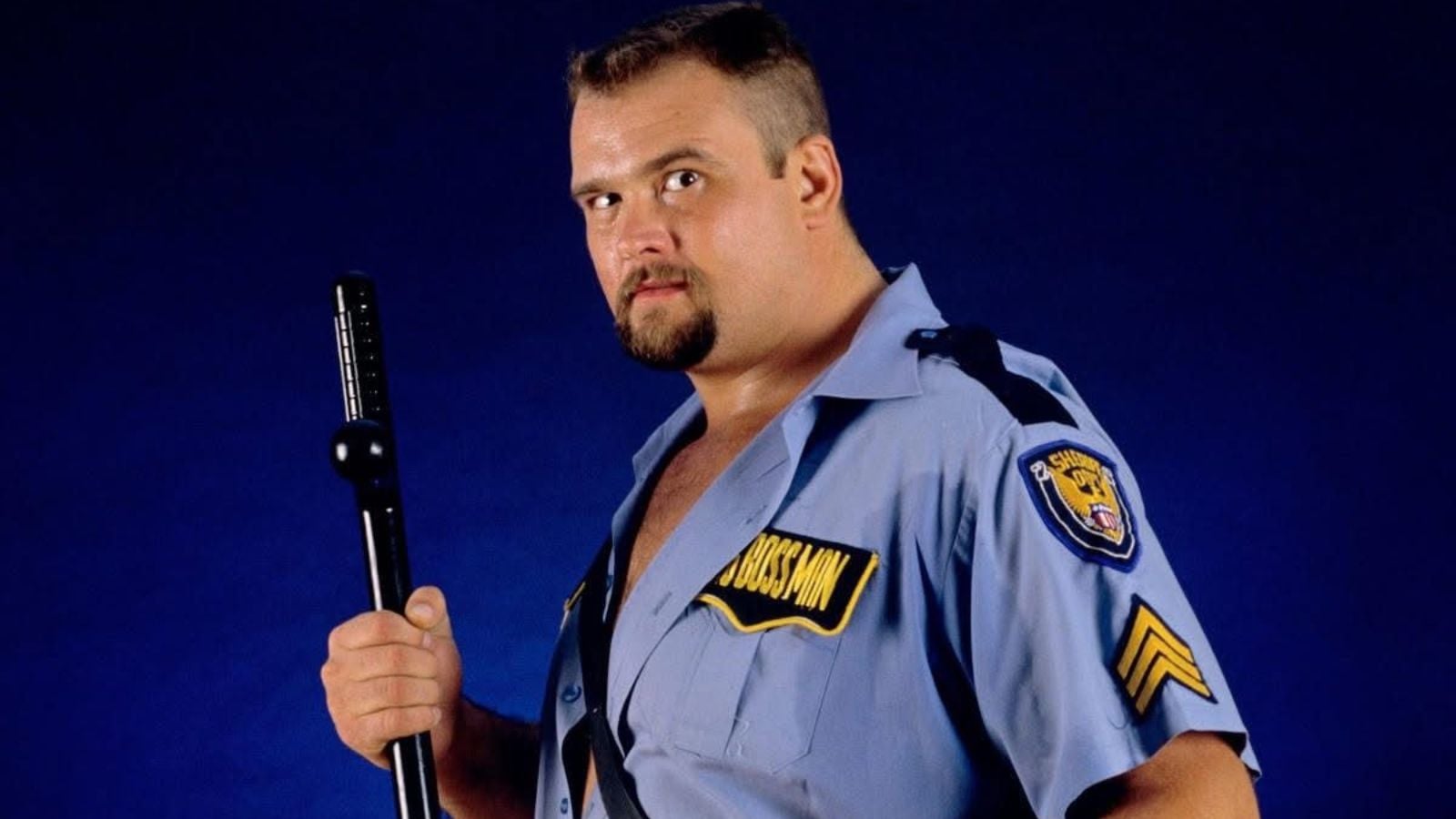
Traylor’s move to the WWF in 1988 gave him the character that Ray Traylor would later be remembered for. Leaning into his actual background as a Georgia corrections officer, the company repackaged him as The Big Bossman, complete with a guard uniform, nightstick, and handcuffs.
He made his pay-per-view debut beating Koko B. Ware at the very first SummerSlam, then made his first real impact attacking Hulk Hogan during an interview segment on The Brother Love Show. This heel turn immediately positioned him as a threat to Hogan’s championship.
He paired with the returning One Man Gang, now rechristened Akeem, to form The Twin Towers, one of the more physically imposing tag teams of the era.
The Towers feuded with Hogan and Randy Savage’s Mega Powers alliance through 1988 and into WrestleMania V, playing a supporting role in the slow-building storyline of Savage’s jealousy and eventual betrayal of Hogan.
The Big Bossman turned babyface not long after, defeating Akeem in under two minutes at WrestleMania VI and quickly becoming one of the promotion’s more popular mid-card faces.
A lawman fans could get behind, feuding with Bobby Heenan’s stable after Heenan took to insulting his mother on television, and beating Mr. Perfect by disqualification at WrestleMania VII in an Intercontinental Championship match that also marked André the Giant’s return.
The character’s signature angle came in 1992, when the WWF introduced Nailz, an ex-convict who claimed on television that Bossman had abused him during a prior incarceration.
Nailz ambushed Bossman on a May 1992 television taping, cuffing him to the top rope and choking him with his own nightstick — an angle brutal enough that it kept Bossman off television for months while he “recovered.”
The feud wrapped up that November at Survivor Series, when Bossman beat Nailz in a Nightstick on a Pole match.
He left the promotion in early 1993 after a pay dispute of his own, working one final house show as a guest referee before signing elsewhere.
A Return to Japan
Throughout the Summer and Fall of 1993, Traylor would compete as “Big Bubba” once again. As the WWF owned the Big Bossman name and likeness, Traylor would revert to what he had used during his time with Jim Crockett Promotions.
During his time, he faced notable names such as Terry “Bam Bam” Gordy, “Dr. Death” Steve Williams, one of the famed Four Pillars of Heaven in Akira Taue and the legendary Giant Baba.
Big Bubba, The Guardian Angel, and Six Years in WCW
Traylor worked in Japan alongside Steve Williams before joining World Championship Wrestling in December 1993, debuting as The Boss and pinning International World Champion Rick Rude in a non-title match right out of the gate.
A trademark dispute with the WWF over the similarity between “The Boss” and “Big Boss Man” forced a name change, and Traylor became The Guardian Angel, dressed in the red beret and colours of the real-life street-patrol organization of the same name. His time in WCW also saw him align with Kevin Sullivan as part of his Dungeon of Doom.
He eventually reverted to his old Big Bubba Rogers persona as a heel, and one notable result of that run came in March 1995, when Bubba beat Sting at Uncensored.
He spent much of his WCW tenure working programs with the Steiner Brothers and, later, feuding with the nWo; a storyline device eventually wrote him out of that group via a contract loophole, turning him babyface again as he went back to competing under his own name, Ray Traylor, briefly managed by Ted DiBiase.
It wasn’t the most prominent period of his career; by his own later admission and by most accounts of the run, he rarely rose above the midcard during this stretch, closing out roughly five years in WCW before it was time to move on again.

The Big Bossman — Back to the WWF
Traylor returned to the WWF on the October 12, 1998, episode of Raw Is War, once again as Big Bossman, but with a reworked persona no longer a straightforward police officer, but a mercenary-style personal security enforcer in a black SWAT uniform, willing to work for whoever paid him.
He was introduced as the first member of The Corporation, Vince McMahon’s stable built to combat Stone Cold Steve Austin and D-Generation X, serving at various points as security for both McMahon and his son, Shane.
The Feud with the Big Show
This run produced Bossman’s most gruesome storyline. Feuding with The Big Show over the WWF Championship picture in late 1999, Bossman escalated a program built around genuine menace: he crashed a televised, storyline funeral for Show’s father, invoking Show’s own real-life loss of his father years earlier, delivering a mocking eulogy before hitching the casket to his squad car and driving off with Show clinging to the top of it.
“With the deepest regrets, and tears that are soaked
I’m sorry to hear that your dad finally croaked
He lived a full life on his own terms
Soon he’ll be buried and eaten by worms
But if I could have a son as stupid as you
I’d have wished for cancer so I would die too
So be brave, and be strong, get your life on track
‘Cause the old b***ard’s DEAD and he ain’t never comin’ back!”
But the feud, in retrospect, didn’t leave a meaningful impression on The Big Show. In the past, he noted just how far the feud with the Bossman’s car had gone, acknowledging that the spot where he jumped onto the moving casket could genuinely have hurt him.
The feud ended at Armageddon in December 1999, with Show beating Bossman.
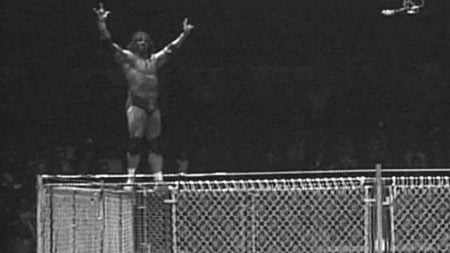
Bossman also feuded with The Undertaker’s Ministry of Darkness through early 1999, culminating in a Hell in a Cell match at WrestleMania XV. Taker won with a Tombstone Piledriver, and the angle didn’t stop there.
Edge, Christian, and Gangrel descended from the rafters, and Taker tied a noose around Bossman’s neck as the cell was raised, leaving him hanging in one of the more controversial visuals in WrestleMania history.
He was, naturally, back in action within weeks. He picked up tag team gold that period too, winning the WWF World Tag Team Championship alongside Ken Shamrock in December 1998, and spent the back half of the Attitude Era largely in the WWF Hardcore division, capturing that title four times, including three separate reigns against Al Snow.
“I loved Big Boss Man, and Ray was a blessing to get to work with. Such a great guy and such a great talent. I really enjoyed it, and he became a great friend.”

The Dog Kennel Feud with Al Snow
While the Bossman’s time in the WWF/E was memorable, not all of his matches and moments were left with something to be desired.
This would include his feud with Al Snow, which featured an infamous series of events, including Snow’s dog being fed to him.
Despite the feud being universally panned, Snow felt that, as a collective, they dropped the ball on this feud with the Big Bossman, specifically their dog-kennel match.
“I was very thankful and appreciative of the opportunity. I just was disappointed because they WWE, or WWF, and to a lesser degree Boss Man and myself dropped the ball.”
“The number one rule in wrestling is to take s*** and make shoe polish. No excuses, no ifs, ands, or buts. You take the circumstances, and you make the best of them as you can.
Because the show has to always go on. You always have to be worthy of the time, money and effort that an audience invests in wanting to watch you.”
The Final Run and Retirement
Bossman’s last several years in WWE were quieter. He teamed briefly with a young protégé, Bull Buchanan, winning a tag match at WrestleMania 2000, then disappeared to the undercard programming of Jakked and Heat for a stretch before a legitimate injury sidelined him in early 2001.
He returned in late 2001 as an enforcer for Booker T, a pairing that fizzled within a couple of months, then briefly teamed with Curt “Mr. Perfect” Hennig after both were drafted to Raw in 2002. His final WWE match came on a May 2002 Heat taping, a loss to Tommy Dreamer.
That same month, Traylor was seriously hurt in a motorcycle accident after hitting a deer while riding his Harley-Davidson, an injury that sidelined him for a lengthy recovery.
WWE shifted him into a trainer role at developmental territory Ohio Valley Wrestling before releasing him from the company in 2003.
Cornette, reflecting on Traylor’s persona, always preferred his Big Bubba Rogers character as opposed to his Big Bossman one. While he acknowledged that he made more money as the Bossman, it was the Rogers character that was up to personal preference.
Traylor wrestled sporadically after his WWE release, including a tournament for the IWA World Heavyweight Championship in Japan in 2004, and stayed active in his community in Paulding County, Georgia, even running unsuccessfully for county commission chairman that July.
On September 22, 2004, Ray Traylor died of a heart attack at his home in Dallas, Georgia. He was 41. He was found by his wife, Angela, his childhood sweetheart, after she’d briefly stepped away; his two young daughters were upstairs at the time. WWE dedicated tribute segments to him on the following episodes of Raw and SmackDown.
The Wrestling Legacy of the Big Bossman
Big Bossman was posthumously inducted into the WWE Hall of Fame in 2016, cementing recognition of a career that ran through nearly every major territory and promotion of his era — Jim Crockett Promotions, Mid-South/UWF, WCW, and two separate stints in the WWF/WWE spanning more than a decade combined.
He wasn’t a top-of-the-marquee singles champion in WWE. Still, he was something arguably more valuable across a nineteen-year career: a dependable, adaptable hand who could carry a gimmick, work either side of a program, and hold his own against Hulk Hogan, The Undertaker, and everyone in between.
For a performer who spent so much of his career playing the guy enforcing someone else’s rules, Ray Traylor, the Big Bossman, left behind a legacy built almost entirely on being well-liked by the people who actually worked alongside him.