
Since 1987, a number of facts about War Games have often been shared, but when exploring 13 lesser known facts about War Games, a number have been shared while a number of them aren’t as readily shared, remembered or even talked about.
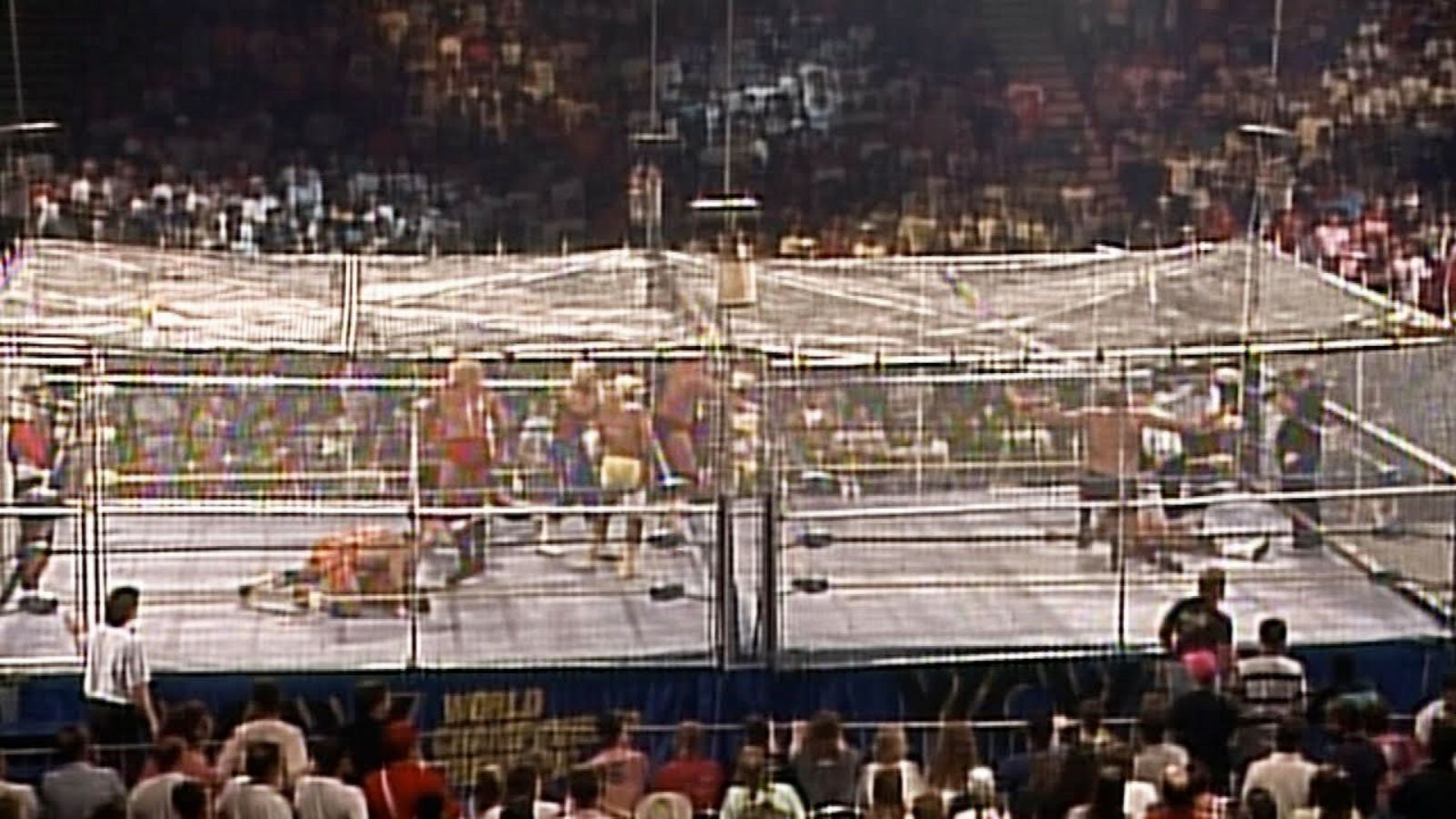
This is WAR GAMES! These words have echoed in recent years, coming from the lips of William Regal. But years before that, the double ring surrounded enclosed cage was a remarkable structure that fans had often appreciated and valued.
13 Lesser Known Facts About War Games

13. Dusty Rhodes’ Original Vision Was Inspired by “Mad Max Beyond Thunderdome”
The two-ring, cage-enclosed match was directly inspired by the dystopian aesthetic of Thunderdome. Dusty imagined a violent battleground where factions clashed in a survival-of-the-fittest format.
Dusty Rhodes, the creative mastermind behind Jim Crockett Promotions (which later became WCW), created the WarGames match—a legendary, brutal cage match featuring two rings under one enclosed steel structure—after watching Mad Max Beyond Thunderdome.
“Dusty said, ‘I had seen this cage [in Thunderdome], and I know the fans… the cage match has always been a big part…
So I said to myself, has there ever been one cage covering two rings with a top on it…and two teams of five?’
It was originally used as a specialty match for the Four Horsemen. The first WarGames match took place at The Omni in Atlanta during the NWA’s Great American Bash ’87 tour, where it was known as War Games: The Match Beyond.
In Mad Max Beyond Thunderdome, combatants enter a domed cage with weapons, battling until only one survives. Dusty took that visual and translated it into the wrestling world:
A steel structure enclosing two rings. Teams of wrestlers entering at intervals, creating suspense. It pushed the cage match concept into something theatrical and brutal.
He effectively leveraged cinema to enhance the drama and stakes of wrestling — a foundation for one of the most enduring and violent match types in the sport.
12. The First WarGames Debut Was a House Show
While many have come to know War Games as a featured match in events, it has even became an event of the same name. But before that could happen, it wasn’t initially something all fans had access to and could see.
The first-ever WarGames match happened at The Omni in Atlanta, Georgia. This was with Jim Crockett Promotions’ NWA’s Great American Bash ’87 tour, where it was known as War Games: The Match Beyond.
However, the show events that featured the WarGames match (behind the scenes but not televised) include: London, Chicago, UIC Pavilion, and Long Island’s Nassau Coliseum. These were all part of the same tour as the televised event, that took place in July 1987,
These were all part of Jim Crockett Promotions’ touring schedule—not yet televised. It was only after these tour dates that WarGames debuted on national pay-per-view: at The Great American Bash ’87 on July 4, 1987, in Atlanta.
That match included Dusty Rhodes, Nikita Koloff, Road Warriors, and the Four Horsemen—it was the same structure that had been tested at house shows days earlier.
In a 2002 interview, Dusty Rhodes said:
“Wargames was thought up on a car trip to a house show, and is his favorite gimmick match.” Inside Pulse
He described it as a “sportz entertainment” experiment—confirming WarGames was first tried at house shows during the Great American Bash tour before being elevated to TV.)
Dusty Rhodes didn’t just invent WarGames on a whim—it was tested tentatively at house shows during the Great American Bash ’87 tour before being brought to national television.
His own words confirm that WarGames started as a real experiment on the road—paid, tested, then perfected for the PPV stage.
11. The Match Concept Was Protected for Years
From 1987 to 1992, War Games wasn’t used predominantly, unlike in years prior, and was only used for top-end rivalries. It was never treated as a throwaway gimmick match.
WWE’s legal acquisition of the rights—the name and the structure—was a key moment. Here’s what PWInsider reported:
“World Wrestling Entertainment has … acquired the rights and trademarks for the WarGames match from Major League Wrestling.”
— PWInsider, February 2019 PWInsider
This shows the match wasn’t in the public domain. MLW had previously held the trademark based on their 2003 usage, making WarGames unavailable unless transferred. WWE’s purchase formalized sole usage rights.
Cody Rhodes, also highlighted the protected status in a 2019 interview:
“I really just want to buy it back… Dusty thought of the match concept on a napkin… Maybe I can get it back.”
— Cody Rhodes, Fightful Fightful
This echoes the notion that WarGames is a valuable, controlled concept—one that needs permission or purchase to use.
Despite its iconic status, WarGames was absent from many years of programming: WCW regularly used it from 1987 to 1998. WWE didn’t revive it until 2017—nearly two decades after acquiring WCW assets and MLW, and despite owning the trademark, which it had used in 2003 and again in 2018, outside of WWE’s control. PWInsider
Other major promotions could not legally replicate the match under the name “WarGames.”, but created similar matches but with different titles and tweaks:
These include Ring Of Honor running “Steel Cage Warfare, TNA introducing “Lethal Lockdown”, and AEW using “Blood & Guts.” Each adopts the two-ring, cage-locked style but avoids the protected name.
MLW’s registration—based on actual use—meant only they, and later WWE, had legal rights to the name. The match’s double-ring steel cage setup, staggered entrances, and submission victory stipulation are distinct enough to be considered proprietary to Dusty Rhodes and those who held production rights.

10. WCW Used War Games as a Creative Reset Button
From 1993 to 1998, WarGames was consistently the main event at WCW’s annual Fall Brawl pay-per-view—essentially marking the close of summer story arcs.
Each year’s match served a dual function: a dramatic conclusion to heated factional rivalries and a fresh starting point for fall narratives.
Fall Brawl ’1993-1997 all featured WarGames match types, with different rosters and inscriptions, signifying that WCW relied on that structure to regularly “clear the canvas” heading into the next phase.
For example, WarGames matched groups like the Four Horsemen vs. Dusty Rhodes’s team or nWo vs. Sting’s allies. These matches didn’t just resolve feuds—they redefined the power structure in a single event.
In 1999, as WCW’s creative direction shifted, Eric Bischoff publicly acknowledged that WarGames no longer served as a key “tent-pole” PPV. He explained:
“If you try to make every event… a tent-pole event… then none of them really are.”
And to me, War Games just wasn’t a tent-pole event.It wasn’t the one or one of the ones that I felt had enough of a personality and could be consistently created to help support and be a major pay-per-view event when it was in such close proximity to Halloween Havoc and to Starrcade. That’s the answer.”
WarGames wasn’t just a match type—it was a powerful narrative tool. It consistently brought dramatic closure to feuds and prepared WCW’s roster for new directions.
9. The 1993 Match Was a Box Office Flop
Despite featuring top stars like Sting and Vader, Fall Brawl 1993 drew just 6,000 paid fans—one of the lowest War Games gates.
According to historic data, Fall Brawl 1993 drew a pay-per-view buy rate of 0.46, ranking among the lowest for WCW at the time. This was significantly below more popular events like Halloween Havoc, which pulled a 0.50 in the same year.
The event took place at the Astro Arena in Houston, with only about 6,000 fans in attendance—a relatively low figure for a major PPV.
By comparison, previous marquee shows such as Starrcade and Halloween Havoc regularly pulled higher numbers both in buys and live attendance, underscoring how Fall Brawl ’93 underperformed.
The main event failed to deliver—and fans and critics alike have continued to point to it as a cautionary tale of how to mishandle a marquee match concept.)
8. 1998 War Games Had a Three-Team Format
Traditionally, WarGames was two teams inside a double-ring cage, with the “Match Beyond” decided by submission or surrender. In 1998, WCW switched to a three-team format, allowed pinfalls, and turned it into a match to earn a World title shot.
The Fall Brawl ‘98 event page lists the three squads: Team WCW (Diamond Dallas Page, Roddy Piper, The Warrior) vs. nWo Hollywood (Hollywood Hogan, Stevie Ray, Bret Hart) vs. nWo Wolfpac (Kevin Nash, Sting, Lex Luger) in a WarGames match.
Tony (Schivone) states there are new rules for WarGames. Bret Hart and Diamond Dallas Page are the first two men in, and the next combatants will come in as names are drawn. What could technically happen is that War Games could possibly end before all nine men are in the match-up.
For the first time ever in a WarGames match, pinfalls were allowed… Page earned a shot at the WCW World Heavyweight Championship at Halloween Havoc.
1998’s WarGames is also remembered for the Warrior smoke spot and the ring trap door that had been installed for his entrance sequences—an element that affected the show beyond the main event.
This was the only WCW WarGames to use three distinct sides (WCW vs. nWo Hollywood vs. nWo Wolfpac), which mirrored the company’s late-1998 faction landscape and attempted to freshen a legacy stipulation.

7. WWE Nearly Debuted War Games in 2002
On his Talk Is Jericho podcast, Chris Jericho shared that the Elimination Chamber match was originally intended to be a WarGames match. He explained:
“Elimination Chamber was originally going to be WarGames, but Vince didn’t want to do WarGames because he said it was too WCW, so then we created our own.”
— Chris Jericho, Talk Is Jericho
TJR Wrestling
WWE was transitioning from the Attitude Era to its brand extension and PG direction. Among many changes—including network presentation and locker-room shifts—WarGames was viewed as a relic of WCW that Vince McMahon felt didn’t fit WWE’s evolving identity.
A behind-the-scenes perspective from Bruce Prichard reinforces this:
“Vince didn’t like double rings… he didn’t care for the gimmick as it was created in WCW.”
– Something to Wrestle with Bruce Prichard
Instead of WarGames, WWE introduced the Elimination Chamber at Survivor Series 2002. This match featured six wrestlers entering at timed intervals from enclosed pods inside a steel structure.
Elimination Chamber officially launched at Survivor Series 2002 in Madison Square Garden, featuring Shawn Michaels, Triple H, Chris Jericho, Booker T, Kane, and Rob Van Dam. (en.wikipedia.org, [turn0search2])
The match structure—pods, a chain-fenced ring, and timed entrances—resembled WarGames in weight and presentation, but offered a distinct presentation aligned with WWE’s branding.
WWE’s creative team—led by Triple H and others—wanted to revive WarGames in 2002, but Vince McMahon vetoed it, citing its close ties to WCW. The Elimination Chamber was created as a brand-new alternative, debuting at Survivor Series 2002 and becoming an annual tentpole match.
A WWE WarGames match in 2002 remains one of wrestling’s most interesting “what-ifs.” The idea resurfaced in NXT years later, and fans still wish it could appear again on the main roster.
6. Triple H Revived It as an NXT Exclusive
After nearly two decades off WWE/WWF television, WarGames returned under Triple H’s NXT banner in 2017. WWE’s own announcement (published Sept. 29, 2017) confirms the rebrand of the Houston TakeOver special to NXT TakeOver: WarGames and notes that “WWE COO Triple H made the announcement on Twitter.” WWE
The 2017 match was the first WarGames held by WWE since acquiring WCW, and the first WarGames anywhere in roughly 20 years. But due to Vince McMahon not being a fan of the gimmick, Triple H decided to make this an NXT-only event.
“Anytime that you’ve had 20 years between something, you have the opportunity to do it in a slightly modified way… there were things that there were some concerns about and we wanted to change those and tweak them up.” – Triple via Wrestling Inc.
“There was some resistance to it in the past, but [after] solving some of the creative issues and the timing being right, it was agreed upon.” -Triple H via Wrestling Inc.
He also framed the return as something NXT would own stylistically:
“For our (NXT) fans, it’s a long time coming… it’s a way to take something historically meaningful for them and make it theirs. Take the past and make it the future, and put their own spin on it and rebrand it and make it their own.”
-(Interview excerpted from For The Win, reported via Cageside Seats.) Cageside Seats
From its 2017 return through 2021, every WWE-branded WarGames was staged on NXT specials:
In September 2022, Triple H—by then WWE’s chief content officer—announced that Survivor Series would feature two WarGames matches, ending the NXT-only era and moving the concept to the main roster:

5. The Women’s War Games Debuted in 2019
NXT’s first women’s War Games featured Team Ripley vs. Team Baszler. It was critically acclaimed and set a precedent for female-driven brutality.
A key factor was that, unlike in earlier eras (e.g., WCW/NWA), NXT had a deep, talented women’s roster by 2019. As noted in The Sportster:
“WCW never had a large enough female roster to organize a match of such level. Additionally, the hype for women’s division at that time was nowhere near what it is today.”
On the October 30, 2019, episode of NXT, an on-screen brawl erupted involving multiple women stars—Shayna Baszler, Rhea Ripley, Io Shirai, Bianca Belair, Candice LeRae, Dakota Kai, Tegan Nox, Marina Shafir, and Jessamyn Duke. This chaos led NXT GM William Regal to announce:
“I have a simple solution for this, — WARGAMES! ”
This dramatic in-ring moment provided a compelling, storyline-justified reason to introduce the Women’s WarGames match at the TakeOver event.
“This is what’s next… I have a whole lot of mixed feelings… to be the captain of my own team is just incredible.”
— Rhea Ripley
On November 23, 2019, at NXT TakeOver: WarGames in Chicago, the first-ever Women’s WarGames took place. Team Ripley (Rhea Ripley, Candice LeRae, Tegan Nox, Dakota Kai) defeated Team Baszler (Shayna Baszler, Io Shirai, Bianca Belair, Kay Lee Ray).
This marked the first time in WWE history that women participated in this iconic match type, and it happened only after conditions had matured—talent depth, storyline heat, and brand identity.
Once NXT had enough credible stars, and the storylines reflected meaningful conflict, the structural and creative alignment finally made Women’s WarGames viable.
The Women’s WarGames in 2019 was not just a novelty—it was a milestone powered by decades of growth in women’s wrestling and the strength of NXT’s roster and narratives. It only became possible when the right talent, story momentum, and brand support converged.

4. There Was a Japanese Version of War Games
All Japan Pro Wrestling promoted a match in 1994 mimicking the War Games format, featuring Tenryu and Kawada-led teams. It was brutal and chaotic.
In New Japan Pro Wrestling held a match under WarGames-style rules as part of their event The New Beginning in Osaka on February 11, 2024. This was the first time in Japanese wrestling that a true WarGames-style setup was used. A Reddit user remarked:
NJPW confirmed that the match would follow WarGames rules—teams entering alternately every two minutes, beginning with a singles start, until all ten participants (two five-man teams) were in the cage. A pinfall or submission then decided the outcome:
To be specific: NJPW introduced WarGames-style rules in Japan for the first time at that February 2024 event. Thus, NJPW’s 2024 match was the first time a Japanese promotion adopted this match structure.
There was indeed a Japanese version of the WarGames match concept, and it took place in NJPW in early 2024. It was the first instance of such rules being used in Japan, marking an important moment in puroresu (Japanese pro wrestling) history.
3. No Roof = Less Blood, More Spots
WWE’s War Games doesn’t feature a roof, unlike the original. This allows for high-flying offense but eliminates the claustrophobic “cage match” violence.
“[Taking the top off the cage] allows you to do so much more stuff… The times have changed, the business has evolved, and the cage that WarGames is held in needed to evolve, too.” – Triple H
By eliminating the roof, WWE creates space for high-flying and aerial maneuvers (“spots”) that were previously impossible due to height constraints. This isn’t about theatrics—it’s a deliberate creative shift prioritizing “more spots.”
This structural change signals less reliance on traditional bloody brutality and more on athletic wrestling moves, with quicker resolutions (pinfalls) and creative space for high-impact “spots.”
“We’re not going to have a roof. I think it’s a little bit limiting… this allows for there to be a little bit of a different opportunity there to do some things.”
– Wrestling Inc.
A number of reasons contribute to the idea of less blood during War Games without it having a roof. For instance, with a roof restricts Blood-Heavy Close Quarters.
Secondly, a traditional roofed WarGames restricted movement—pining opponents via blading or rooftop stunts created heavy bloodshed. Removing the roof changes the spatial dynamic, encouraging ring-based athletics over brutal close-up violence or weapon use.
Thirdly, it enables early finishes. With pinfalls allowed, matches shift away from extended brutal sagas to fast-paced, high-impact climaxes—focused more on athleticism than endurance carnage.
Finally, it aligns with PG Audience Standards. WWE’s Hell in a Cell remains roofed, but WarGames shifted to pinfalls and broadcast standards, reducing graphic violence (and thus blood) while enhancing visual action.
When fans say “No Roof = Less Blood, More Spots,” they’re pointing to a real evolution: structurally more open, less brutal, and more spectacular—that’s exactly what Triple H and fans expected and received.
2. The 1997 War Games Match Foreshadowed Bret Hart’s WCW Debut
While not yet officially debuting, Bret Hart was featured in the nWo Hollywood team, strongly implying his allegiance with the group and hinting toward his upcoming involvement with WCW. Wrestling Inc..
This appearance served as a sneak preview: fans saw Hart inside the cage as an nWo ally, foreshadowing his official debut and aligning his character with the villainous faction—even before the contract formalities were completed.
Bret Hart agreed to a deal with WCW around early November 1997, signing a multi-million-dollar contract that gave him creative control and a lighter schedule. His move was announced the day after Survivor Series 1997 (November 9).
Hart made his televised WCW debut on December 15, 1997, during a Nitro show where Eric Bischoff introduced him.
Shortly after, at Starrcade 1997, he served as the special guest referee for the Bischoff vs. Zbyszko match—and later intervened to shift the outcome of the main event between Hogan and Sting, echoing his real-life “Montreal screwjob” experience.
In the September WarGames match, Bret was already integrated into the nWo Hollywood structure, visually aligning him with WCW’s top heel faction ahead of his official arrival. This set expectations for fans that his debut would be impactful and antagonist-aligned.
Transitioning from the WWF’s “Canadian screwjob” controversy, Bret’s inclusion in the nWo team signaled a continued storyline of betrayal and controversy—now with an unmistakable factional alignment, making his next transition organic in the storytelling realm.
Featuring Bret in a marquee PPV match before his debut heightened audience intrigue—it wasn’t just speculation; it was confirmed visually before it happened. That WarGames portrayal primed viewers for “something big” from Hart over the coming months.
The WarGames appearance, especially in a cage match known for chaos and shifting allegiances, mirrored the broader themes of loyalty, betrayal, and surprise that characterized both Hart’s real-life move and storyline journey into WCW.
Sting’s spot in that match was rumored to go to Bret Hart, but his WWF contract dispute wasn’t finalized until Survivor Series.
📖 Source: Bret Hart autobiography “Hitman”

1. AEW Was Denied the War Games Trademark
By November 2019, WWE filed its own new trademark application for “WarGames” to solidify full control across media and broadcast services.
In a public media scrum following AEW Revolution (circa early 2020), Tony Khan stated that AEW would not use the term “WarGames”—specifically noting that WWE owns that trademark and they would not infringe upon it:
“I have not used that term and will never use that term,” referring to WarGames. Rajah
This statement reflects both legal awareness and respect for WWE’s trademark control.
Cody Rhodes applied to trademark “The Match Beyond” (part of the original War Games terminology), but WWE already owned the IP and blocked it.
In response to legal restrictions, AEW coined their own branded version of the concept, titled “Blood & Guts,” starting with the March 25, 2020 episode of Dynamite. AEW even filed for trademark protection for “Blood & Guts.”