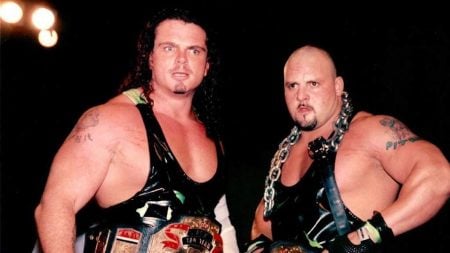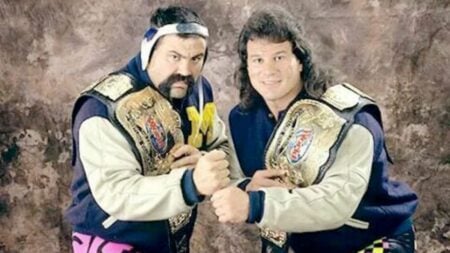


On November 6th, 1994, the groundbreaking ‘When Worlds Collide’ PPV took place at the Los Angeles Sports Arena. Whilst on the surface this was a AAA show (the only one to ever take place in the United States), it was a co-production between that group, as well as WCW (World Championship Wrestling) and Puerto Rico’s IWC.
The most famous match on the card saw El Hijo Del Santo and Octagon defeat Los Gringos Loco (Eddie Guerrero and ‘The Love Machine’ Art Barr) in a 2/3 falls match. Here are all the things to note about this monumental event.
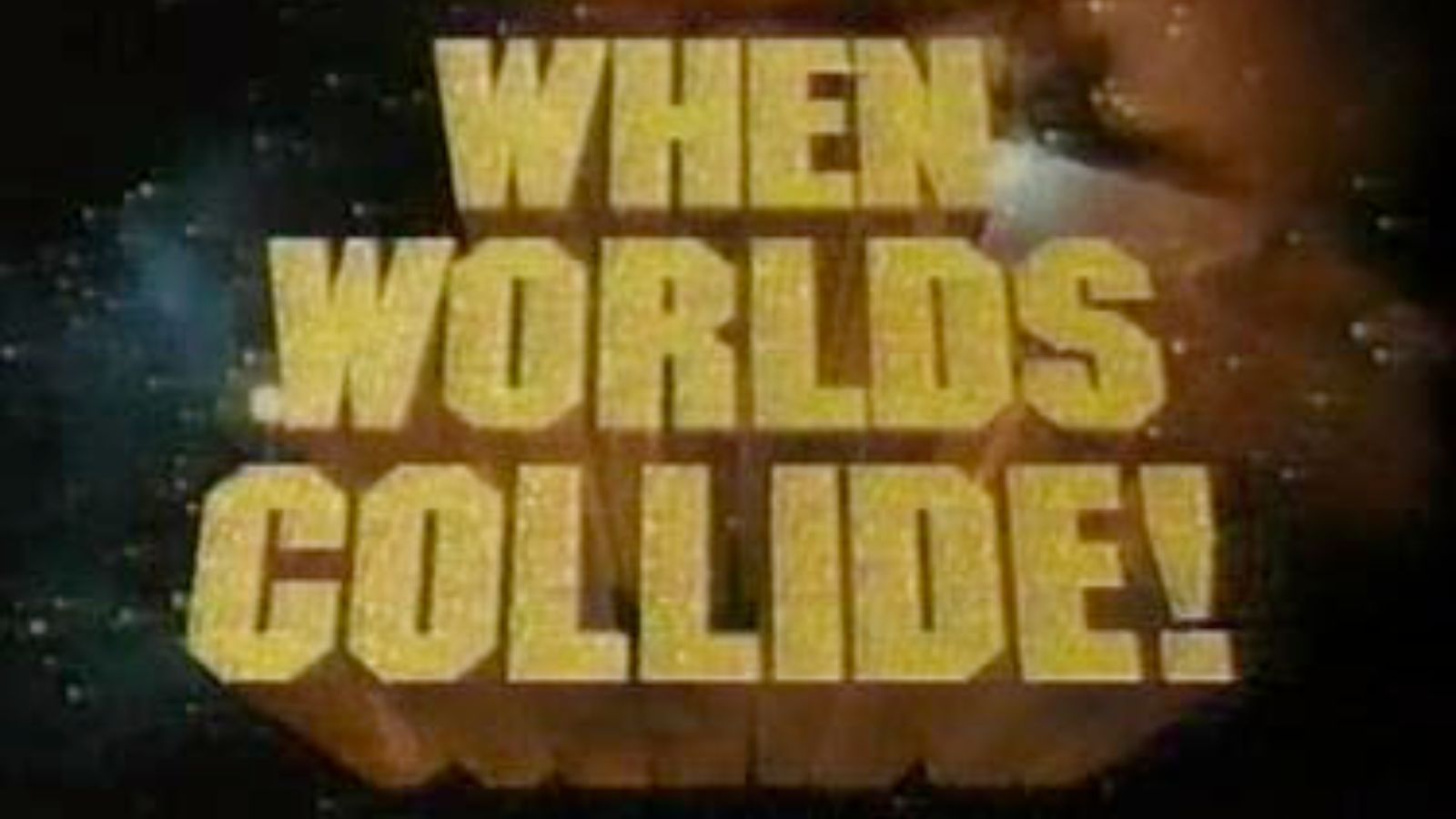
When Worlds Collide – The basics: crowd, gate, and buys
The show played to a packed Sports Arena, with reported attendance figures of around 13,000–13,500 (the venue was sold out).
Sources that tracked the night also estimate the live gate at roughly $200,000 and the PPV buyrate in the neighborhood of 0.24–0.3 — small by mainstream standards but huge for a foreign promotion with minimal U.S. promotion. Those numbers helped convince American bookers that lucha talent had an audience.
The card highlights and key matches
The broadcast was shorter than a typical AAA major show (WCW producers cut the runtime), so AAA trimmed entrances and converted several traditional two-out-of-three falls matches into single-fall contests for the American PPV. What stayed on the card, though, delivered.
Mascarita Sagrada & Octagoncito vs. Espectrito & Jerrito Estrada (Mini-Estrellas opener) — A fast, crowd-pleasing start that set the tone for high-tempo action.
Six-man tag: Fuerza Guerrera / Madonna’s Boyfriend / Psicosis vs. Rey Mysterio Jr. / Heavy Metal / Latin Lover — An early showcase of the young Rey Mysterio and the high-risk style that would later sell U.S. TV.
Octagón & El Hijo del Santo vs. Art Barr & Eddie Guerrero — Lucha de Apuestas (Mask vs. Hair) — The semi-main event and the night’s emotional centerpiece.
The match employed classic lucha rules and multiple falls; Barr’s knees to the head and an illegal piledriver added real heat, culminating in Guerrero and Barr having their heads shaved after losing. That fall-for-fall drama is the reason this match still shows up on “best of” lists.
Konnan vs. Perro Aguayo — Steel cage (main event) — A brutal, brawling climax. The match was a victory-by-escaping-the-cage, featured heavy outside interference, and produced dramatic spots, including Aguayo’s high-risk top-rope double stomp and both men bleeding heavily. The match closed the show and capped the storyline that had built between those two stars.

The match that made the night: Octagón & El Hijo del Santo vs. Art Barr & Eddie Guerrero
If you read only one match report from When Worlds Collide, make it this one. It hits all the classic lucha beats — fast sequences, reversals, outside interference, a piledriver that was treated as a severe transgression, and the visual payoff of two men being shaved in public.
The psychology and stakes were real. In lucha culture, masks and hair carry enormous meaning; losing them is an emotional career moment.
Barr and Guerrero played the heel role with brazen intensity (Barr’s “swimming” taunt is still talked about), while Octagón and Hijo del Santo played the proud, veteran technicians who refused to be humiliated. The match combined precise in-ring action with an emotional payoff that landed on TV.
The star reaction and legacy of the bout earned a five-star rating from the Wrestling Observer and has been used as a recruitment reel ever since.
Paul Heyman, WCW scouts, and others watched the show and signed multiple performers. Eddie Guerrero later reflected in interviews and in his autobiography about how matches like this opened doors for him in the U.S. market.
Memorable moments and micro-stories
The piledriver move was treated as taboo in lucha — when Art Barr hit it, Octagón was carried from the ring on a stretcher. The image amplified the heel heat and made Guerrero/Barr’s eventual loss feel like poetic justice.
Art Barr and Eddie Guerrero used a showboat ‘swimming’ taunt aimed at Mexican audiences and the U.S. crowd; footage of it is still discussed and sometimes excised from modern packages, but it was central to the heel identity Los Gringos Locos cultivated.
The main event’s rough brawling between Konnan and Perro Aguayo and multiple run-ins gave the crowd a visceral finish, even if some critics rated the in-ring technical level lower than the tag match. The crowd heat and physicality made it a memorable capstone.
The aftermath: death, departures, and long-term impact
Seventeen days after the show, Art Barr died at age 28. His death ended the Los Gringos Locos storyline and led AAA to retire the AAA World Tag Team Championship rather than find new champions.
Barr’s passing, combined with the Mexican peso crisis that followed, accelerated the migration of lucha talent to U.S. and Japanese promotions (most notably Eddie Guerrero moving toward ECW and then WCW/WWE). The event’s ripple effects were immediate and long-lasting.
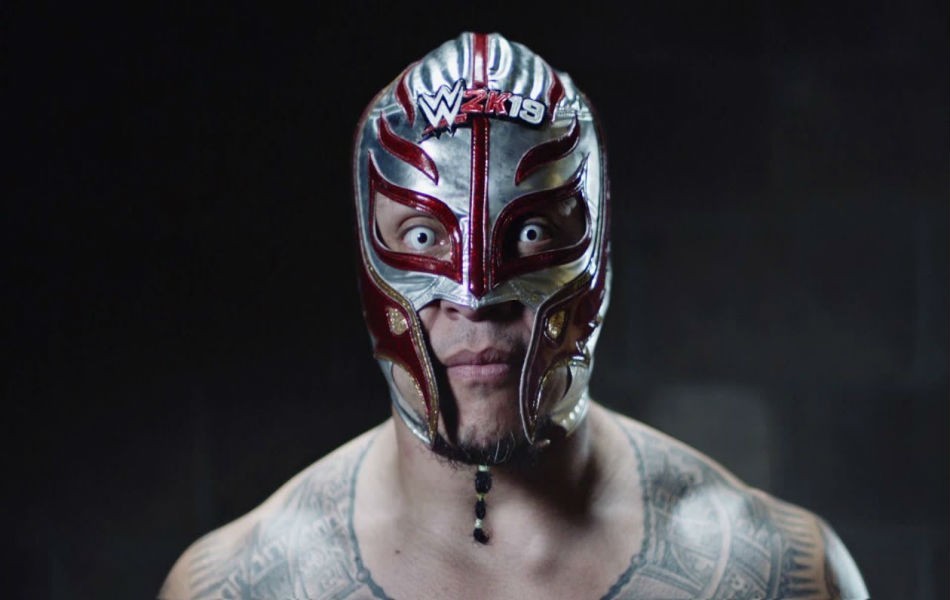
Promoters and talent who watched When Worlds Collide saw that AAA’s wrestlers could be presented on a U.S. PPV and make an impact: Rey Mysterio Jr., Psicosis, Juventud Guerrera, and Konnan all parlayed exposure into American bookings.
In short, the event is often credited with opening doors — both in terms of scouting and of changing promoter assumptions about what the U.S. audience would accept and enjoy.
WWE has featured clips in retrospectives, calling the PPV “the best PPV you’ve never seen,” and modern reviewers repeatedly recommend the event to fans who want to see the core of 1990s Mexican wrestling. The show is widely available on classic tape compilations and online clips.
There are a few common reasons why ” When Worlds Collide is still talked about.
It put AAA stars in front of U.S. pay-per-view viewers. Many American fans saw Rey Mysterio Jr., Eddie Guerrero, Konnan, Psicosis, and Juventud Guerrera for the first time there. The performance quality persuaded ECW, WCW, and WWF to pick up lucha talent.
It produced at least one instant classic. The tag Lucha de Apuestas (Mask vs. Hair) between Octagón & El Hijo del Santo, and La Pareja del Terror (Art Barr & Eddie Guerrero), which is consistently rated as one of the best matches of the year, and received five stars from Wrestling Observer Newsletter readers. The match’s storytelling and heat forced even skeptical American viewers to pay attention.
The show’s aftershocks changed careers and storylines. Art Barr died only 17 days later, ending Los Gringos Locos as AAA had been building it. Eddie Guerrero would move toward the U.S. independent scene and eventually WCW/WWF, and Konnan’s rise followed quickly. The event’s fallout reshaped the mid-1990s lucha landscape.

When Worlds Collide was never the highest-grossing event in wrestling history. It didn’t have a large mainstream advertising push in the U.S., and the PPV numbers were modest.
What it did have — in spades — was authenticity, cultural stakes, and a handful of world-class matches that changed how promoters and fans outside Mexico regarded lucha libre.
For several top Mexican stars, the Los Angeles show was the stepping stone to careers in ECW, WCW, and WWE; for the form itself, it helped prove that lucha’s fast-paced style could be integrated into mainstream American wrestling storytelling