



The headlock is one of professional wrestling’s most fundamental and recognizable holds. It is one of the earliest moves taught to trainees, and it has been a staple of wrestling matches since the late 19th century.
Despite its simplicity, the headlock has a long and documented history in both amateur and professional wrestling.
Over time, it has evolved from a feared finisher into a transitional move, yet it remains essential to in-ring psychology and technical proficiency.
This article examines the documented origins of the headlock, its early pioneers, its evolution and variations, the technique behind it, its initial role as a submission or pinning maneuver, the reasons it fell out of use as a finisher, and how it survives today. Included are a timeline of key moments in its history and a list of signature users by decade.
Documented Origins of the Headlock
The headlock has its origins in catch-as-catch-can wrestling, which developed in England’s Lancashire region in the mid-to-late 19th century.
Manuals and teaching guides from the 1870s–1890s describe the headlock as a controlling hold designed to crank the neck and apply pressure to the head to immobilize an opponent.
One of the earliest documented uses of the headlock in an organized competition occurred in an exhibition match featuring American wrestler Frank Gotch in 1905.
Gotch used the headlock in exhibitions prior to his famous match with George Hackenschmidt. The Chicago Tribune noted in a February 1905 article that Gotch “applied a twisting headlock” on his opponent during a demonstration bout.
Gotch incorporated the headlock as part of his arsenal, but it was Ed “Strangler” Lewis in the 1910s who popularized it as a feared finisher.

Early Pioneers
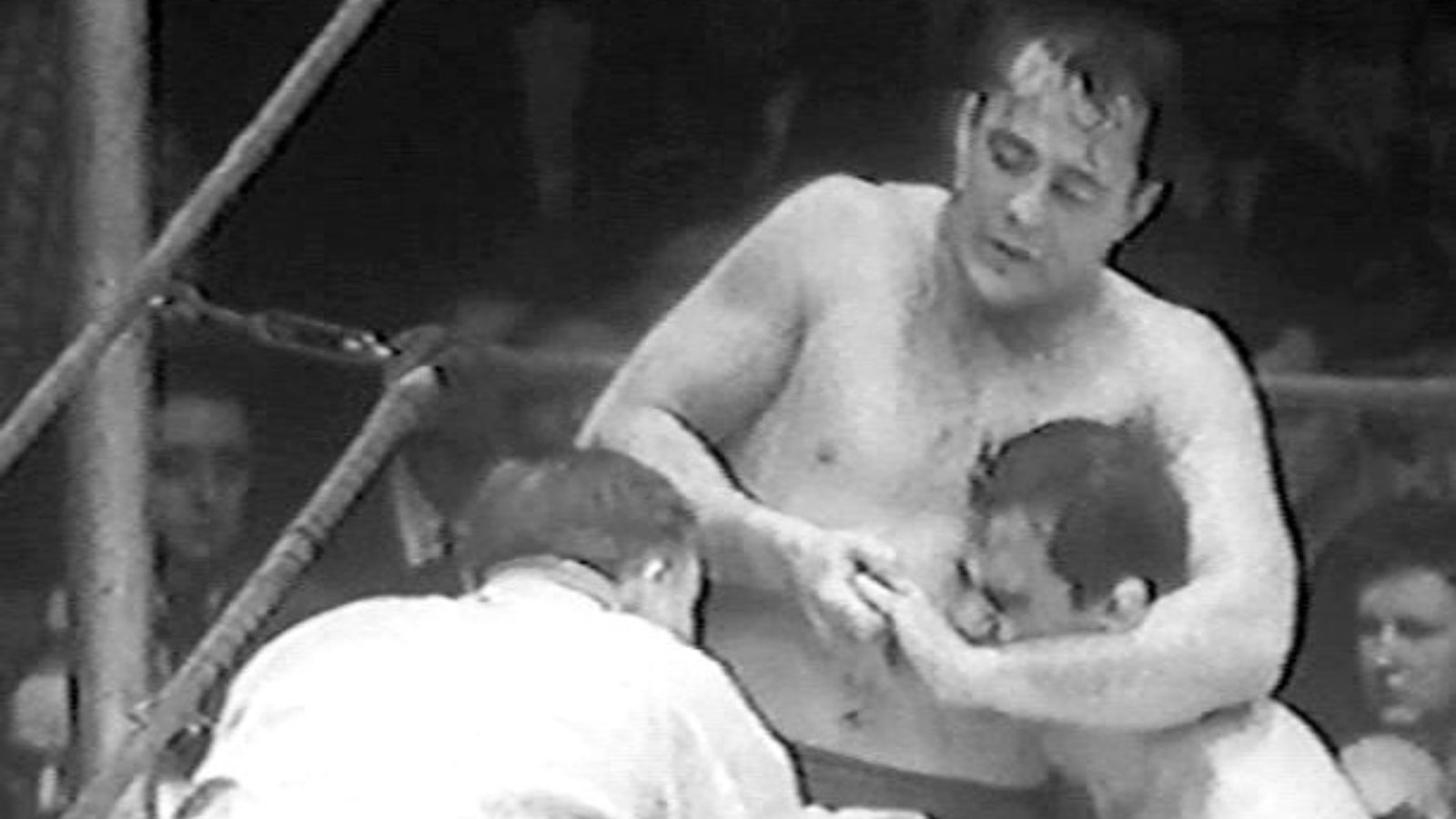
Ed “Strangler” Lewis was the most prominent early practitioner of the headlock. Between 1914 and 1935, Lewis reportedly won over 350 matches using his devastating headlock.
His version was applied with tremendous torque, grinding the opponent’s temple and neck until they either submitted or were pinned.
Lewis is quoted in Mike Chapman’s Wrestling Tough (2001):
“A headlock done right is enough to make a grown man quit. You don’t just hold his head, you crush it.”
His headlock was so effective that promoters began discouraging its use as a regular finish in the 1930s because crowds grew tired of predictable endings.
Lou Thesz, who trained under Lewis, explained in a 1993 interview:
“Ed could end a match in two minutes if he wanted. His headlock was that real. He taught me to turn a simple move into a dangerous weapon.”
Lewis’s success inspired other stars of the 1920s and 1930s — including Jim Londos and Ray Steele — to adopt the headlock as a primary hold.
The Evolution of The Headlock and Its Spawned Variations
The headlock has undergone many evolutions and spawned several variations. Originally, it was primarily a submission or controlling maneuver.

- Side Headlock: The classic version, applied from the side while standing or kneeling.
- Side Headlock Takedown: Adds a hip throw while maintaining the hold, often leading to a pin.
- Front Headlock: Applied from the front, often leading into a guillotine choke in modern contexts.
- Headlock Driver: Innovated by Mike Quackenbush, transitioning into a sit-out driver or DDT.
- Headlock Choke: Applied like a kataha-jime from judo; rare in pro wrestling but common in MMA.
In the 1940s and 1950s, wrestlers like Verne Gagne and Danny Hodge began using the side headlock takedown extensively.
This added visual dynamism and allowed the wrestler to control their opponent on the mat while the referee counted near-falls.
By the 1960s, wrestlers incorporated extended headlock sequences to tell in-ring stories, slow down the pace, and draw crowd reactions.
The Art of Execution
A proper headlock requires precise technique. Wrestlers trained under Lou Thesz, Karl Gotch, and Billy Robinson learned to apply the hold tightly enough to control the opponent without causing legitimate injury.
The key elements of execution include:
- Positioning the forearm against the opponent’s temple or jawline.
- Keeping the hips low and feet planted to prevent counters.
- Adjusting pressure by flexing the bicep and leaning into the hold.
Danny Hodge was renowned for his grip strength and once demonstrated his headlock on a television host, who submitted in seconds. William Regal has said:
“A good headlock lets the audience see how much control you really have. You can tell a lot about a wrestler by how they apply it.”
Can it be used as a Submission or Pinfall?
In the early 20th century, the headlock was often used to force a submission. If an opponent refused to submit, the hold could be used to roll them onto their back for a pin. Matches often ended with one wrestler immobilized and pinned while trapped in a headlock.
In Lewis’s day, it was a feared submission hold. Lou Thesz recalled:
“People knew when Strangler Lewis locked it in, the match was over.”
As wrestling became more entertainment-focused and audiences became desensitized to simple holds, promoters moved away from using it as a finish.
By the 1970s and 1980s, audiences expected more visually impressive finishes. As moves like the figure-four leglock, piledriver, and superplex grew in popularity, the headlock was relegated to a transitional or rest hold.
Bill Watts explained in 1982:
“When something looks too simple, it stops selling as a finish. Fans think they can do it themselves.”
By the late 1980s, only about 5% of matches ended with a headlock. Today it’s rarely used to finish matches, though some wrestlers — like Kevin Owens — have occasionally won matches with it as a callback to tradition.
The Modern Role of the Headlock
Today, the headlock remains a critical part of match structure. Wrestlers like Bryan Danielson, Kevin Owens, and Dax Harwood use it to control the pace and tell stories in their matches. In Japan, Zack Sabre Jr. still uses headlocks as legitimate submission threats in mat sequences.
Owens has even once joked on social media:
“Plan for tonight: win with a headlock. Old school forever.”
Below is a timeline of the Headlocks used by notable talent decade by decade in Wrestling History
Signature Headlock Users by Decade
1900s–1910s – Frank Gotch, Joe Stecher, Stanislaus Zbyszko
1920s–1930s – Ed “Strangler” Lewis, Jim Londos, Ray Steele
1940s–1950s- Verne Gagne, Danny Hodge, Lou Thesz
1960s -Jack Brisco,
1970s-Harley Race, Dory Funk Jr., Billy Robinson
1980s-Ric Flair, Nick Bockwinkel, Ricky Steamboat
1990s-William Regal, Dean Malenko
2000s–2010s-Bryan Danielson, Kevin Owens, Zack Sabre Jr.
2020s- Josh Alexander, Claudio Castagnoli
Statistical Snapshot: Headlock as a Finisher
Between 1910 and 1930, it was reported that approximately 40% or fewer of matches ended with a headlock. From the 40s to 50s, approximately 25% ended with a headlock, the following decade of the 60s to 70s, approximately 10% ended this way, from the 1980s to 1990s, 5% matches ended this way, and from the turn of the century, now approximately less than 1% of matches will end with a headlock.

Lou Thesz once summarized its value:
“Every good wrestler knows where to start — and that’s with a good headlock.”
References
- Chapman, Mike. Wrestling Tough. Human Kinetics, 2001.
- Thesz, Lou. Hooker: An Authentic Wrestler’s Adventures Inside the Bizarre World of Professional Wrestling. Crowbar Press, 1995.
- WrestlingData.com archives: www.wrestlingdata.com
- Various interviews: Wrestling Perspective (1993), Sports Illustrated archives