


The clothesline is one of the most recognizable, impactful, and enduring moves in the history of professional wrestling. Its simplicity—extending an arm and striking an opponent across the upper chest or neck—belies its importance as a storytelling and physical tool in matches.
From its unassuming origins to its modern high-impact variations like the lariat and discus clothesline, the clothesline has remained a core part of the wrestling move set for over a century.
This article traces the history of the clothesline, from its earliest documented use to its role in finishes and transitions, and the wrestlers who made it a signature weapon in their arsenal. Included are a timeline and a decade-by-decade list of signature users.
Origins of the Clothesline
The move we now call the clothesline is believed to have evolved from the short-arm strike or running shoulder block used in early 20th-century grappling.
However, the first documented description of a move resembling the modern clothesline comes from a 1932 edition of The New York Daily Mirror, which described wrestler Jim Browning flattening an opponent with a
“charging arm strike across the neck that dropped his man like a board.”
Browning, a catch wrestler and early world heavyweight champion, used stiff strikes to create dramatic impact in the pre-television era. His version wasn’t named “clothesline” at the time, but the motion was consistent with the move we now recognize.
The term “clothesline” reportedly began to be used in the late 1950s, likely popularized by announcers trying to describe the motion’s resemblance to a person running into a clothesline strung across the yard. The terminology stuck, and by the 1960s, the clothesline was a fixture in North American pro wrestling.
Early Usage and Development
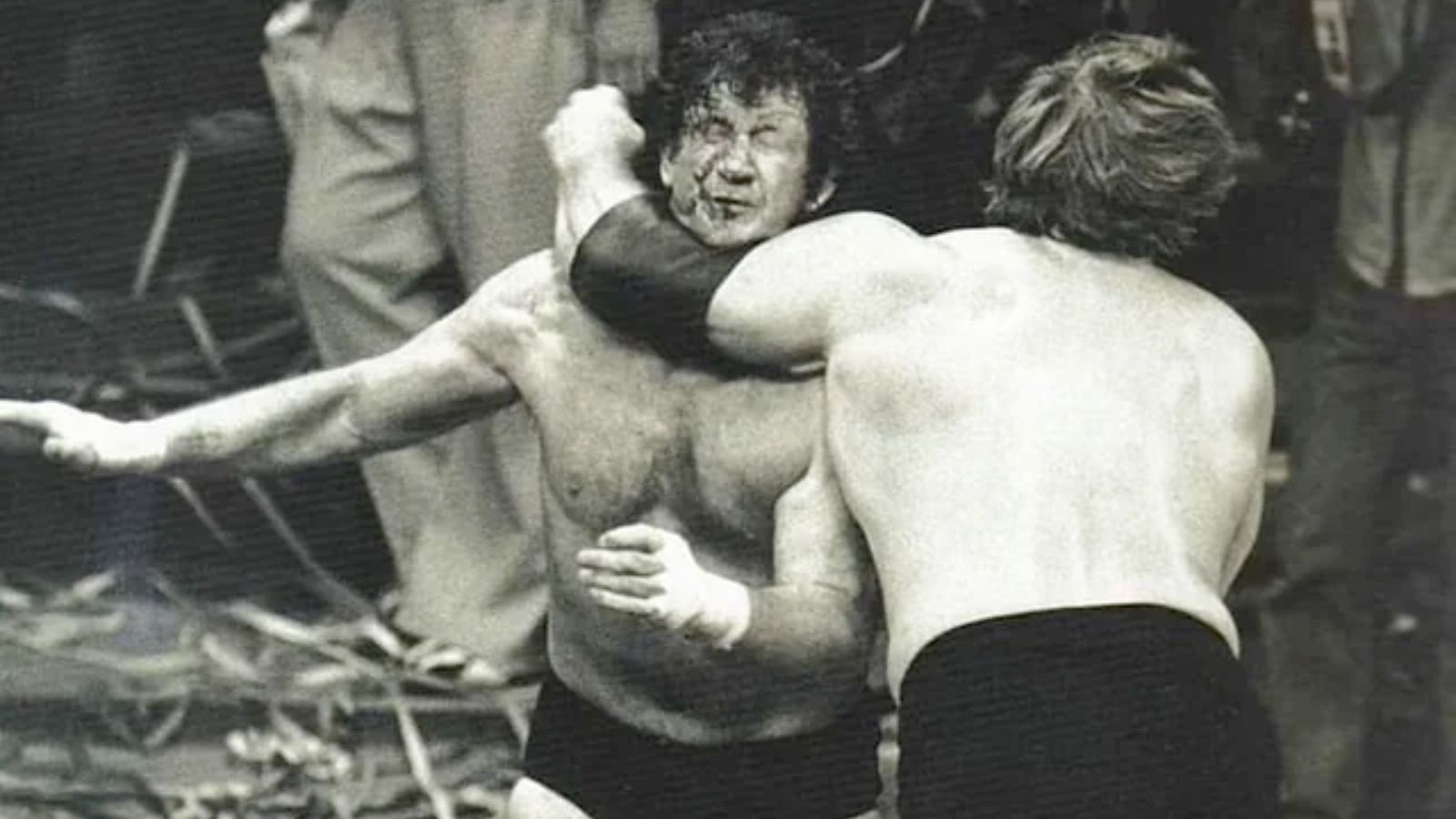
In the 1960s and 1970s, the clothesline was typically a mid-match move, used to knock down opponents and transition to a rest hold or pin attempt.
Wrestlers such as Bobo Brazil and Dick the Bruiser utilized running arm strikes as part of their offense, but the move wasn’t yet commonly used as a match-ending tactic.
This changed with the rise of Stan “The Lariat” Hansen in the 1970s. Hansen brought a new level of force to the clothesline.
His version, the Western Lariat, often ended matches outright. Hansen developed the move in Japan, where the style emphasized realism and physicality. In a 1996 interview, Hansen said:
“I wasn’t the best technical guy, but I could hit hard. I started using that lariat because it looked like a train hit you—and sometimes it felt like one.”
Hansen’s lariat knocked out opponents in All Japan Pro Wrestling and earned him a fearsome reputation. It also helped evolve the move from a simple strike to a legitimate finisher.
The Clothesline Becomes a Finisher
Throughout the 1980s, the clothesline became a regular finishing move. Hansen’s success influenced others to adopt more impactful versions of the hold.
There were a number of wrestlers who used it as a finisher in the 1980s or a precursor to a finisher in the 1980s. For instance, Hulk Hogan would use a running clothesline before his leg drop. Kerry Von Erich would use a discus variation as a finisher in World Class Championship Wrestling.
The Junkyard Dog known for his stiff standing clotheslines. Bruiser Brody had a wild, charging clothesline to match his chaotic style.

And as far as tag teams would go, The Road Warriors (Hawk & Animal) would use the Doomsday Device, a flying clothesline off the top rope, as a finisher.
The Road Warriors’ version elevated the move’s visual impact. With Animal hoisting opponents on his shoulders and Hawk delivering a flying clothesline, it became one of the most feared and protected finishers of the era.
Variations of the Clothesline
Over time, wrestlers developed variations to make the clothesline more dynamic, unique, or suited to their style. These variations included: a standard Clothesline, which was delivered while running or standing.
Next, there is a short-arm Clothesline opponent’s wrist is held and yanked into the strike. This was a strike popularized by Jake ‘The Snake” Roberts in the 1980s.
Thirdly, there was the Disqus Clothesline. This is where a wrestler spins 360 degrees before impact (used by Kerry Von Erich, Stan Stasiak).
The Flying Clothesline was next, and it involved leaping into the move. This is followed by a corner clothesline, which was delivered while the opponent is trapped in the turnbuckle.
The rebound Clothesline is when a wrestler bounces off the ropes before delivery. Dean Ambrose/Jon Moxley popularized that throughout the mid-2010s and beyond.
The “Lariat“ tends to be a stiffer and more direct version, popularized by Stan Hansen and later used by the likes of John “Bradshaw” Layfield.
As mentioned before, the Doomsday Device is a top-rope tandem variant popularized by The Road Warriors.
Finally, titled the “Clothesline from Hell”, JBL’s finisher was a full-speed running lariat with a long windup. This was unlike the direct version of the Lariat he would use.
Execution and Psychology
A good clothesline requires timing, physical commitment, and body control. The strike targets the upper chest or neck.
To avoid legitimate injury, the attacker’s arm must remain flexible while the receiver bumps flat or rolls through the momentum.
According to William Regal, execution is key to credibility:
“If you don’t lay it in, it looks fake. But if you overdo it, someone’s going to get hurt. The clothesline lives in that balance.”

In Japan’s All Japan and New Japan promotions, the move is taken more seriously, often used as a match-ending strike.
Wrestlers like Kenta Kobashi and Kazuchika Okada have treated lariats as turning points or match finishers even in recent decades.
Submission or Pinning Use?
The clothesline was rarely used to force submissions, as it is primarily a striking maneuver. However, in the 1980s and early 1990s, it was often used as a match-ending pinfall setup, particularly in Japan and territories such as Texas or Georgia, where brawling styles were prominent.
Stan Hansen’s lariat and JBL’s Clothesline from Hell were among the most protected match finishers in their primes. In Japan, Kobashi’s rolling lariat often followed sequences of other power moves, but ended matches outright.

Why It Stopped Being a Common Finisher
By the mid-2000s, the move was increasingly used as a transition or signature move, no longer protected as a finisher. Several factors contributed:
Firstly, it became overused as more wrestlers began using clotheslines during matches, the move became expected and less impactful.
Next, with the evolution of wrestling toward high-impact finishers (e.g., F-5, RKO, One-Winged Angel), the clothesline no longer felt “final” to modern audiences, and they typically expected something “more” than the standard strike.
Finally, as faster, more athletic styles emerged, basic striking moves took a back seat to flashier maneuvers, and there was a tendency for wrestlers to become increasingly athletic over time.
However, when executed well and by credible wrestlers, the clothesline still garners reactions. Hangman Adam Page’s Buckshot Lariat is a modern variation that has finished matches and retained credibility.
As the timeline of the clothesline’s use in wrestling history has changed so have the names and faces that executed it.
From the simple ‘arm strike across the neck’ in a match to the name being given to the move in the middle of the 20th century, the clothesline has changed.
From it being a ferocious strike as ‘a lariat’ to wrestlers working in tandem to obliterate their opposition, to the use of athleticism today by the likes of Hangman Page and Logan Paul using the buckshot lariat, the clothesline doesn’t appear to be going anywhere anytime soon as one of wrestling’s most used strikes, regardless of the generation.