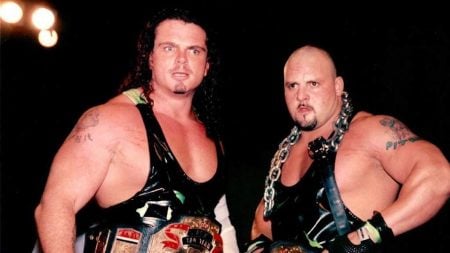

As first cousins from Wigan, England, Tommy Billington and David Smith formed one of the most talked about tag teams in wrestling, the British Bulldogs.
Related through Billington’s father and Smith’s mother, the duo would originally cut their teeth in their home country of Britain in the 1970s. But it wouldn’t be until an invite from a legendary family in Calgary, Alberta, Canada, late in the decade.
Bruce Hart would invite both men to his father, Stu Hart’s Stampede Wrestling promotion. It would initially be Billington that would come to Calgary first and then was followed by Smith.
But their union wouldn’t come about immediately. In fact, it would be that despite being related that a feud would emerge between the two in Stampede Wrestling.
Their feud actually would span over two continents. Smith and Billington would continue their rivalry in Japan as well.
While in NJPW, their feud would include the likes of George Takano, who competed as The Cobra at the time, and involved the NWA World Junior Heavyweight Championship. Eventually, cooler heads would prevail and their feud came to an end.
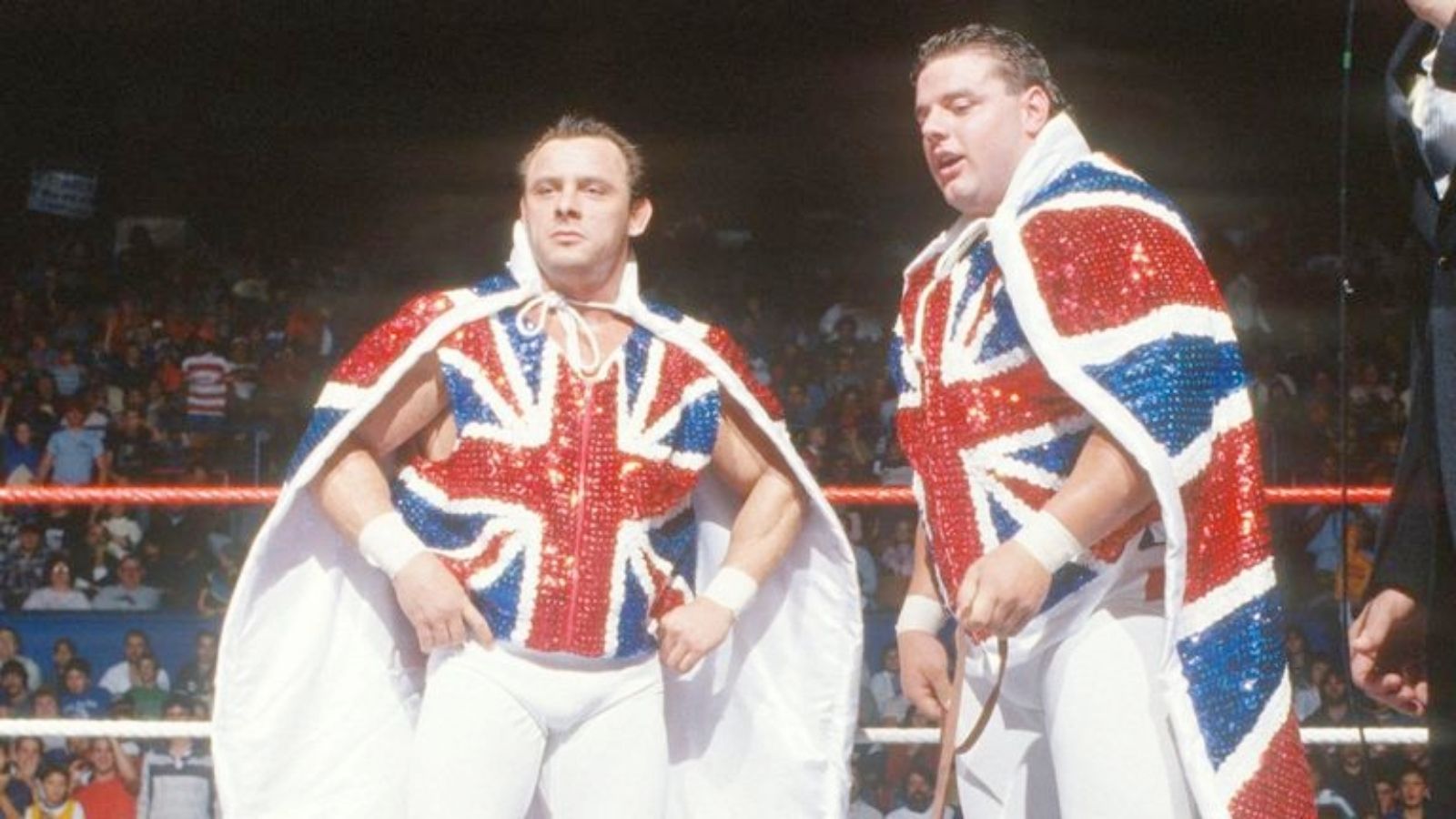
The British Bulldogs – Bound by Family, Divided By Difference
The two would form the British Bulldogs tag team in 1983 and competed as a team in both Stampede Wrestling and New Japan Pro Wrestling.
Success quickly came their way as well as they would capture the Stampede Tag Team Championships the following year.
But when they would no longer compete for NJPW but rather for AJPW, that would end their time in the rival company moving forward.
In 1984, however, the British Bulldogs would move from competing in Stampede Wrestling and All Japan Pro Wrestling to the World Wrestling Federation.
As Vince McMahon Jr had purchased Stu Hart’s Stampede Wrestling, David Smith and Tommy Billington would join McMahon’s company as part of his global expansion.
They, along with Smith’s brother-in-laws, Jim Neidhart and Bret Hart the four were all a part of the company’s new young tag team division.
Familiarity breeds trust and who else can you trust in the ring but your family? The first feud for both the Hart Foundation and the British Bulldogs were against one another.
The two teams created magic each time they stepped into the ring together. Technical prowess along with a high-flying ferocity would all prove too well what their feud would be like.
When the feud of Davey Boy Smith and The Dynamite Kid’s against the Hart Foundation had come to an end it would be the Dream Team to whom the British Bulldog’s would have their sights on next.

But this wouldn’t be just any feud as it would be a feud against the WWF World Tag Team Champions, Brutus Beefcake and Greg ‘The Hammer’ Valentine to whom they would face off against next.
The two teams would wage a war with one another that would culminate with a match against one another at WrestleMania 2.
With Ozzy Osbourne and ‘Captain’ Lou Albano in tow, The British Bulldogs would defeat The Dream Team to capture the WWF World Tag Team Championships in what was billed as being their final championship opportunity.
But by the end of 1986, The Dynamite Kid had suffered a serious back injury while competing in Hamilton, Ontario Canada. The following month, into 1987 the Bulldogs would lose their titles against the Hart Foundation.
It was a rather tragic sight as Billington was in such pain that he needed to be carried from the ring. There was so little physicality from Billington in the match.
With the Bulldogs no longer the champion, Billington was given time to recover. Upon his return the duo would resume their rivalry with the long-time rivalry with the champions the Hart Foundation.
At WrestleMania III, the Hart Foundation along with their partner ‘Dangerous’ Danny Davis would feud with The British Bulldogs and Tito Santana in a six-man tag team match.
Despite not winning the match, Santana and The Bulldogs would continue to earn the adulation of the fans in attendance.
One of the easiest means to market the duo was have them accompanied to the ring by an animal. With the two being ‘Bulldogs’ it would only make sense to have a ‘bulldog’ accompany them. Matilda would be the pet bulldog that would accompany Smith and Billington to the ring.
Matilda would be a key element in the British Bulldog’s feud with Bobby ‘The Brain’ Heenan and his Islanders. Heenan and The Islanders.
Tama and Haku would ‘dognap’ Matilda and mock her absence by coming to the ring with a dog leash but no dog attached to it. Smith and The Dynamite Kid would rescue Matilda but what would result would be another six man tag team match at the following year’s WrestleMania.
At WrestleMania IV, the British Bulldogs along with Koko B. Ware would face The Islanders and Bobby Heenan. Ware’s pet parrot, ‘Frankie’ would accompany the Birdman and his partners to the ring in their six-man match up.
Once again the Bulldogs would lose at WrestleMania as it would be Heenan that would earn the deciding pinfall for his team.
Shortly thereafter, tensions both in and out of the ring began to emerge more strongly. Their departure from the WWF later in 1988 came amid backstage issues, particularly a notorious run-in with Jacques Rougeau.
Accounts differ, but it is often recounted that the Bulldogs had pranked the Rougeau Brothers, leading Jacques to sucker-punch Dynamite Kid (with quarters in his fist) and knock out several of his teeth.
In the WWF, their last major pay-per-view was Survivor Series 1988. After that, they left, returning to their roots in Stampede Wrestling (Calgary) and resuming tours in All Japan.
While in WWF, the team had enjoyed a balanced blend: Dynamite brought speed, technical finesse, and aerial innovation; Davey brought power, size, and charisma.
But that balance was already under pressure by late 1988 as injuries, ego, and differing ambitions began to diverge their paths.
Stampede Wrestling Return and tag feuds
On their return to Stampede, hopes were high that the Bulldogs might revitalize the struggling promotion. But the return run was not as smooth or as magical as earlier years.
Past injuries—especially Dynamite’s chronic back trouble—and changes in their physiques (exacerbated by long-term steroid use) limited some of their earlier flair.
In Stampede, they renewed feuds with teams such as The Cuban Commandos and Karachi Vice. On December 12, 1988, the Bulldogs won the Stampede International Tag Team Championship for a second time.
However, their hold on that title was not to last: they dropped it to Karachi Vice on December 30, 1988. In early 1989, tensions began to bubble more overtly. Dynamite Kid entered into a bitter feud with Johnny Smith (not Davey), after Johnny interfered and attacked Billington, and even cut his hair as provocation.
Split in Stampede, but pressure in All Japan
By May 1989, the decision was made inside Stampede to split the Bulldogs — at least for certain feuds. However, Giant Baba (promoter of All Japan) still pushed them as a tag team in Japan, complicating matters.

In Stampede, the split was played out in storyline form: Dynamite formed The British Bruisers (with Johnny Smith) and feuded with Davey, who himself teamed with a young Chris Benoit.
Meanwhile, in All Japan, they continued some joint bookings for a time. But by September 1990, Davey Boy Smith abruptly withdrew the Bulldogs from the annual World’s Strongest Tag Determination League by returning to the WWF. He justified it by telling the AJPW office that Dynamite had suffered a serious car accident and could not compete.
Because Davey had trademarked “The British Bulldog” during their previous WWF run, he then used that to relaunch himself as a singles act in the WWF, and even had people in the UK pressure promoters not to bill Dynamite Kid as “British Bulldog.”
The sense of betrayal from Billington was deep and long-lasting. In Billington’s later comments, he affirmed that
“there will never be a reconciliation.”
The British Bruisers and final phases
After the split, Dynamite Kid and Johnny Smith continued in AJPW as The British Bruisers, mostly midcard, though they did capture the All Asia Tag Team Championship briefly.
The Bruisers ran from 1989 to December 6, 1991 (full-time), with a brief reunion in 1993 for one league. Meanwhile, solo, Davey Boy Smith was pulling away to reinvent himself in the WWF, while Billington was physically deteriorating. Billington’s style—once groundbreaking—had exacted a punishing toll.
Dynamite Kid officially announced his full retirement on December 6, 1991.
While the core of Bulldog activity post-1988 was their All Japan bookings, the fracturing and repackaging led to a few distinct incarnations and tag combinations in Japan.
As noted, the British Bruisers (Dynamite + Johnny Smith) was the primary post-Bulldogs team in AJPW.
During the overlap period post-1989, Davey occasionally was still booked together with Billington in AJPW — but those joint bookings were more for promotional continuity than sustained tag prominence.
Billington would make occasional special appearances in Japan after his formal retirement, such as a tag match in 1993 with Johnny Smith, but without long-term plans.
Dynamite’s post-retirement life in Japan is limited—his physical condition deteriorated to the point he was wheelchair confined, and he rarely worked. Slam Wrestling+2Pro Wrestling Stories+2
Beyond that, there were no new “Bulldogs” in Japan under that name, largely because Davey held the name rights and actively blocked use.
The British Bulldogs – Two Careers Divided

Dynamite Kid (Tom Billington)
After 1991, Billington’s in-ring career effectively wound down, though he did participate in occasional matches (e.g., a six-man match in 1996).
By 1999, Billington re-emerged to give interviews, notably doing a live Q&A via his website. In that chat, he candidly addressed his physical decline, steroid use, and fractured relationships. He said:
“Nobody told me to take steroids, but if I didn’t use them, I would never have had a job with the WWF.
I was too small. Steroids were maybe partly to blame, but mostly it was down to the way I wrestled.”
His 1999 statement marked his first significant public engagement in years. He later co-wrote Pure Dynamite: The Autobiography of Tom “The Dynamite Kid” Billington.
His physical decline is well-documented: by the later years, he was wheelchair-bound, lost much mobility, and struggled with health issues tied to steroid and cocaine abuse, concussion accumulation, spinal injuries, and more. He died on December 5, 2018 (his 60th birthday).

Davey Boy Smith (“The British Bulldog”)
Davey’s solo career in the early 1990s in the WWF was moderate in the U.S. but huge from a British/UK perspective.
He rejoined the WWF in 1990 as a singles competitor, leveraging the “British Bulldog” name he had trademarked. His televised return came on October 27, 1990, when he defeated Brooklyn Brawler.
He engaged in feuds, most notably with The Warlord, and built popularity, especially in the U.K. market (via WWF’s expansion there).
On October 3, 1991, at Albert Hall in London, Davey won a 20-man Battle Royal (eliminating Typhoon last) — a big highlight for his UK status.
Then came SummerSlam 1992: held in Wembley Stadium, Davey Boy Smith challenged Bret Hart and won the WWF Intercontinental Championship in front of a massive home crowd, a landmark moment in his singles legacy.
He later held the European Championship, Hardcore Championship, and another time the Tag Team Championship (with Owen Hart).
In 1997, he joined WCW but encountered injuries: in April 1998, he suffered a spinal infection after landing awkwardly on drawn trap doors during a match.
Tragically, Davey Boy Smith died on May 18, 2002, at age 39 due to a heart attack. In 2020, he was posthumously inducted into the WWE Hall of Fame.
A particularly illuminating voice is Ross Hart (of the Hart family / Stampede connections). In his interview “Ross Hart on Why Dynamite Kid HATED Davey Boy Smith”, he outlines the personal and psychological tensions:
“Tom (Dynamite Kid) hated Davey… he resented the fact that Davey got pushed in WWF, got marketed, sometimes overshadowed him.”
Ross Hart’s broader commentary underscores how Billington viewed many of his contemporaries in competition, sometimes crippling long-term relationships in the process.
He also criticized modern WWF booking direction, called one storyline “disgusting,” and offered praise to Mick Foley.
- Dynamite Kid Speaks Slam Wrestling
Bret Hart has spoken in various venues about the duality of admiration and sorrow when it comes to Dynamite Kid. In Sky Sports’ reflection, Hart is quoted:
“We’d both been blessed with innate ability and passion, but his life and his choices had caught up with Dynamite.”
- Bret Hart – Sky Sports
Others have noted that Billington’s innovation — especially his matches with Tiger Mask in Japan — influenced an entire generation of junior-heavyweight-style wrestlers.
And yet, many accounts (including in Dynamite & Davey, a 2022 book) observe that the narrative has often skewed more toward Billington—partly due to his more confessional content and estranged relations with Davey’s family. Slam Wrestling
The cost of brilliance
The very style that made The British Bulldogs influential — especially Billington’s high-risk flair, stiff strikes, and willingness to push limits — also became the vector of their downfall physically and personally.
Billington’s body, after repeated trauma and substance stressors, simply could not sustain perpetual high-impact performance.
Similarly, fractures in trust, identity, and business ownership (esp. with Davey’s trademarking and his pulling the team out of Japan) ensured that the duo would never meaningfully reconcile their paths. Billington’s own statements left little room for rapprochement.
Legacy in tag and singles realms
In tag history, the British Bulldogs remain a widely cited example of how to blend styles — power and finesse — under a coherent image. Posterity often views them as one of the all-time great tag teams (though their tag title count was modest).
As a singles wrestler, Davey Boy Smith arguably achieved more quantifiable success: a major Intercontinental title win in his home country, multiple championships (European, Hardcore, Tag Team again), and a sustained presence on major U.S. shows.
Billington’s solo legacy is more tragic in tone — fewer accomplishments post-1991, but an impactful mythos. His directness, candid admissions, and autobiographical confessions keep his flame alive in certain wrestling historiography.