


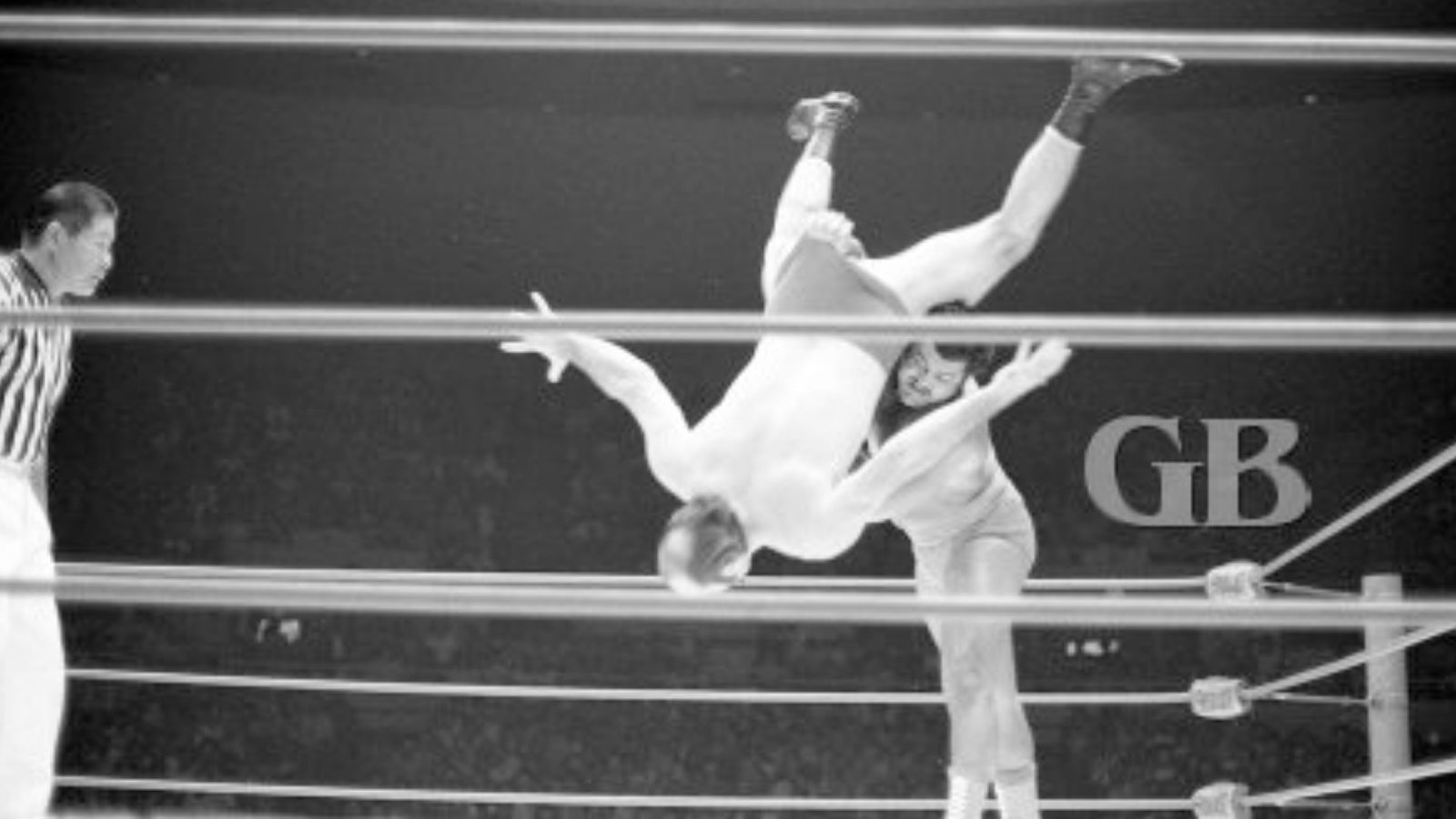
The bodyslam looks simple: lift, turn, drop. In practice it’s one of professional wrestling’s oldest and most important tools — a visual shorthand for power, drama, and momentum.
Over more than a century the bodyslam has evolved from a catch-wrestling throw into dozens of variations (powerslam, chokeslam, scoop slam, etc.), produced some of wrestling’s biggest pop-culture moments, and become shorthand outside the ring for “dominating” an opponent.
This is the history of that move: where it came from, who shaped it, how it mutated into the forms fans know today, and why it still matters.
The Bodyslam –
Origins: From Catch-as-Catch-Can to Showmanship
The technical ancestor of the bodyslam is older than pro wrestling’s modern entertainment era. In the 19th century, the catch-as-catch-can style (commonly called “catch wrestling”) emphasized throws and takedowns where a competitor could “catch” an opponent in whatever hold worked.
Those controlled throws, aimed at producing a decisive fall, are the same mechanical logic behind modern slams: lift, control the opponent’s center of gravity, and direct the landing to sell impact while protecting both bodies.
Catch wrestling’s techniques spread through the British Isles and into the United States in the late 1800s and early 1900s, forming the technical basis for many moves used by carnival and early professional grapplers.
In short, the bodyslam didn’t appear as a branded, single-inventor move; it emerged as the staged descendant of legitimate grappling throws.
As pro wrestling transitioned from legitimate contests to scripted shows in the early 20th century, performers retained the physical appearance of a throw while adjusting the motion for safety, audience reaction, and the show’s drama.
The Move Goes Mainstream: Early 20th Century to Mid-Century
Footage discovered from early 1900s matches shows throws that are recognizably similar to modern slams, though the exact, branded “bodyslam” term came later as move names standardized in the TV era.
Wrestling’s transition into theatre-style shows — with set finishing sequences and signature moves — in the 1940s–1960s codified certain slams as crowd cues for dominance.
As promoters sought spectacle, lifts and slams that made a big impact on camera and produced a visceral reaction became mainstays.
By mid-century, the bodyslam was a basic power move: clear, easy for crowds to understand, and adaptable to different bodies.
One could sell a story with a simple lift: the face appeared vulnerable at first, but after a successful slam, the balance of power shifted visibly.
Certain wrestlers turned the bodyslam into a signature moment or a pop-culture image. Here are a few examples within the last four decades alone where the bodyslam was heralded and represented more than simply just the act.

Hulk Hogan vs. André the Giant (WrestleMania III, 1987).
The image of a bulging-muscle Hogan picking up and slamming Andre in front of 90,000+ fans is the single most famous bodyslam in modern wrestling history.
The late Gorilla Monsoon had advertised the match as being a battle between the “irresistible force” meeting an “immovable object”.
From this point on it became a symbol of 1980s wrestling expansion and the mainstreaming of pro wrestling. Hogan has reflected many times on the lift and its meaning for his career; sports outlets and WWE video packages consistently call that slam “iconic.”

Big John Studd’s “body slam” challenges.
Before the Andre/Hogan match-up at WrestleMania III, in the early 1980s, Studd used the body-slam challenge (offering money if anyone could lift and slam him) as a promotional device.
Those examples show two things: (1) the bodyslam reads dramatically on a big stage; and (2) promoters and wrestlers have long used the slam as a moment to build a wrestler’s aura.
The Evolution of the Bodyslam – Variations On How One Move Became Many
Over time, the basic lift-and-drop branched into dozens of named variations. Some are simple cosmetic changes; others are mechanically distinct. Key variations include:
Aptly known as the “Powerslam” — a classic, forceful slam in which the attacker lifts an opponent onto his shoulder, runs, and falls forward to drive the opponent back-first into the mat.
Bill Watts is often credited with naming and popularizing a specific “powerslam” variant; Dr. Death Steve Williams helped make it famous in modern wrestling, and Davey Boy Smith conducted a running powerslam.

The Scoop slam/scoop powerslam consists of the attacker scooping the recipient up from a bent position and dropping them back-first. It’s a safe, visually clean variation often used against bigger opponents.
Many modern transition slams (e.g., sit-out powerslams) borrow the lifting mechanics of suplexes and convert them into slams, making them all transitional slams
Each variation exists on a spectrum of spectacle vs. safety; promoters and trainers pick styles that sell but minimize risk.
Who “Created” the Bodyslam?
The short answer: no single creator. The bodyslam is an evolutionary product. Its mechanical ancestor — controlled, theatrical throws — comes from catch wrestling and early grappling contests.
As pro wrestling moved toward staged spectacles, performers adapted those throws into a theatrical slam that sold better in arenas.
Wrestling historians caution against the myth of a single inventor: moves evolved regionally, with different performers refining how lifts were sold and incorporated into storytelling.
The Bodyslam as Storytelling Device
An academic angle helps explain why the bodyslam matters beyond theatrics. Scott R. Stroud’s paper, “The Ideology of the Body-Slam” (Iowa Journal of Communication, 2003), dissects how the slam functions as symbolic violence within pro wrestling’s staged narratives.
The slam’s visual clarity lets promoters encode a story beat: loss of control, reversal of momentum, or the decisive, physical humiliation of an opponent. Stroud argues that the slam is ideological — it dramatizes dominance in a way audiences immediately grasp.
That’s why the body-slam is used sparingly and for maximum effect: it’s not just a physical maneuver, it’s a communicative punctuation mark in the match’s narrative. (UNI ScholarWorks)
Put plainly: the slam is useful because it’s readable. The crowd sees the lift and reacts instantly to meaning (power, comeback, shock). That readability is why the move persists even as styles shift.
Wrestlers and promoters often talk about the bodyslam in pragmatic terms: it sells, it creates a pop, and it must be protected. A few notable reflections:
The WWE/ESPN retrospectives and Hogan’s interview clips treat the slam as both a physical feat and a turning moment in wrestling’s cultural rise. (YouTube)
Where direct, long-form interviews about the technical origins of the slam are rare, wrestlers instead treat slams as part of match psychology and spectacle: a calculated device rather than mere showmanship.
The Bodyslam in Film & TV
The bodyslam is visually decisive; it naturally migrated to film and television whenever creators wanted to show “wrestling” in a single beat. While wrestling fans the world over have often known of the move from its use in countless matches throughout the years, it was through film where pop culture became familiar with the move.
For instance, in the Sylvester Stallone classic, Rocky III (1982), features Hulk Hogan as “Thunderlips” in a cameo match, one of the most famous 1980s crossovers between mainstream cinema and wrestling.
While not a documentary of wrestling technique, Thunderlips’ ring work used the visual language of slams to sell spectacle. During his “boxing match”, with Stallone’s Rocky Balboa character, Thunderlips proceeds to bodyslam Balboa ultimately ending the match.
Body Slam (1986 film) — a comedy centered on wrestling culture that literally used the move in marketing and scenes, reflecting how the slam had become shorthand for the sport.
WrestleMania broadcasts & documentaries — the Hogan/Andre slam has been replayed ad nauseam in documentaries and highlight reels because it works on television as an iconic, shareable clip. ESPN, WWE, and news outlets have used the image to anchor retrospectives on the 1980s wrestling boom. (ESPN.com)
In news media and as a metaphor the phrase “body-slammed” has entered political news as a metaphor for decisive defeats.
Paste Magazine explored how journalists use “body-slam” language to dramatize non-wrestling contests (e.g., politics). The move’s visceral image makes it an easy metaphor for dominance in any arena. (Paste Magazine)
In short, film and television use the slam when they need an instantly readable symbol of domination or spectacle.
Safety, Training, and Why the Move Is Managed Carefully
A proper bodyslam requires timing, technique, and trust. Even the standard scoop or powerslam can injure if the lifter loses balance or the landed wrestler doesn’t tuck safely.
Training focuses on body positioning (how to get the opponent horizontal), safe drop angles, and how to absorb impact without injury.
Modern wrestling schools drill slams with progressive conditioning: small lifts, turns, and finally full slams with mats and spotters.
Promoters avoid gratuitous slams that might risk career-ending injuries; a big slam is still reserved as a match highlight rather than a routine. This is a pragmatic reality behind Scotts Stroud’s ideological reading: the slam is a powerful signifier so it’s used sparingly and with care. (UNI ScholarWorks)
The Bodyslam’s Cultural Afterlife
The move’s resonance continued beyond the ring:
Iconic snapshot — Hogan slamming Andre is an image museums and magazines use when discussing pro wrestling’s 1980s cultural breakthrough. That single lift helped position wrestling in mainstream nostalgia and sports discourse for decades. (ESPN.com)
Merchandise and marketing — promotional stunts (e.g., Studd’s money challenges) and movie titles show how promoters monetize the move’s spectacle. A slam can be packaged into an ad campaign that sells tickets, pay-per-views, and mainstream attention. (Bleacher Report)
Why the Bodyslam Still Matters
The bodyslam survives because it’s economical: one move, immediate meaning. It’s flexible: adaptable into dozens of variants that fit different bodies and storytelling needs.
It’s theatrical: a way to translate a match’s emotional arc into a single image. And it’s durable: whether in a small gym in 1908 or the Pontiac Silverdome in 1987, the slam still instructs audiences in a language they understand.
As wrestling moves forward — more athletic, more specialized, and more visually complex — the bodyslam remains a baseline. Trainers teach it early; promoters save it for moments; historians read it as a symbol. In both the ring and the culture, the bodyslam is not obsolete; it’s foundational.
Selected Sources & Further Reading
Scott R. Stroud, “The Ideology of the Body-Slam: A Critical Examination of Professional Wrestling,” Iowa Journal of Communication, 2003. — a scholarly examination of the cultural meaning of the move. (UNI ScholarWorks) https://scholarworks.uni.edu/ijc/vol35/iss2/3
Britannica, Catch-as-Catch-Can wrestling — origins and technical roots that underlie many slam variations. (Encyclopedia Britannica)
https://www.britannica.com/sports/catch-as-catch-can-wrestling
Paste Magazine, “Why Is Everything a ‘Body Slam’ to the News Media?” — on the move’s migration into political and cultural metaphor. (Paste Magazine)
Film: Body Slam (1986) — example of the bodyslam in fiction and film marketing.