

When wrestling fans think of the late 1990s cruiserweight boom, the name Psychosis is one that instantly comes to mind.
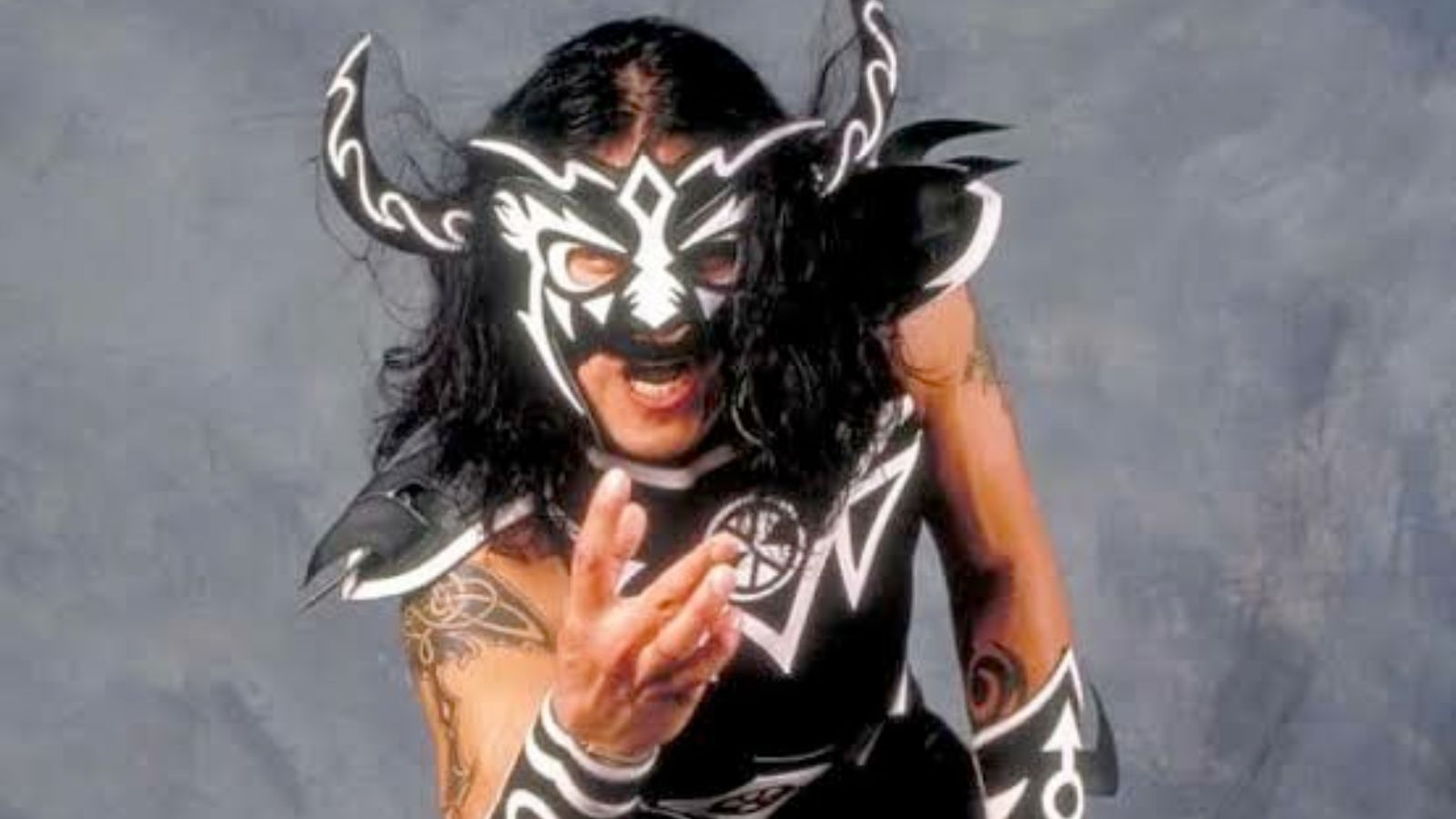
The Mexican luchador, known for his intricate mask, wild hair, and dazzling high-risk style, helped redefine what lighter wrestlers could bring to the international stage.
Alongside names like Rey Mysterio Jr. and Juventud Guerrera, Psychosis brought lucha libre to audiences in the United States, introducing a new level of excitement to WCW and beyond.
Over a career spanning three decades, Psychosis became one of the most recognizable rudos in Mexico and abroad, earning respect for his consistency, longevity, and willingness to put his body on the line for the fans.
Psychosis – The Origins of The Masked Marvel
Psychosis was born Dionicio Castellanos Torres on December 19, 1971, in Tijuana, Baja California, Mexico. Growing up on the border, he was exposed to both American and Mexican wrestling styles, and by his teens, he was already training to become a professional wrestler.
He debuted in 1989 under the name El Salvaje before adopting the name Psychosis and the menacing mask that would become his trademark.
Inspired by comic book villains and horror movies, Psychosis wanted a look that stood out from the traditional colorful tecnicos.
Speaking about his mask design in a 1997 WCW Magazine interview, he said:
“I wanted something that would scare the kids and make people think twice. Not just another pretty mask.”
That philosophy fit perfectly with his hard-hitting, risk-taking style and earned him early success in AAA, Mexico’s premier lucha libre promotion at the time.
His Rise in AAA and Arrival in ECW
Psychosis quickly rose through the ranks in AAA, debuting with the promotion shortly after its founding in 1992. He became one of its top rudos, feuding with Rey Mysterio Jr., Juventud Guerrera, and other high-flying stars.
One of his early career highlights came at When Worlds Collide, AAA’s landmark pay-per-view co-produced with WCW in 1994.
Psychosis teamed with Fuerza Guerrera and Madonna’s Boyfriend to take on Rey Mysterio Jr., Heavy Metal, and Latin Lover in a fast-paced, six-man tag match that showed U.S. audiences what lucha libre was all about.
Shortly after, Psychosis made his way to ECW in 1995, where Paul Heyman booked him in a series of matches against Rey Mysterio Jr. that became legendary.
Their match at November to Remember 1995 earned rave reviews, showcasing a mix of brutal chair shots and breathtaking aerial maneuvers.
As Heyman said in a 2015 interview about Psychosis:
“He was fearless, completely fearless. He’d fly into the crowd if he thought it would pop the people.” (Paul Heyman on ECW: WWE Network Documentary)
These performances caught the attention of WCW executives, who were building a cruiserweight division to compete with WWE’s heavyweights.
WCW – The Cruiserweight Era
Psychosis signed with WCW in 1996 and quickly became a mainstay of the company’s groundbreaking cruiserweight division.
His WCW debut match came at Bash at the Beach 1996 against Rey Mysterio Jr., a match praised for its innovation and pace.
Over the next few years, Psychosis was part of some of the most exciting matches on WCW programming, regularly stealing the show on Monday Nitro and Thunder. He faced off against the likes of Rey Mysterio Jr., Eddie Guerrero, Chris Jericho, and Dean Malenko.
His rivalry with Mysterio was particularly intense. The two men had incredible chemistry, dating back to their AAA days.
At SuperBrawl VII in 1997, Psychosis and Mysterio tore the house down once again, with Rey coming out on top in a high-octane contest.
One of his most memorable WCW moments came on Nitro in 1997, when he won the WCW Cruiserweight Championship for the first time by defeating Jericho. He held the title twice in his WCW tenure, cementing his place as one of the division’s cornerstones.
In a 2006 interview with SuperLuchas, Psychosis reflected on the WCW era:
“We opened the eyes of a lot of fans. They didn’t know what lucha libre really was until we brought it to them.”
(SuperLuchas, 2006)
WWE and the Mexicools
After WCW was bought by WWE in 2001, Psychosis returned to the independent circuit in Mexico and the U.S. before signing with WWE in 2005.
He joined forces with Juventud Guerrera and Super Crazy to form The Mexicools, a tongue-in-cheek stable that poked fun at Mexican stereotypes while showcasing their talents.
Psychosis debuted on SmackDown! riding a John Deere lawnmower alongside his partners, declaring that they were there to “clean up” the WWE tag team and cruiserweight divisions.
As part of the Mexicools, Psychosis feuded with tag teams like MNM and singles wrestlers like Paul London and Billy Kidman.
Though the stable was short-lived, it gave Psychosis one more run on U.S. television and introduced him to a new generation of fans.
Psychosis’ career was punctuated by memorable rivalries that spanned promotions and continents. These feuds weren’t just matches — they were showcases of chemistry, storytelling, and the evolution of lucha libre meeting American audiences.
Below is a detailed look at how each rivalry developed, why it resonated, and what his opponents had to say about working with him.

Rey Mysterio Jr.: The Defining Rivalry of a Generation
The rivalry between Psychosis and Rey Mysterio Jr. began in the early 1990s in AAA. As a young upstart tecnico (face), Mysterio became the perfect foil for the imposing, masked rudo (heel) in Psychosis.
The two were matched repeatedly in Mexico because their styles complemented each other so perfectly: Mysterio’s blinding speed and creativity contrasted with Psychosis’ more grounded, yet still acrobatic, power-based attack.
Rey Mysterio on working with Psychosis:
“Psychosis was one of my greatest opponents. We made magic together. Without him, there’s no me in the U.S. He always made me look like a million bucks.” (WWE.com Interview, 2012)
Their chemistry became obvious to AAA promoter Antonio Peña, who booked them together on AAA’s biggest stage — When Worlds Collide (1994), a PPV that introduced U.S. fans to lucha libre.
They met again in ECW in 1995, and their matches at November to Remember and House Party became instant classics. The feud carried over to WCW, where they clashed numerous times between 1996 and 1999 over the Cruiserweight Championship.
Paul Heyman praised their ECW matches:
“You could just let them go out there and wrestle. Every night it was something new, something spectacular. They brought lucha libre to Philadelphia.”
-Paul Heyman (Heyman on ECW Unreleased)
Even in WWE, over a decade later, they occasionally crossed paths during Psychosis’ run as part of The Mexicools.
Their matches elevated both men’s careers and set a new standard for cruiserweight wrestling in North America.
Juventud Guerrera: Rivals and Partners
Like Mysterio, Juventud Guerrera came up through AAA and the Mexican independent scene in the early 1990s, and he and Psychosis found themselves on opposite sides of the ring as much as they did on the same team.
In AAA, they occasionally teamed, but as two flashy, cocky luchadors with similar skillsets, they inevitably clashed.
In WCW, their rivalry took center stage when Juventud was positioned as a crowd favorite against the villainous Psychosis.
Juventud on their chemistry:
“We grew up together in AAA. We knew each other’s moves, our timing. Sometimes we’d argue backstage, but when the bell rang, we gave the people a show.”
– Juventud Guerrera (SuperLuchas Interview, 2010)
They wrestled numerous matches in 1997–1999 on Nitro and Thunder, often over title contendership. Even in WWE, as members of The Mexicools, there were subtle tensions in their dynamic, as Juventud was pushed as the leader while Psychosis and Super Crazy played secondary roles.
The rivalry with Juventud showcased their competitive drive and underscored the depth of talent in the Mexican contingent WCW assembled.

Eddie Guerrero: Short but Intense Rivalry
Psychosis’ interactions with Eddie Guerrero in WCW were shorter-lived but no less memorable. Their paths first crossed on AAA cards in Mexico when Guerrero worked under the Black Tiger persona in Japan and sometimes back home.
However, their most famous clashes came in WCW’s early cruiserweight division, where Eddie was already established as a top star while Psychosis was a newer face to American audiences.
Eddie Guerrero (in his autobiography Cheating Death, Stealing Life):
“Guys like Psychosis didn’t get enough credit. He was one of the smoothest, most creative guys I ever worked with. He made me work harder every night.”
-Eddie Guerrero (Guerrero, 2005)
One of their most notable encounters came on Nitro in 1996, where they delivered a 15-minute clinic that blended lucha libre and American mat wrestling.
They faced each other several more times in 1997 and 1998, usually with Eddie playing the arrogant, cheating heel and Psychosis as the dangerous, unpredictable challenger.
Their matches helped showcase Psychosis’ versatility against more technically-minded opponents.
Chris Jericho: Classic Cruiserweight Antagonists
Chris Jericho’s WCW debut in 1996 coincided with the peak of the cruiserweight division, and Psychosis was a natural opponent for him.
The two wrestled numerous times between 1997 and 1998, often on Nitro or PPVs, usually with the Cruiserweight Championship on the line.
Psychosis defeated Jericho on Monday Nitro to win his first WCW Cruiserweight title — a career-defining moment.
“Psychosis was awesome to work with. He’d bump like crazy, take risks, and never complain. He was one of those guys who deserved more of a push than he got.”
-Chris Jericho (Talk is Jericho Podcast, 2015)
Jericho, at the time, was developing his egotistical heel persona, and Psychosis’ wild in-ring style played perfectly against that.
Their matches were praised for combining lucha’s high-risk offense with Jericho’s storytelling and crowd work.
Dean Malenko: Styles Make Fights
Dean Malenko was another staple of WCW’s cruiserweight scene, and his methodical, submission-based style created a stark contrast to Psychosis’ unpredictable aerial attacks.
They wrestled numerous times on Nitro and Thunder in 1996–1998, often in title tournaments or eliminators. Malenko, nicknamed “The Iceman,” was clinical in his approach, often trying to ground Psychosis and target his legs to neutralize his high-flying arsenal.
“Working with Psychosis was always a challenge in a good way. He’d come up with things I never saw before, and it forced me to adapt and think on my feet.”
-Dean Malenko (WWE Network Interview, 2014)
Their matches, while sometimes overshadowed by flashier bouts, were excellent examples of psychology and technical precision meeting athletic explosiveness.
Their clashes added depth to WCW’s cruiserweight division, showing how different wrestling philosophies could still produce great matches.
After his WWE release in 2006, following an off-screen incident that led to his departure, Psychosis returned to the independent scene in Mexico.
He competed for AAA, CMLL, and various other promotions, sometimes under different variations of the Psychosis name due to trademark issues.
He worked sporadically throughout the 2010s, occasionally teaming with or facing former rivals such as Super Crazy and Juventud Guerrera.
In an interview with LuchaWorld in 2017, he commented on his legacy:
“I don’t regret anything. I gave everything I had to this business, and I’m proud that people still remember my matches.”
– Super Crazy (LuchaWorld Interview, 2017)
Psychosis also began training younger wrestlers in his hometown of Tijuana, passing on his knowledge to the next generation.
Psychosis is remembered as one of the key figures who brought lucha libre to an international audience in the 1990s. His risk-taking style, combined with his ability to play the perfect villain, made him a fixture of the U.S. cruiserweight revolution.
He influenced a generation of wrestlers — including modern stars like Kalisto and Andrade — who grew up watching his battles with Rey Mysterio Jr. and others on WCW Nitro.
As Rey Mysterio himself said in a 2012 interview:
“Psychosis was one of my greatest opponents. We made magic together. Without him, there’s no me in the U.S.”
(WWE.com, 2012)
Even decades later, his matches are still cited by fans and wrestling historians as some of the best examples of lucha libre-style wrestling combined with American-style wrestling.
Psychosis remains a revered figure among hardcore wrestling fans. Though he never achieved main-event status in the U.S., his body of work as a cruiserweight pioneer earned him a permanent place in wrestling history.
His contribution to the ECW and WCW cruiserweight divisions, along with his role in AAA’s golden era, helped open doors for countless luchadors who followed.
He captured the WCW Cruiserweight Championship twice, the IWRG Intercontinental Middleweight Championship, and was the AAA Parejas Increíbles Tournament Winner in 1999. Additionally, he held multiple regional and independent titles in Mexico and the U.S. throughout his career.
His career can also be summed up by this final quote by Paul Heyman.
“Psychosis was one of those guys who made sure you never forgot lucha libre belonged in the main event conversation.”
-Paul Heyman (WWE Network Documentary)