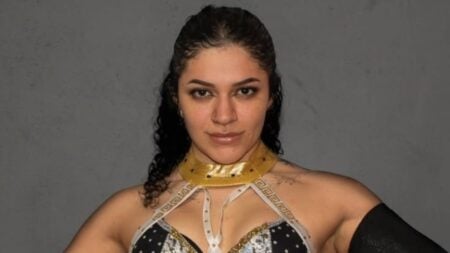



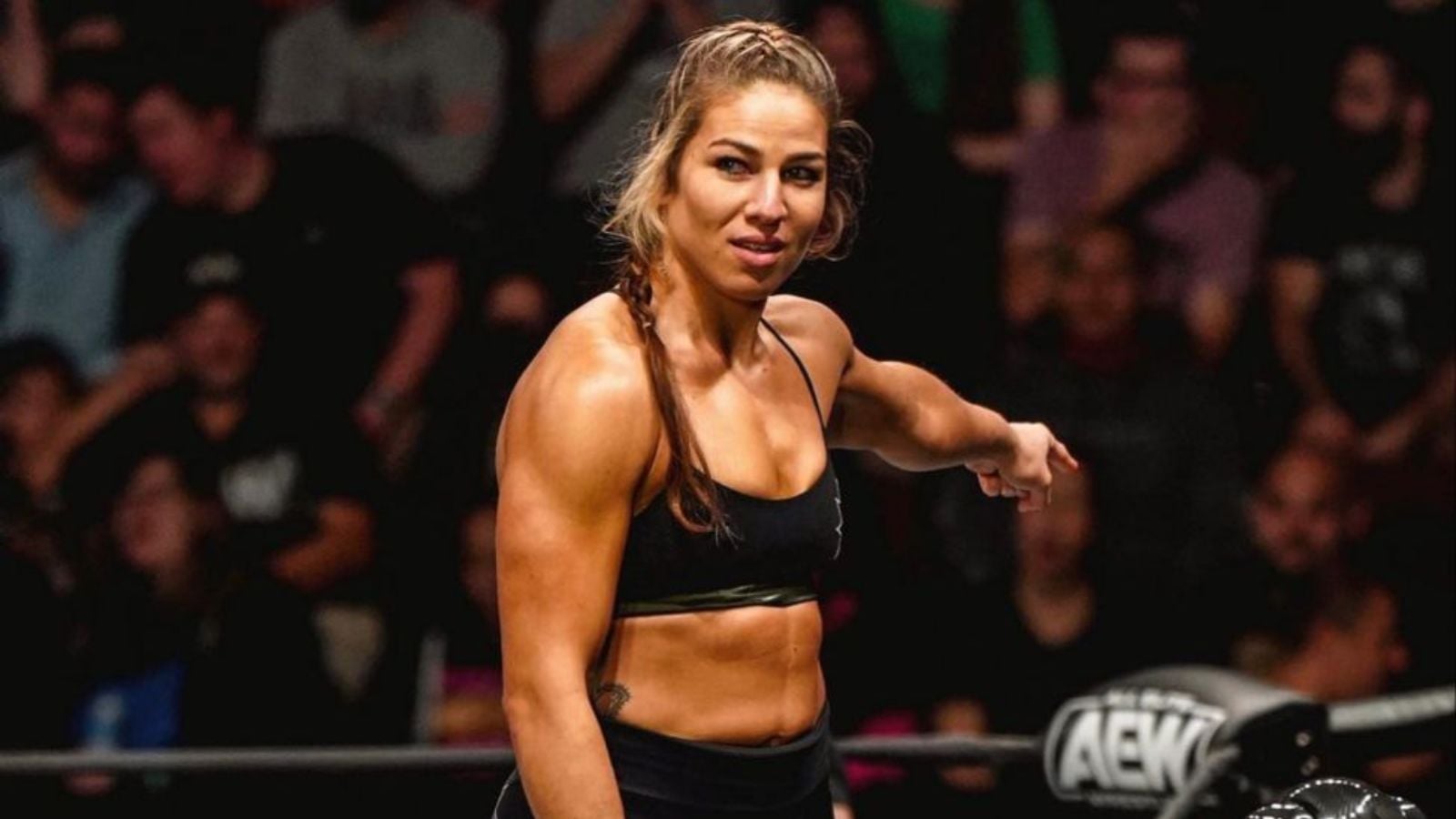
If every wrestler in this sport worked as hard every single day as Marina Shafir, everybody would be a thousand times better.The work ethic that she has, the approach to this game, living the life, not just talking about it but living it.
As Jon Moxley has stated above, Shafir’s commitment to growth is evident each day. But before that opportunity came about, Marina Shafir didn’t call wrestling her profession but rather a discipline of Martial Arts.
Before Marina Shafir earned the nickname “The Problem” in professional wrestling, she started out in judo. She was born in Moldova and grew up in New York, always looking for discipline and new challenges. This made combat sports a natural fit for her.

Marina Shafir – The Problem That Can’t Be Solved
Shafir got interested in combat sports early on because she liked the structure of martial arts. She picked judo because it was uncomplicated and straightforward, not because it was popular.
As she put it,
“It wasn’t about being the toughest person in the room. It was about solving a puzzle with your body.I needed to know what I was capable of, and the only way to find out was to put myself in situations where I could fail, get back up, and try again.”
Her drive to get better took her to California, where she trained with Gene LeBell. There, she met Ronda Rousey, and together they became part of the “Four Horsewomen.” They helped each other through tough training, hard weight cuts, and the early days of women’s MMA.

When Shafir started her professional MMA career, she used her judo skills to become a strong ground fighter. Rather than trading punches, she focused on getting close, taking her opponents down, and staying in control.
Fighting in Invicta and other regional events, she rapidly became known for her precise, submission-based style. Her time in MMA brought big challenges and lots of chances to learn.
The sport showed her where she needed to improve, so she had to grow from a judo specialist into a more complete fighter. When opponents could stop her judo, she had to respond quickly.
“People see the highlight reels and think it’s just strength,”
Shafir remarked about her approach to training during her MMA tenure.
“But it’s actually about the ability to be calm while someone is trying to dismantle you.I loved the chess match. If you couldn’t stay calm, you couldn’t compete. That’s what I learned in the gym every single day—how to find the calm in the absolute worst-case scenario.”
Her MMA career influenced how people saw her and pushed her to keep growing. Whether she was fighting in MMA or moving into wrestling, Shafir never let herself be boxed in or underestimated.
She relied on her judo background, early discipline, and support from others to build a strong career. For her, switching from fighter to performer wasn’t about changing who she was, but about using her focus in a new way.
Some people see moving from MMA to wrestling as a sideways step, but for Marina Shafir, it was a smart choice. She changed her focus from testing her own limits to learning how to connect with an audience.

By 2018, after years of tough competition in women’s MMA, wrestling was the next logical step for someone who always wanted to get better.
Shafir didn’t make this move alone; her MMA friends helped her a lot. She often mentions Roderick Strong as a big influence who pushed her to try wrestling.
“Roddy was my biggest supporter. He encouraged me to keep being who he knows. Even when you try and fail, just do it again. … There are no f***ing roadblocks, it’s all learning.
Shafir began formal training at the Performance Center, and many were surprised that she didn’t adopt a flashy, high-flying style.
Instead, she stuck to what she knew best, focusing on technical moves and submissions from her judo background. She wanted more than just to perform—she wanted real competition in the ring.
Her fellow wrestlers supported her move into wrestling and noticed her unique intensity. Instead of trying to win over the crowd, she focused on gaining respect. Shafir shared that the most difficult part of the transition from MMA to pro wrestling was her own ego.
“My own ego. Learning to swallow that motherf****r was real hard. It still is sometimes.I’m starting to realize where the real levels of competitiveness come from in pro wrestling and I ain’t there yet, but I know that.Just being vulnerable, that was hard. It still is hard. It’s hard for me in relationships. It’s hard for me everywhere. I think it’s hard for everybody.I think in pro wrestling, the biggest transition is understanding how much you need to be vulnerable because you’ve got to know yourself.Yeah, it’s really understanding that every time you put yourself in that arena, you have to be taking like somewhat of a step forward.You have to. Whichever way you think it is, you really have to. That freedom, that’s difficult. Because in fighting, it’s easy.Like you go three rounds. If you spar for three three-minute rounds, you will learn a lot about yourself.In nine minutes, you can figure out, ‘My conditioning sucks. I need to work on my jab. I leave this open, I need to make sure that I know how to circle this way.’ Like you can find out so many things. It’s a little bit more elusive and pro wrestling because of how you’re looking at it.”
That’s how she got the nickname “The Problem.” In a division known for showmanship, Shafir stood out as a technical wrestler who broke down her opponents piece by piece.
Looking back, Shafir said she made the move to find a place where she could have more creative control.
Moving from MMA to wrestling was a gamble, but it fit her skills. She made the women’s division feel more real and quickly got noticed.

While others worked on their characters, Shafir focused on technique. She used her judo background, MMA challenges, and time with the Horsewomen to build a character that was truly dangerous—because she really was. “The Problem” wasn’t just a nickname; it served as a promise.
Shafir left NXT quietly because the system didn’t fit her style. By 2021, WWE’s strict development program clashed with her desire for a more real and tough approach.
She didn’t leave because she lacked skill, but because her values didn’t match the system. For her, wrestling was still about real competition, not just putting on a show.
Soon after leaving WWE, Shafir got the chance to join All Elite Wrestling (AEW) thanks to her connections. She kept training and added new wrestling styles to her proficiency set.
Her unique approach helped her fit in at AEW. Jon Moxley played a big role, appreciating real danger in the ring more than perfect technique, and seeing Shafir’s potential in a place that values unpredictability.
AEW first introduced Shafir with short video clips that emphasized her “Problem” persona. She was shown as a real competitor who relied on instinct.
These videos were simple, skipping fancy entrances or long speeches, and focused on her as an athlete who wanted to win. This approach played to her strengths and showed off her judo background.
Shafir then joined Jon Moxley and the group that became the Death Riders. Joining them was a smart move, since the Death Riders prioritize survival and view the ring as a place for real competition. Shafir wasn’t acting when she established herself as the problem. It was a reflection of who she is.
“I’m not a flashy, flippy toy. I’m a f***ing G.I. Jane f***ing character. I’m just very different from the rest of the roster and I needed to understand that that was special in itself and just learn how to fortify that and not just completely go left and start doing s**t that I’m not good at.
Going forward, Shafir is ready to help make the women’s division feel more real. She’s moving from being a newcomer to a veteran who can challenge and mentor others.
She wants more than just titles—she wants to set a standard. By mixing real fighting skills with storytelling, Shafir makes herself essential. She isn’t chasing fame; she’s focused on being a tough opponent for everyone else.
“It’s really cool because he just gives me like a little feedback after my matches,” she said. “I feel like he states some obvious s**t sometimes [that] I just don’t see …
He had said a few things to me [in a way that] I just absorb it a little bit better. His perspective on s**t that I do is very interesting.
Some of the things that he has suggested for me [to do have] clicked … I still have some work to do, but I’m not very far off … It’s gonna be clicking for me whether it wants to or not and he’s definitely helping me use that together.”
Despite wrestling professionally for less than a decade, Shafir has earned the respect of her contemporaries. With her husband’s equal commitment, her place as a standout performer in the women’s division, and her trajectory for success are evident and a problem for everyone else.