

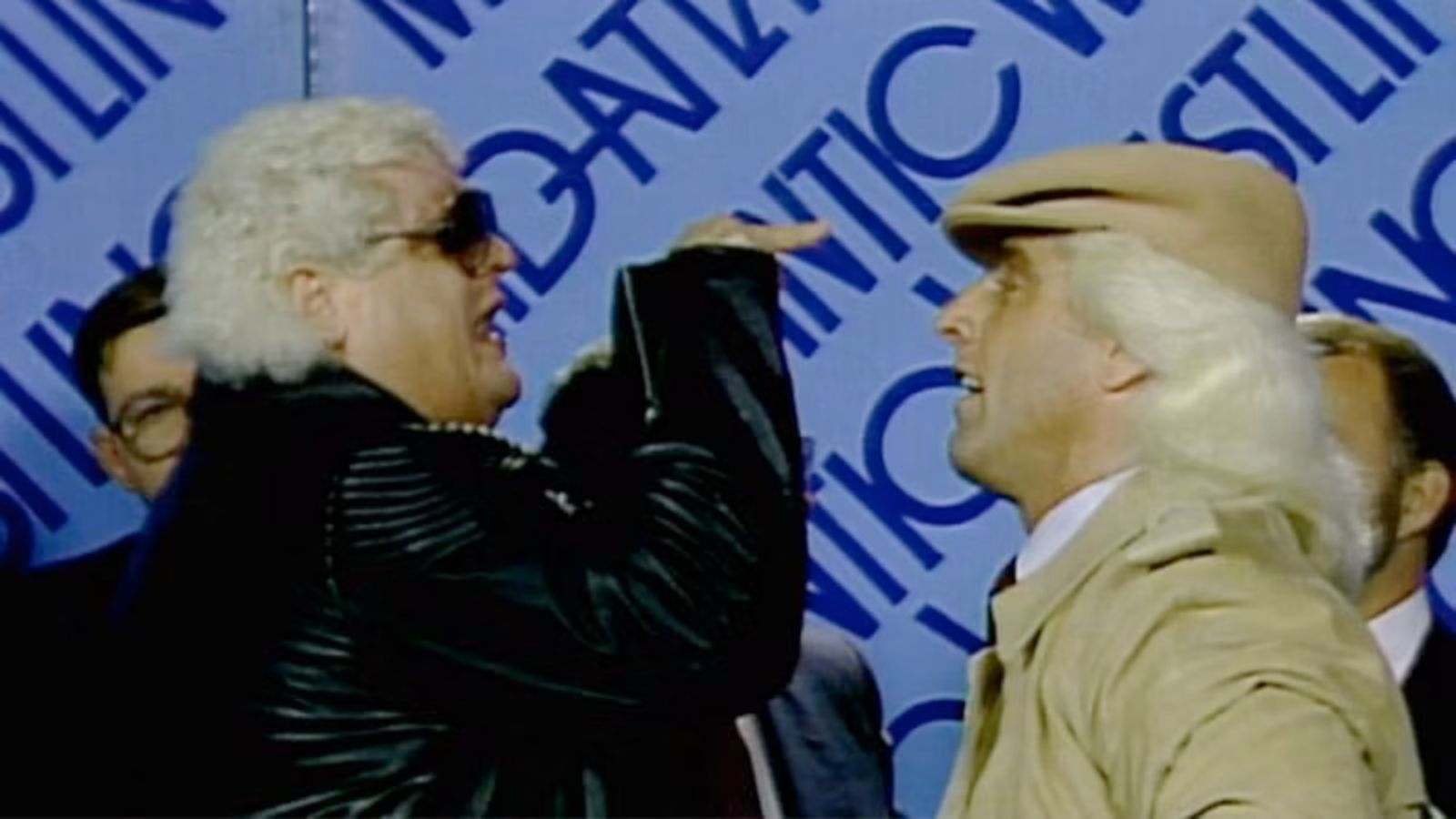
Professional wrestling thrives on characters, and few have ever been bigger than Dusty Rhodes and Ric Flair, the American Dream and the Nature Boy.
From the late 1970s into the 1980s, their rivalry defined not only Jim Crockett Promotions but the very template of the modern wrestling feud: the arrogant champion versus the relatable underdog.
Both men were larger than life, but in different ways. Flair lived his “jet-flying, limousine-riding” persona both inside and outside the ring.
Rhodes was the voice of the common man, dressed in simple polka dots and preaching about “hard times.” Together, they created one of the most enduring rivalries in sports entertainment history — one that still echoes in today’s storytelling.

Dusty Rhodes and Ric Flair –
Origins: Two Paths Converge
By 1974, Ric Flair was an up-and-coming heel in the Mid-Atlantic territory, having just returned from recovery after surviving a devastating plane crash in 1975.
Dusty Rhodes was already a star in Championship Wrestling from Florida, captivating fans with his charisma and passion.
When Flair captured his first NWA World Heavyweight Championship in September 1981, he immediately became the man to beat. Dusty, as the perennial hero of the people, was the obvious choice to chase the arrogant champion.
As Flair said years later in a WWE.com interview:
“Dusty was my greatest opponent. He was the perfect foil for me. He made me better every night.”
(WWE.com)
The American Dream and The Nature Boy – Their Clashes Early On
Between 1981 and 1984, the two would challenge one another for the National Wrestling Alliance’s World Heavyweight title.
Rhodes first challenged Flair for the NWA World Heavyweight Championship in the early ’80s, often coming heartbreakingly close before Flair would retain through underhanded tactics or controversial finishes.
Their match at The Omni in Atlanta in 1981 drew a sellout crowd and set the stage for their rivalry. Although Rhodes scored a pinfall, the result was overturned when it was revealed Flair’s foot was on the ropes — a classic example of Flair’s ability to “steal” victories.
However, the time of The Great American Bash in 1985, their feud against one another would only ramp up further.
On July 6, 1985, at the inaugural Great American Bash in Charlotte, Dusty finally appeared to beat Flair in front of over 27,000 fans at Memorial Stadium.
It was one of Rhodes’ crowning moments, but even that didn’t last — the NWA later reversed the decision, claiming referee error.
Jim Ross, on his podcast Grilling JR, remembered the night vividly:
“That pop when Dusty pinned Ric was deafening. It’s one of those moments you don’t forget.”
(Grilling JR)
Fans’ growing admiration for the American Dream was undeniable. Rhodes’ relatability and common man nature would certainly represent the fanbase that were drawn to him.
In comparison, Ric Flair’s character was among the most despised at the time, and any instance in which fans could see the Nature Boy get comeuppance was a reason to watch.

At Starrcade 1985 The Gathering, the American Dream and the Nature Boy would meet once again but this time the type of match was far more dangerous than before.
The two met in a steel cage match for the NWA World Title. This time, Rhodes again seemingly won the championship, but the decision was again reversed in favor of Flair days later. Fans were enraged — and invested, which only made the feud hotter.
The beauty of their feud was it wasn’t relegated to only the two of them but rather others who would also be elevated on the card by their sheer involvement in this feud. This was no more evident than during their next match, which was part of a team battle.
Their rivalry culminated in team warfare as Flair led the Four Horsemen against Dusty and his allies in the first-ever WarGames match at The Great American Bash 1987. The match — bloody and chaotic — became a classic and a staple of the feud.
The rivalry cooled after 1988, as Rhodes left Jim Crockett Promotions for Vince McMahon’s WWF; however, the echoes of their battles remained part of wrestling lore.
Rhodes would return to the NWA/WCW, and Flair would depart for the WWF and return a couple of years later. Once both men were in WCW once again, their longstanding rivalry was never rekindled.
For all that these two did in the ring against one another, it’s what they said about one another that has had some of the quotable moments.
Their War of Words
One of the reasons this feud resonated was that both men were elite talkers. Their promos added depth to the matches, turning their conflict into a story of class and culture. Some of their most memorable promos in their careers were often tied to their jostling of words against one another.

Perhaps the most famous promo in wrestling history came from Dusty during the build to Starrcade ’85:
“Ric Flair, the world’s heavyweight champion, has put hard times on Dusty Rhodes and his family.
But hard times are when a man has worked at the same job for thirty years, and they give him a watch, kick him in the butt, and say ‘hey, a computer took your place, daddy.’”
– Dusty’s “Hard Times” (YouTube: Hard Times Promo)
This speech defined Rhodes as the everyman’s hero and is still quoted by wrestlers and fans alike.
Flair countered with some of the most cutting promos of his career, flaunting his wealth and mocking Rhodes’ humble image. On World Championship Wrestling, Flair famously sneered:
“You talk about hard times? Hard times is trying to live like me, Dusty. Hard times is buying the Rolex, the limousine, the jet!”
– Flair’s Retorts
The contrast between the two — one representing the elite, the other the common man — made their feud feel bigger than wrestling.
“I’ve wined and dined with kings and queens, and I’ve slept in alleys eating pork and beans. And Ric Flair, you’re everything I’ve fought against my whole life.”
– Dusty Rhodes:
It was the constant battle between the everyman and the one who sees themselves as superior in every possible fashion.
“Dusty, you’ll never know what it’s like to be me. And that’s why you’ll never beat me.”
– Ric Flair
Dusty Rhodes and Ric Flair – After the Ring
Ric Flair: The Legend Lives On
Flair continued wrestling well into his 50s, retiring (briefly) after his emotional match with Shawn Michaels at WrestleMania XXIV in 2008.
He stayed visible as a manager, mentor, and public figure, making appearances in WWE and AEW and launching his own line of products.
In a 2017 ESPN interview, Flair reflected on Dusty:
“We made each other. Without Dusty Rhodes, there’s no Ric Flair as people know him today.”
(ESPN.com)
Dusty Rhodes: The Teacher
After leaving the spotlight, Dusty became a key creative force in WWE’s developmental system, mentoring stars like Seth Rollins, Bayley, and Kevin Owens in NXT. His influence shaped the next generation of wrestlers.
Sadly, Dusty passed away in June 2015, prompting an outpouring of tributes from across the wrestling world.
Cody Rhodes, his son, said at the 2015 Hall of Fame:
“Ric Flair brought out the best in my dad. Together, they created magic.”
(WWE.com)
The Flair–Rhodes rivalry helped Jim Crockett Promotions compete head-to-head with Vince McMahon’s WWF in the 1980s.
Their matches regularly sold out arenas and drew strong television ratings, proving that character-driven stories could be just as successful as cartoonish gimmicks.
Their feud also mirrored societal tensions of the time. Flair represented excess and greed, while Dusty embodied the struggles of everyday Americans in a shifting economy. Wrestling fans saw themselves in Dusty — and loved to hate Flair.
Many modern feuds borrow from this template: Steve Austin vs. Vince McMahon, Daniel Bryan vs. The Authority, and even Cody Rhodes’ own stories in WWE today carry echoes of his father’s battles with Flair.
In 2019, Triple H said in an interview with WWE.com:
“Dusty and Ric created the perfect storm. That’s still the standard we all try to live up to.”
(WWE.com)
The American Dream and The Nature Boy – Why Their Feud Still Resonates
At its core, Flair vs. Rhodes worked because it was believable. Fans didn’t just want to see Rhodes win; they needed him to. And they didn’t just boo Flair because he was a villain; they envied him, even as they despised him.
Their feud showed that wrestling could tell stories about more than just wins and losses — it could be about identity, aspiration, and the eternal conflict between haves and have-nots.
Wrestling journalist Dave Meltzer summed it up in a 2015 Wrestling Observer column:
“There are great matches, and there are great rivalries. Flair vs. Rhodes was both — and it defined an era.”
(Wrestling Observer)
Decades later, fans still chant Dusty’s name and quote his promos. Flair is still “The Nature Boy,” a living legend. And their rivalry remains the gold standard.
It wasn’t just about belts. It wasn’t just about ego. It was about two men in the American Dream and the Nature Boy who understood that professional wrestling, at its heart, is about making people feel something real.
As Cody Rhodes put it best in 2023:
“My father and Ric Flair showed the world what wrestling could be — larger than life, but still real.”
(Sports Illustrated)
From their promos, to their matches, to the impact of their battles, the American Dream and the Nature Boy will forever be one of wrestling’s most remembered rivalries. It was a feud that pushed both the American Dream and the Nature Boy while elevators others in the process and will forever be one of wrestling’s greatest rivalries.