



The Bible tells of a story of a young farmer’s son called David. He defeated a giant and went on to become king for forty years. The story of Blue Demon is similar. A humble farmer’s son would conquer a giant in lucha libre, and ruled over the sport for forty years.
The man who would become the Blue Demon was born on the outskirts of a small city within Nuevo León, Mexico, in 1922.
It was renamed García in honour of its most famous resident. Joaquin García was born there, and went on to become a two-term state governor. Little did Blue know he would become a national legend.
Blue Demon – The Face Of Masked Wrestling
Blue was born into a large but poor Catholic family. He was the fifth of twelve children. They practically lived off whatever they grew or made for themselves. As was the tradition for young men in his situation, he left school to seek work in the capitol city of Monterrery.
His uncle gave him a job with the National Railroad. His co-workers gave him the nickname “Manotas”, which translated literally as “hands”.
His supporters claimed it was an affectionate nickname because of his powerful strength. In reality, it was just because his co-workers felt the teenager had unusually large hands.
It was while working for the Railroad that Blue met local wrestler Rolando Vera. Vera was still quite early into his career. He was nowhere near the legendary status he would reach.
Yet he had already achieved enough to become recognisable. He had been a fan of lucha libre since he was a child. While the name means “free(style) fighting”, it is the Mexican-style of pro wrestling. Vera knew he was destined to become a luchador himself. Vera’s stories made Blue curious about wrestling.
Vera trained Blue in the beginning. Blue was one of over a dozen future legends he trained on his way to becoming one himself. He forced Blue to become an amateur wrestler at first.
Vera had competed in the sport by choice. He strongly believed it would help him once he was in a position to train for lucha libre.
This was proven to be true as his grappling skills made him both a natural and a fan favourite. Blue earned a record of 8-0 on the mats.
Vera was asked to help find some talents for a show in Laredo, Texas, in 1948. He told his newest protégé that he would be debuting at the event. The young man lived on the breadline and could not afford his own gear.
He borrowed some that his mentor no longer needed. He would compete as “Tusco Muñoz”, and faced Chema Lopez. The match was not a try-out, but it was a test. Lucha libre was more than a profession.
It is a lifestyle choice that demands a lifelong commitment. He needed to be sure before he made a decision. And a decision was made.
A talent scout from Empressa Mexicana de Lucha Libre (EMLL) had been sent to Laredo to scout for female talent. By coincidence, he was in the crowd for Munoz’ match.
When he went to the pay window to collect his pay check, he was also handed a letter that the agent had left for him. It contained a recommendation to the EMLL. He did not feel he was ready for the opportunity. Vera insisted that he take it because it may not ever happen again.
Vera felt there was something important missing. The world of lucha libre took their characters and traditions very seriously. Vera gave his friend the character of Blue Demon.
The character was easy to explain. In a deeply spiritual country, the demon was an unquestioned symbol of evil. He was a rudo (heel) that needed to be defeated by the técnicos (babyfaces).
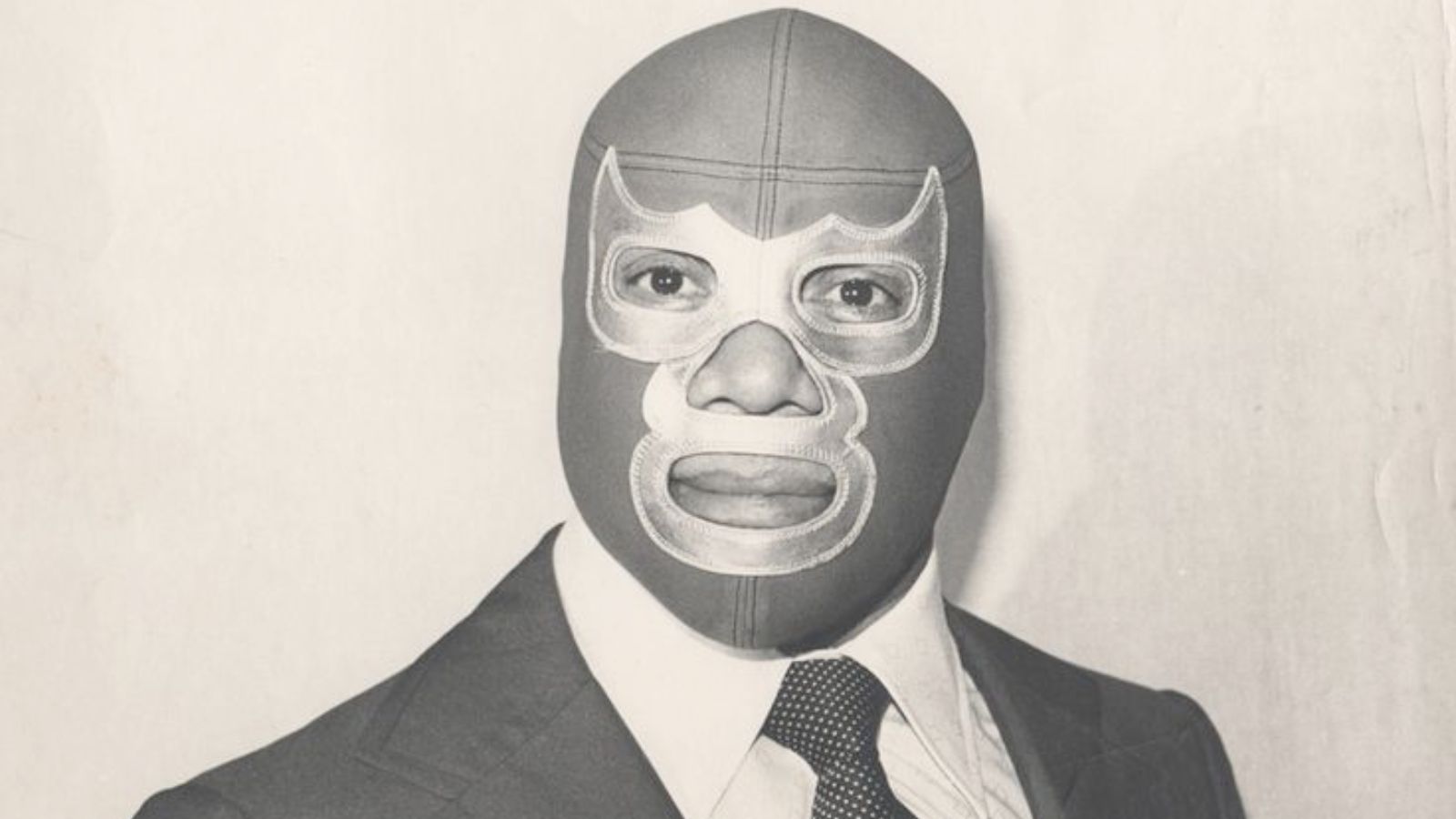
Vera got him blue ring gear and a mask with silver trims. The silver was a reference to higher ranking luchadors that Blue would later feud with.
His lucha libre debut was a “2-out-of-3 falls” match against Ciclon Veloz. Blue lost both falls by disqualification, and continued to pummel Veloz after the match ended. He was instantly established as a rudo.
Vera felt there was something important missing. The world of lucha libre took their characters very seriously. Vera gave his friend the character of Blue Demon. The character was easy to explain.
In a deeply spiritual country, the demon was an unquestioned symbol of evil. He was a rudo (heel) that needed to be defeated by the técnicos (babyfaces). Vera got him blue ring gear with silver trims.
The silver was a reference to higher ranking luchadors that Blue Demon would later feud with. He continued working for the railroad until he started making decent money from wrestling.
After his debut, he immediately moved his family to Mexico City so he could better fulfil his commitments to EMLL. It was an affiliate with the National Wrestling Alliance.
He sometimes competed under the Spanish translation, “Demonio Azul”. Those unfamiliar with lucha libre, you could be misled into thinking Blue was an enhancement talent in his early years.
Most of his matches were tag team matches because they are more popular in Mexico. A teammate can “tag themselves in” if their partner exited the ring for any reason.
This prevented slow down in matches and made them more excited. He lost often because it was common practice to have the técnicos beat the rudos.
During his rookie year, he was placed into a tag team with The Black Shadow. They had competed on the same side sparingly before this. Now as a legitimate tag team, they were presented as brothers.
They were named “Los Hermanos Shadow” (literally “The Shadow Brothers”). They were paired together due to their may similarities. They became a top rudo team that eventually won the Mexican National Tag Team Championships.
Their main rivals were El Santo and Gory Guerrero. Guerrero is best-known as the patriarch of the Guerrero wrestling dynasty. His four sons Hector, Chavo, Mando, and Eddie all became successful wrestlers in the United States, as did his grandson Chavo, Jr.
But El Santo was more important. He had gone through multiple characters before finding something that worked. He was part of a stable that all dressed in silver to show their (self-imagined) superiority.
Santo emerged as the breakout star of this group. He rarely lost, and when he did, it was usually because his tag team partner got pinned. Santo had beaten the Hermanos every time he stepped into the ring with them.
Santo had begun challenging técnicos in “Lucha de Apuestas” matches. These “betting fights” required both participants to put something valuable on the line.
For Santos, the only prize he wanted was his opponent’s mask. In luchador tradition, the mask is sacred. You were required to keep your private identity a secret.
Once your mask had been removed in public, you were forbidden from wearing it ever again. The most shameful thing a luchador could do is take the mask of another luchador.
He challenged Black Shadow, and won. He stripped his opponent of his mask, and the Black Shadow character was done. Blue Demon vowed to avenge the loss. This one remark instantly turned him técnico.
Blue Demon faced El Santo in a singles match for the first time in September 1953. The irony of a “demon” being the good guy and a man named “Saint” being the villain was not lost on the Catholic crowd.
At 5’ 9’’ and weighing around 200lbs, Santo would not be considered intimidating in most wrestling rings around the world. Yet in the world of lucha libre, he earned his reputation for being a monster.
One that seemed impossible for the 5’ 7’’ and 170lb Blue Demon to overcome. Yet this is not how history recorded it.
Blue Demon’s victory over El Santo is considered to be one of the most important in EMLL. It gave Blue his first ever singles title, the Mexican National Welterweight Championship.
It was also the first time that Santos had lost a match in two straight falls. This sparked the largest feud in lucha libre history. Santo became so obsessed with avenging that one loss against Blue.
Most of their clashes ended with Blue’s hand being raised. On the very rare occasion that Santo won, it was cheap and did nothing to quell his desire for revenge.
Santo was so desperate to overcome his new foe that he wagered his own legacy on it. He had been synonymous with the NWA World Welterweight Championship.
Santo was the first person to hold the title, and retained it for eleven months. He regained it at EMLL’s 19th Anniversary show. Santo put it on the line to get another shot at Blue Demon at the 20th Anniversary event.
The gamble backfired as Blue left with yet another win and another title. He would also overshadow both of Santo’s reigns by fending off all challengers for over three years.
His titles were his second most coveted possession. Some challengers tried to strike at the heart of Blue Demon by claiming his mask. He would compete in a dozen ‘Lucha de Apuestas’.
Every challenger had Blue Demon put his mask on the line. Every challenger wound up facing the forfeit. Four lost their masks, while the rest had their heads shaved in front of the crowd.
One exception was Conde Giuseppe Diadone, who lost his signature beard. Mathematico was the only person foolish to gamble against Blue twice. First, he lost the mask, then he lost his hair.
In July 1957, Blue suffered his first serious injury. He was working a match against El Espectro. Blue attempted his Octopus Stretch finisher early into the match.
It was a variation of the abdominal stretch submission hold. He would normally place a leg over the opponent’s head to add extra weight and pressure.
Espectro blocked the move by performing a leverage throw. While he performed the move correctly, Blue did not get enough rotation before hitting the mat. He fractured his skull and was side-lined for several months.
Soon after his recovery, he had a falling out with EMLL. It was not uncommon for them to book Blue in different cities across Mexico and Texas close together.
For one particular tour, they had Demon travel by truck instead of by plane. This was uncomfortable for him and greatly increased his time travelling. While attending a commitment in El Paso, Texas, he visited Guerrero.
After a bit of conversation, he worked a one-off match for Guerrero. He was overpaid so that he could afford to book his own flight back to Mexico City.
EMLL were not happy that Blue worked a show for a different promotion without their permission. They called him into a meeting to discuss his punishment. Before they could, he cut them off and announced he was leaving.
Blue Demon spent the ‘60s and ‘70s as an independent. His name alone made it easy to get well-paid bookings anywhere within lucha libre.
It also allowed him to decide his own schedule. He booked matches around his new acting career. Producer Enrique Vergara had made many movies starring El Santo.
Having seen Blue Demon rise to popularity, and because Santo had started asking for more money, he decided to try and make Blue his new star.
His first two movie roles were as minor characters. They were based on lucha libre, and he portrayed his Blue Demon character alongside multiple other luchadors. While working with Vergara, he was always in a lead role.
Just like Santo, all of his films were a mixture of science fiction and horror. His first movie Demonio Azul in 1965 established him as a superhero like Santo. He too would battle supernatural creatures and the occult.
Blue Demon and Santo appeared in nine movies together as allies, yet they continued to be rivals in the ring. Three of the movies tried to establish Blue as the leader of a team of luchador superheroes.
“Los Campeones Justicieros” (The Champions of Justice), featured big name técnicos like Mil Máscaras, Tinieblas, El Fantasma Blanco, and others.
In 1965, Blue Demon suffered yet another serious injury. While working a match with Cavernario Galindo, Blue fell out of the ring. The collision on the concrete floor burst a blood vessel.
He ignored the doctor’s warning not to eat anything and ate dinner. A few minutes after this, he lost consciousness while climbing the stairs. He fell and fractured his skull again. The injury forced him to put both careers on hold for years.
When he recovered, he attempted to keep working the same wrestling and movie schedules he had prior to his injury. His long-time enemy Santo ended their rivalry and turned técnico.
The pair would team together frequently until Santo’s retirement in 1982. He also founded The Blue Demon Instituto Atletico, his own lucha libre wrestling school.
In 1988, he decided it was finally time to start wrapping up his in-ring career. He did one final tour. His final career match saw him team with his adopted son, Blue Demon, Jr. Blue Demon was 67 at the time of this match.
He continued to train luchadors at his school and make non-competitive appearances at various promotions. Always wearing his iconic mask. In 1996, he was invited to Lucha Libre AAA Worldwide for the first time.
Ray Mendoza and himself were being honoured for their careers. They were then attacked by Pierroth, Jr. Having younger wrestlers attack retired wrestlers for heel heat has become an all-too-often cliché in wrestling.
But this was the first time something like this had happened in lucha libre. Pierroth generated such intense heat that fans would sometimes riot if he attempted to make a ring entrance.
AAA tried to make lightning strike twice by repeating it two years later. Blue Demon and Blue Demon, Jr. were brought in to present a mask to a rookie. They were then attacked by Abismo Negro.
Abismo attempted to perform a piledriver on Blue Demon, but he was rescued by his son. This initiated a feud between Abismo and Blue Demon, Jr. While the plan was for both men to be put over, only Abismo’s career improved.
Even before his retirement, Blue Demon’s mask had become a visual icon for wrestling, not just lucha libre. It is used as a logo representing the sport by hundreds of magazines and publications, including those that only specifically cover promotions Blue Demon has never worked for.
The Wrestling Observer Newsletter created their own Hall of Fame. The first class featured over a hundred inductees, including Blue Demon. The main editors worked on John Molinaro’s book The Top 100 Wrestlers of All Time. It listed Blue Demon at #28.
On October 27, 2000, Consejo Mundial de Lucha Libre (former EMLL) hosted their first ever Leyenda de Azul (“Blue Legend”) tournament. As the name suggests, it is a tribute to Blue Demon.
The competition is not as prestigious as their Leyenda de Plata (“Silver Legend”) tournament, which honours El Santo.
The winners of either tournament win an exclusive championship belt, and a plaque with the respective legend’s mask. Like with the WWE’s King of the Ring, the winner may temporarily work the victory into their characters and begin a push.
Every tournament has taken place in the Arena Mexico in Mexico City. Most of them have been a “Torneo cibernetico” match. All sixteen participants are divided into two teams of eight.
Each team member is given a random number. The match is conducted like a normal tag team match with elimination rules. A teammate can tag himself in if his partner exits the ring.
Only the next member numerically may enter the match (e.g. if #3 leaves the ring, only #4 may take his place). Once a team has been fully eliminated, the remaining members of the surviving team will face off to determine one overall winner.
Due to time constraints, sometimes only the second half of the match will be broadcast. Blue Panther pinned Mr. Niebla to become the inaugural winner.
On December 16, 2000, Blue Demon was found dead on a park bench. He had been training students at his school earlier that morning. He had to travel home by subway train.
The health conditions that arose from breaking his skull twice meant he was no longer allowed to legally drive, and he hated taxis. He had suffered a heart attack and medics at the hospital were unable to revive him.
This came as a surprise to those who knew him as he never had any issues with his heart before. He continued to work-out at the gym in his school every day. He had just finished his last workout before heading home that day. He was 78 years old.
Blue Demon had honoured the luchador traditions for his entire adult life. One of the hardest to keep was hiding his true identity from the public until his death.
It was only then his real name was publicly revealed as Alejandro Muñoz Monroe. As he had gone more than half his life under his ring name, fans choose to honour his legacy by only referring to him as Blue Demon. He was buried with his famous mask on.
CMLL paused the Leyenda de Azul tournaments out of respect for Blue Demon’s memory. They resumed as an annual event in 2003.
Between 2005 and 2007, they used a more traditional tournament format. The participants faced each other in singles matches with the winners advancing to the next round. They brought back the torneo cibernetico for 2008.
In a move that surprised lucha libre, Blue Demon, Jr. threatened legal action against CMLL. He was previously a top star in the company, and had endorsed every Leyenda de Azul to date.
Then his own promotion became an NWA affiliate, being renamed NWA Mexico. CMLL were still using some of the NWA’s championships from when they were part of the NWA.
Blue Demon, Jr. threatened legal action against CMLL on NWA’s behalf. CMLL have never commented publicly on this. They paused the Azul tournaments until 2011.
They had managed to secure a deal with Blue Demon’s biological son, El Hijo de Blue Demon (literally “the son of Blue Demon”). While the tournaments have become semi-regular, Hijo has endorsed them all since.
In 2015, the television series Blue Demon presented a fictionalised version of the real Blue Demon’s life and career. The show was only available in Spanish.
In 2002, Lucha Libre AAA Worldwide inducted him posthumously into their Hall of Fame. He had never competed for the company, but he had influenced and trained many of their top stars.
Blue Demon’s legacy lives on through his sons El Hijo de Blue Demon, and Blue Demon, Jr. The latter’s son recently started wrestling as Blue Demon III.
The debate about who the greatest wrestler is shall never be settled. When your image has become the international symbol for wrestling, you have a stronger claim to that title than anyone.
Yet his popularity in Mexico is only second to El Santo. The only victory his rival can claim over him and also the greatest. Not that Blue Demon minds this. He is quoted as saying “If the Silver Legend of El Santo can continue, then so can the Blue Legend of Blue Demon.”