
Before He Was Big John Studd
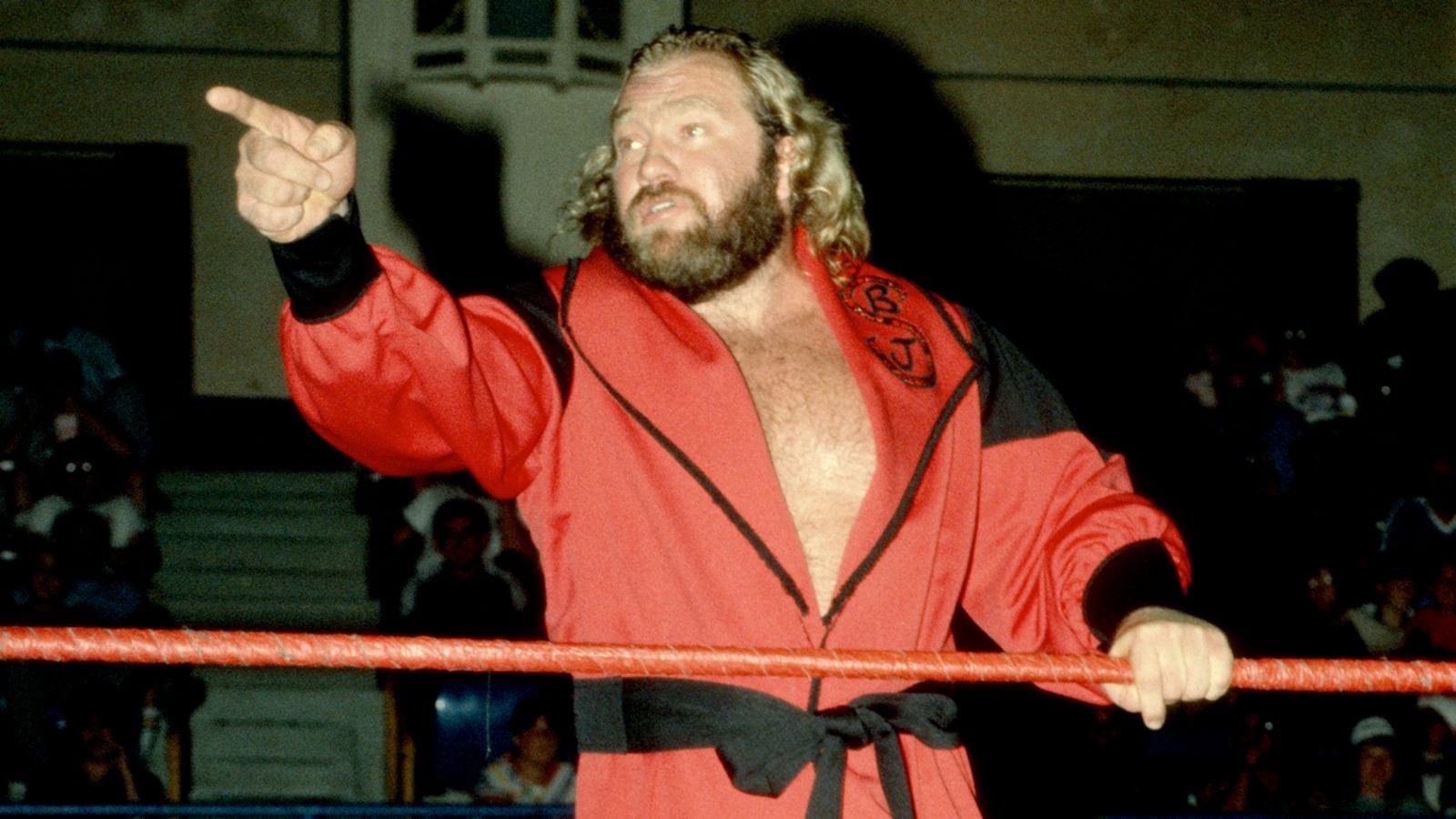
John William Minton was born on February 19, 1948, in Butler, Pennsylvania. Long before fans knew him as Big John Studd, he was simply an unusually large athlete trying to find his place in professional wrestling.
His size opened doors. His work ethic kept them open.
Minton trained under the legendary Killer Kowalski, whose school produced numerous future stars. Kowalski later recalled that Minton possessed one of the most imposing physiques he had ever seen.
Studd entered the wrestling business, but he also understood that size alone would not guarantee success. The territories were filled with big men who never learned how to connect with an audience.

By the mid-1970s, Studd had become a familiar face throughout several major territories. He worked extensively in Texas under Fritz Von Erich, where promoters quickly realized that his size alone generated interest.
Fans did not see many legitimate giants during that era. Studd’s height and frame made him stand out before the opening bell.
His partnership with José Lothario proved particularly successful. Together, they captured the NWA American Tag Team Championship, giving Studd one of the first significant title accomplishments of his career. The reign helped establish him as more than a curiosity attraction. He was becoming a dependable performer trusted in featured positions.
Studd also spent time in Championship Wrestling from Florida, Mid-Atlantic Wrestling, and other NWA-affiliated promotions.
The travel was demanding, but it provided an education few modern wrestlers experience. A performer could work before one audience on Friday, another on Saturday, and a completely different crowd on Sunday. Every market responded differently.
Years later, Studd reflected on those experiences by noting that the territories taught wrestlers how to work. Television exposure could create stars, but territory wrestling forced performers to learn crowd psychology, timing, and adaptability.
Killer Kowalski spoke highly of his former student throughout Studd’s career. Kowalski frequently noted that while many people focused on Studd’s size, they overlooked his intelligence.
According to Kowalski, Studd understood how to use his physical advantages without becoming dependent upon them.
That distinction mattered. Many giants relied entirely on spectacle. Studd learned the craft.
By the time he arrived in the WWF, he was no longer developing into a main-event performer.
He already was one.
Becoming Big John Studd
The Big John Studd persona emerged during the latter half of the decade and fit Minton perfectly. Unlike many wrestling names that felt manufactured, this one sounded authentic. Fans immediately understood what they were getting.
A giant, a bully. and a threat.
Studd’s combination of size and experience separated him from many of wrestling’s other giants. He could handle lengthy programs, television appearances, and demanding road schedules without looking overwhelmed.
By the time Vince McMahon’s expanding WWF came calling, Studd arrived as a finished product rather than an untested attraction.
The company needed villains capable of standing opposite its biggest stars. Studd was one of the few men who looked capable of intimidating anyone.
Enter Bobby Heenan
The partnership between Big John Studd and Bobby Heenan became one of the defining manager-wrestler combinations of the 1980s.
Heenan could talk audiences into the building.
Studd could keep them there.
Their chemistry was immediate. Heenan bragged endlessly about Studd’s superiority while Studd backed those claims with calculated destruction. Together, they became a centerpiece of the Heenan Family, one of wrestling’s most successful heel stables.
Years later, Heenan reflected on Studd’s value to the organization, noting that when Studd walked into a room, nobody had to be told he was a main-event wrestler. His size accomplished that before the bell even rang.
Fans wanted to see him lose. Promoters wanted to feature him.
That combination is how money is made in professional wrestling.

The Battle of the Giants
The WWF‘s biggest attraction in the early 1980s was André the Giant. No one was bigger or more beloved.
To challenge André, promoters needed someone credible. Someone gigantic. Some of the audience believed it could hurt him. Big John Studd became that man.
Their feud began in earnest during 1984 and quickly became one of wrestling’s defining programs. The premise was simple. Studd wanted to prove he was the true giant. André disagreed, and the crowds loved it.
The visual alone sold tickets. Two enormous men confronting one another created an atmosphere unlike anything else in wrestling at the time.
Their matches were held throughout North America, drawing large crowds wherever they appeared.
Fans genuinely wondered whether Studd could accomplish what few others had managed—defeat André.
The feud with André the Giant succeeded because it felt believable. Wrestling audiences had spent years hearing that André was unbeatable. Studd represented one of the few opponents whose size made that claim worth challenging.
Bobby Heenan later explained the appeal in simple terms. He often remarked that fans would immediately stop and stare whenever Studd and André stood face-to-face. No elaborate storyline was required. The visual sold the match.
Their rivalry reached another memorable chapter during WrestleMania’s formative years. While André ultimately won the famous Bodyslam Challenge at WrestleMania, the angle accomplished exactly what WWF officials wanted. It transformed a wrestling match into a spectacle that mainstream audiences could easily understand.
Studd remained one of André’s most consistent opponents throughout the mid-1980s. House show reports from the period regularly placed their matches near or at the top of the card. In many cities, they represented the featured attraction.
Reflecting on André years later, Studd praised his longtime rival’s instincts. He noted that André understood how to control an audience without doing very much physically. According to Studd, André knew precisely when to move, when to sell, and when to give fans the moment they had paid to see.
Those lessons stayed with him long after the rivalry ended.

The Hair-Cutting Incident
Then came one of wrestling’s most memorable moments. The haircut.
In 1984, Studd and Heenan attacked André and cut off a substantial portion of his hair during a televised angle. The act generated tremendous outrage.
Today, a haircut angle may seem ordinary. Back then, it was different. André rarely appeared vulnerable. Seeing him humiliated enraged fans and dramatically intensified the feud.
The segment became one of the WWF’s most effective storytelling devices of the decade. Suddenly, this wasn’t merely giant versus giant. It was very personal.
WrestleMania and the Bodyslam Challenge
The rivalry reached its most famous chapter at WrestleMania. Studd and André met in a “$15,000 Bodyslam Challenge.” The stipulation was straightforward: the winner would receive the prize money if he could slam his opponent.
For years, André had been promoted as nearly impossible to bodyslam. That made the challenge compelling. The match itself wasn’t a technical masterpiece.
It didn’t need to be.
The attraction was the spectacle. When André eventually bodyslammed Studd, the crowd erupted. Then came another memorable moment.
André began throwing the prize money into the audience before Heenan protested.
The image became one of WrestleMania’s enduring highlights and further cemented André’s status as a heroic attraction.
For Studd, however, the loss did not diminish his standing. If anything, it reinforced his importance. Very few wrestlers were presented as legitimate threats to André. Studd was one of them.
More Battles With André
The feud continued through 1985 and into 1986. House show circuits across North America featured repeated clashes between the giants.
Steel cages, tag matches, and special attractions kept fans buying tickets. The rivalry worked because neither man needed complicated storytelling. Their size alone created drama.
Studd represented arrogance and intimidation. André represented perseverance and pride. The formula never got old.

Retirement, Return, and Post-Wrestling Life
When Studd stepped away from wrestling in 1986, many fans assumed he would eventually return. Few believed he would voluntarily leave during one of the industry’s most profitable periods.
The decision reflected careful planning rather than frustration.
In several interviews conducted after retirement, Studd explained that he had invested his earnings in real estate and other ventures while still wrestling. Unlike many performers who depended entirely upon their next booking, Studd built financial security outside the ring.
“I didn’t have to wrestle,” he explained in one retrospective interview. “I wanted to wrestle, but I didn’t have to.”
That single statement separated him from many contemporaries. The wrestling business has produced countless stars. Financial independence has been far rarer.
His return in late 1988 surprised audiences and immediately generated interest. The villain fans had spent years booing, suddenly found himself receiving cheers.
Part of that reaction came from nostalgia. Part came from Bobby Heenan’s absence. Fans remembered Studd, but they no longer viewed him through the lens of Heenan’s constant arrogance.
The transformation culminated at the 1989 Royal Rumble, where Studd eliminated Ted DiBiase to win the match. At the time, the Royal Rumble had not yet become a guaranteed path to the championship, but the victory restored Studd’s standing as a major attraction.
After retiring for good, Studd remained connected to wrestling through convention appearances and fan events. Friends and colleagues often described him as thoughtful, intelligent, and considerably different from the intimidating figure portrayed on television.
His son, Sean Studd, later entered professional wrestling and carried the family name into a new generation. While comparisons to his father were inevitable, Sean frequently acknowledged the challenge of following one of wrestling’s most recognizable giants.
Bobby Heenan perhaps summarized Studd best when discussing former members of the Heenan Family. He described Studd as a dependable performer who always understood his role and delivered what promoters expected.
For a man whose career was built on standing out physically, that professional reliability may have been his greatest strength.
His Son’s Wrestling Career
Wrestling eventually became a family tradition. Studd’s son, Sean Minton, entered the wrestling business under the name Sean Studd. Like his father, Sean possessed exceptional size.
Naturally, comparisons followed. While matching the legacy of Big John Studd was an enormous challenge, Sean carried the family name into a new generation of wrestling fans.
His appearances on the independent scene kept the Studd name alive long after John’s retirement.

Hall of Fame Recognition
Big John Studd passed away on March 20, 1995, at the age of 47, following complications related to liver cancer and Hodgkin’s disease.
His death shocked many within wrestling. He seemed too young, strong, and big.
Years later, the WWF—by then known as WWE—recognized his contributions by inducting him into the WWE Hall of Fame in 2004.
The honor acknowledged what longtime fans already knew. Big John Studd mattered.
The Legacy of Big John Studd
History often remembers Big John Studd as André the Giant’s rival. That’s understandable. Their feud remains one of wrestling’s greatest giant-versus-giant attractions. But Studd’s legacy extends beyond those battles
He helped establish the Heenan Family as a dominant force. He became one of the defining villains of wrestling’s national expansion.
He proved that giants could draw money, tell compelling stories, and remain credible without holding world championships.
Most importantly, he helped create moments fans still discuss decades later. The haircut, bodyslam challenge, Royal Rumble victory, and the staredowns with André.
Those memories endure because they worked. They felt important. They made audiences care.
Professional wrestling has featured many giants. Some were taller, heavier, and held more championships. Few, however, combined presence, credibility, timing, and longevity the way Big John Studd did.
For a generation of fans, he was the giant who dared challenge André the Giant. For wrestling history, he remains something more.
A cornerstone of the 1980s boom. He was a villain and a respected veteran. And one of the most recognizable giants the sport has ever produced.