

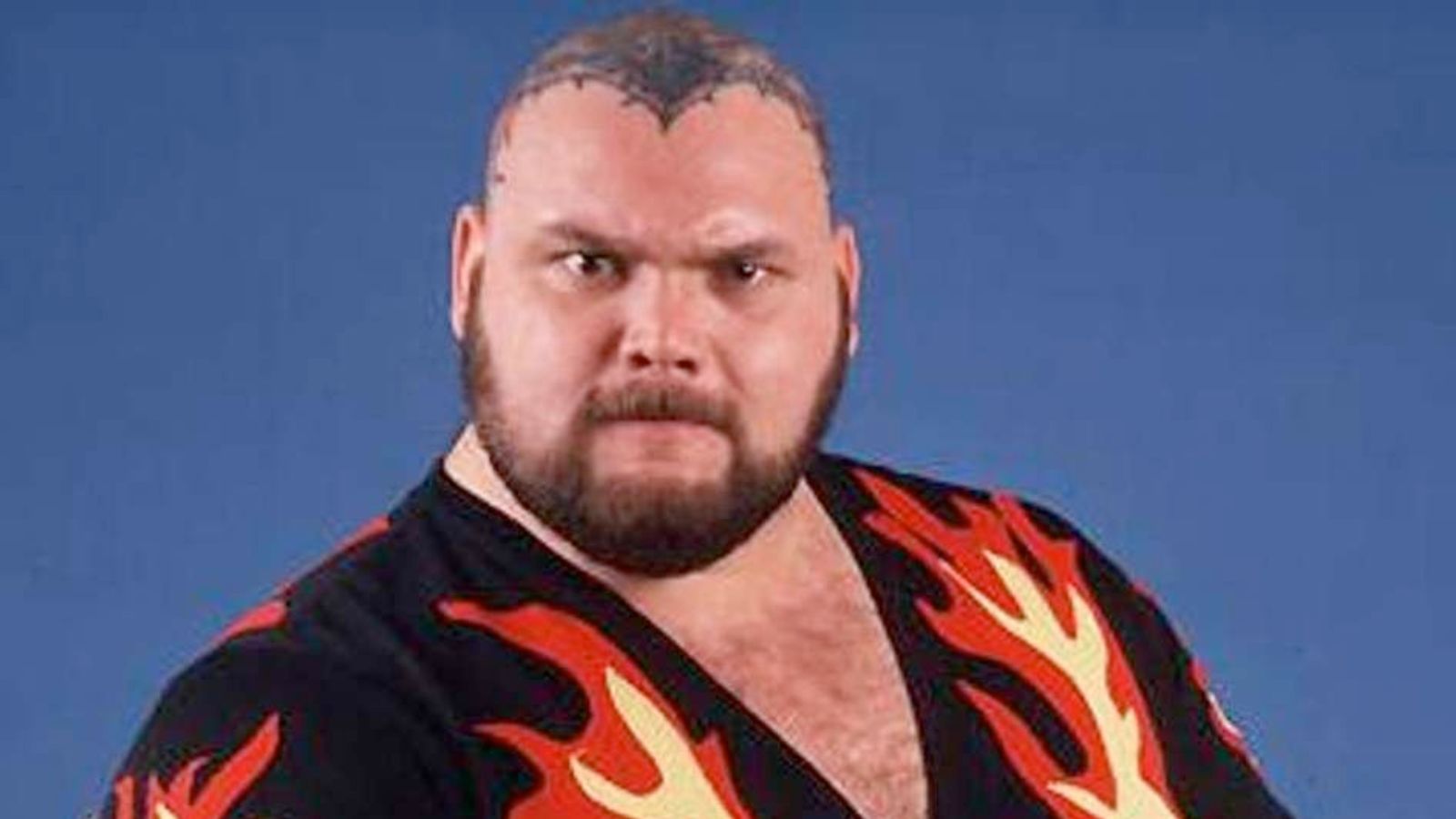
Scott Charles Bigelow, better known to the world of professional wrestling as Bam Bam Bigelow, was one of the most unique and unmistakable figures in wrestling history.
Standing 6’4” and weighing over 390 pounds, Bigelow moved with surprising agility for his size. His signature flame tattoo covering his bald head, combined with his speed and athleticism, made him an attraction wherever he worked.
Over a career that spanned more than two decades, Bigelow captured titles in several promotions, wrestled in memorable matches on some of the biggest stages, and left a mark on the industry that endures to this day.
Bam Bam Bigelow –
Early Life and Wrestling Beginnings
Scott Bigelow was born on September 1, 1961, in Asbury Park, New Jersey. A natural athlete from a young age, Bigelow was a standout amateur wrestler in high school, where he reportedly won the New Jersey state championship.
After high school, he held various jobs, including serving as a bounty hunter, before transitioning to a career in professional wrestling.
He trained under the famed Larry Sharpe at the Monster Factory, a New Jersey-based school that produced stars like Tony Atlas and King Kong Bundy. Sharpe, who was instrumental in Bigelow’s early career, said in a 1987 interview:
“There was nobody like him. Here’s this giant of a man who could move like a cat and had charisma. The flame tattoos were his idea—he wanted to stand out.”
Bigelow debuted in 1985 and quickly earned a reputation as a unique big man, wrestling under various names in the U.S., Japan, and Puerto Rico.
In his early days, he wrestled in Memphis, New Japan Pro Wrestling, and Puerto Rico’s WWC, winning over audiences with his athleticism.
Rise to Prominence in the WWF
Bigelow debuted in the WWF (now WWE) in 1987, managed by Oliver Humperdink. In his first run, he was pushed as a babyface attraction who could take on any of the WWF’s top heels.
His high-profile matches that year included teaming with Hulk Hogan, Don Muraco, and Ken Patera at Survivor Series 1987, where he was the last man left on his team before falling to André the Giant.
Bigelow’s performance in that match stood out: after Hogan was eliminated, Bigelow pinned both King Kong Bundy and One Man Gang before succumbing to André. It was a strong showcase for a newcomer, cementing his status as a big man who could carry a match.
“I wasn’t just a big guy. I was a worker. I could go with anybody,” Bigelow said in a 2001 shoot interview.
His first WWF stint was brief, and by 1988 he left the company due to injuries. He wrestled in Japan and WCW before returning to the WWF in 1992.
A Monster Made for the East
Bam Bam Bigelow’s time in Japan was a pivotal, often underrated part of his career that enhanced his legitimacy and expanded his global appeal.
His size, agility, and look were perfectly suited for the Japanese market, where credibility in the ring and hard-hitting athleticism are often more highly valued than entertainment or gimmick-heavy presentation.
Bigelow worked with multiple promotions in Japan, but his most notable stints came with New Japan Pro Wrestling (NJPW) and later with All Japan Pro Wrestling (AJPW).
Bigelow first wrestled for New Japan Pr0 Wrestling in the late 1980s, aligning with top international talent as part of the company’s ongoing strategy of bringing in credible foreign “gaijin” stars.
His appearance was a huge draw — the flaming skull tattoo on his head and surprising agility made him stand out immediately to Japanese fans.
One of the most memorable aspects of his NJPW run was his tag team partnership with Big Van Vader. Together, they were booked as an unstoppable force of size and power.
Managed at times by Masahiro Chono or other handlers depending on the storyline, the team was billed as a monstrous foreign duo, creating chaos in the heavyweight tag division.
In July 1988, Bigelow and Vader faced Riki Choshu & Masa Saito in a physical, high-profile tag bout. Though they often came up short against top-tier Japanese talent (in traditional booking fashion), they elevated the profile of foreign wrestlers in Japan.
Japanese fans respected Bigelow for his in-ring realism, ability to work stiff, and high spots for a man of his size — such as cartwheel backflips and enzuigiris. This agility helped separate him from the usual lumbering big men that Japanese audiences had seen over the years.
Return To The East for the Beast
After his first WWF stint ended in 1988–1989, Bigelow returned to Japan intermittently, later showing up in All Japan Pro Wrestling (AJPW), which had one of the strongest heavyweight divisions globally.
In All Japan, Bigelow competed against some of the hardest-hitting names in the business — Mitsuharu Misawa, Toshiaki Kawada, Kenta Kobashi, and Stan Hansen. His matches there weren’t about angles or characters; they were about physicality and endurance.
A notable feud for Bam Bam was against The Lariat. Bigelow clashed with Stan Hansen in several battles between gaijin heavyweights. While not full-blown feuds, their stiff exchanges were crowd-pleasers and added legitimacy to Bigelow’s resume.
Although Bigelow never won a major Japanese title, he did participate in several Champion Carnival tournaments, Japan’s equivalent of the G1 Climax at the time. His performances were respected, even when he didn’t reach the finals.
Japanese wrestling media frequently praised Bigelow. In a 1993 interview with Tokyo Sports, Mitsuharu Misawa commented:
“Bigelow moved like a junior [heavyweight] and hit like a veteran. Every time he came here, the fans believed in what he did.”
In an interview on the NJPW World History Documentary (aired in 2021), Keiji Mutoh (Great Muta) said:
“He didn’t need to talk to tell a story. That’s why Japan loved him.”
While Bigelow’s work in Japan was often overshadowed by his WWF and ECW runs, it was in Japan that he built his global reputation as a serious competitor.
Japanese promoters booked him as a legitimate threat, not a gimmick, and younger Japanese wrestlers learned how to work with and around larger opponents by studying Bigelow.
His time in Japan influenced how he approached later matches, especially in ECW, blending snug strikes, legitimate bumps, and pacing that reflected puroresu psychology.
Bam Bam Bigelow may not have won a belt in Japan, but his contributions were long-lasting:
He helped raise the standard for what a “big man” could do in the ring. Bigelow opened doors for agile big men like Mike Awesome and Jeff Cobb in Japanese rings.
Finally, he increased credibility for foreign workers who came not to clown, but to compete. He was never a sideshow — he was a legitimate threat.

Headlining WrestleMania XI – Bam Bam Bigelow vs. LT
Their WrestleMania main event gave Bigelow mainstream exposure. This feud culminated in the WrestleMania XI main event — one of the most high-profile, mainstream moments in wrestling history.
Bigelow, representing the New Generation era’s heel faction, The Million Dollar Corporation, was chosen to face NFL Hall of Famer Lawrence Taylor.
The Inciting Incident:
At Royal Rumble 1995, after losing a tag match, Bigelow got into a confrontation with Lawrence Taylor, who was sitting ringside. Bigelow shoved Taylor, setting the feud in motion.
At WrestleMania XI, Lawrence Taylor vs. Bam Bam Bigelow battled in the main event at the Hartford Civic Center, Hartford, CT. It was a rare celebrity vs. wrestler main event for WrestleMania.
Bigelow was a true professional. He worked the match like a veteran, leading Taylor step-by-step through a surprisingly competitive match.
Taylor defeated Bam Bam Bigelow cleanly with a flying shoulder block. After the match, Bigelow was publicly shamed by the Million Dollar Corporation, slowly turning baby face in the weeks that followed.
Wrestling insiders praised Bigelow’s professionalism. He made a non-wrestler look credible in the biggest match of the year.
Bruce Prichard said on Something to Wrestle With:
‘If it weren’t for Bigelow, that match would’ve been a disaster. He carried Taylor bell to bell.’
(Episode Archive)
This match drew mainstream media attention — ESPN, Sports Illustrated, and local news covered the event. Although not favored by traditional fans, it helped the WWF secure sponsorships and gain attention during a financially challenging period.
He was equally comfortable as a menacing heel or a sympathetic face, which allowed him to fit into various roles.
Bigelow’s second WWF run was more impactful, especially during his association with the Million Dollar Corporation led by Ted DiBiase.

After a strong showing at King of the Ring 1993, he began a feud with Doink the Clown and later became tag team champions with Tatanka.
This feud was emblematic of the cartoonish character era of the early 1990s. Doink, at the time still portrayed by Matt Borne, was a sadistic heel clown who used deception and mind games. Bigelow, despite his menacing appearance, was used as a foil for Doink’s psychological warfare.
During Monday Night RAW on multiple segments in 1993, Doink played pranks on Bigelow — tripping him, pie-faced him, and even using a water bucket gag. One angle featured multiple Doinks, creating confusion and comedy during matches.
At WrestleMania IX, while Bigelow wasn’t involved in the Doink match directly, the double-Doink finish (vs. Crush) foreshadowed the comedy tone of their later feud.
On WWF Superstars and Challenge (Spring 1993), Bigelow and Doink had matches that aired regularly. Bigelow worked stiff, grounding the otherwise zany Doink antics in legitimate-looking offense.
Bigelow aligned with Luna Vachon, who began a parallel feud with Doink’s valet, Dink (the mini Doink). This added intergender and comedic segments to the storyline.
While not a technical classic, this feud demonstrated Bigelow’s willingness to commit to outlandish characters and scenarios, helping sell WWF’s kid-friendly direction while still protecting his aura as a bruiser. The matches balanced entertainment with flashes of aggression, giving Bigelow airtime during a transitional period.
However, his most famous match took place at WrestleMania XI in April 1995, where he headlined against NFL star Lawrence Taylor in one of the most unusual main events in WWE history.
Bigelow carried Taylor to a surprisingly good match, showing his ability to work with a non-wrestler on the biggest stage of the year. Though he lost, Bigelow’s professionalism and performance were widely praised backstage.
Jim Ross later recalled: “Bam Bam carried LT that night. He made him look like he belonged. That’s the kind of pro Bam Bam was.”
The match drew mainstream headlines and drew a reported 340,000 pay-per-view buys.
The Beast Unleashed an EXTREME
After leaving WWF in 1995, Bigelow made his way to Extreme Championship Wrestling in 1996. In ECW, he reinvented himself as a dominant heel and became part of the Triple Threat stable with Shane Douglas and Chris Candido.
He won the ECW World Heavyweight Championship by defeating Douglas in October 1997 and also captured the ECW World Television Championship.
One of his most memorable moments came in 1998 when he faced Taz at Living Dangerously. In an iconic spot, Bigelow drove Taz through the ring mat with a suplex, creating one of ECW’s most unforgettable visuals.

The Beast from the East vs. The Human Suplex Machine
In ECW, he would feud with the Human Suplex Machine, Taz. Their matches were brutal, innovative, and defined the hardcore era of ECW.
By 1997, Bam Bam Bigelow was a veteran with WWF and WCW experience, while Taz had become the face of ECW’s new breed — intense, no-nonsense, and shoot-style in presentation.
Their feud was about toughness and legitimacy, with Bigelow positioned as the unstoppable wall against Taz’s explosive ferocity. They engaged in several key matches and had notable moments during these matches as well.
For example, at ECW Hardcore Heaven 1997, Bigelow joined the Triple Threat stable with Shane Douglas and Chris Candido, putting him in direct conflict with Taz, who had declared himself the “FTW World Champion.”
This match teased physicality, but the full payoff would come later. It was mostly buildup for their major encounters in 1998.
Next, at ECW Living Dangerously 1998, their match was for Taz’s FTW Title, Held in Asbury Park, New Jersey — Bigelow’s hometown.
Midway through the match, Taz locked in the Tazmission, and Bigelow backward-dived through the ring canvas, both men disappearing through the floor.
This visual became iconic in ECW lore. Bigelow won by emerging from the hole and pinning Taz, capturing the FTW Championship. It solidified Bigelow’s monster status and showcased ECW’s blend of violence and spectacle.
Finally, at ECW Heat Wave 1998, Taz & Sabu would take on Bigelow & Rob Van Dam. It was a high-paced hardcore tag match that combined multiple feuds. This ended the Taz-Bigelow rivalry with a chaotic crescendo.
Taz would regain the FTW belt and eventually the ECW World Championship. Bigelow was praised for lending credibility to ECW’s roster by selling for Taz and making him look legitimate.
Paul Heyman said in an interview:
“Bigelow could’ve walked into any company. But he helped us make Taz. He helped elevate our brand.”
(Wrestling Observer, 2004)
After leaving ECW, Bigelow had another run in WCW from 1998 to 2001. In WCW, he feuded with Goldberg and Diamond Dallas Page and was part of the hardcore division, winning the WCW Hardcore Championship
He also held titles in Japan, including the IWGP Tag Team Championship alongside Vader in New Japan Pro Wrestling, and had notable matches against the likes of Bret Hart, Hulk Hogan, and Ric Flair.
After WCW folded in 2001, Bigelow worked sporadically on the independent scene before retiring from active competition in 2004. He also tried his hand at acting, appearing in Major Payne (1995) and doing stunt work.
Bigelow lived a quiet life in New Jersey after wrestling, though he battled health issues and personal struggles. He was badly injured in 2000 when he rescued three children from a burning house, sustaining burns over 40% of his body.
Speaking about the incident, he said:”I did what anybody would have tried to do. I burned 40 percent of my body with second-degree burns and spent almost two months in the hospital.“
Sadly, Scott Bam Bam Bigelow passed away on January 19, 2007, at the age of 45, due to an accidental drug overdose. He left behind a son, Shane, and a lasting legacy in the business.
The Impact of a Beast on the Industry
Bam Bam Bigelow remains one of the most respected big men in wrestling history. His ability to perform moonsaults and cartwheels, his speed, and his charisma set him apart in an era where most men his size were lumbering powerhouses.
He influenced later generations of agile big men, including wrestlers like Samoa Joe, Keith Lee, and Bronson Reed, all of whom have cited Bigelow as an inspiration.
Samoa Joe once said:
“Guys like Bam Bam Bigelow showed that you could be 350 pounds and still go like a cruiserweight. He broke the mold.”
His work with celebrities like Lawrence Taylor also proved that he could make anyone look good, and his memorable moments in ECW contributed to the company’s hardcore legacy. His head tattoo and distinctive look remain iconic, even decades later.
Bam Bam Bigelow’s legacy endures because he brought something different to the sport at a time when few others did. He showed that big men could be athletic, that wrestlers could also be believable in crossover matches, and that character presentation mattered.
Fans and peers remember him fondly. Paul Heyman once remarked:
“Bam Bam was an unbelievable talent. He was a star anywhere he went. ECW wouldn’t have been the same without him.”
While he has yet to be inducted into the WWE Hall of Fame—a fact that many fans and wrestlers alike view as an oversight—his contributions are undeniable.
Scott “Bam Bam” Bigelow lived fast, worked hard, and gave his all to professional wrestling. He may not have always been in the main event picture, but he was a true professional who elevated everyone he worked with. His unique look, agility, and work ethic make him one of the most beloved big men in wrestling history.
As Mick Foley once put it:
“Bam Bam was a big man who made big men cool.”
His flame burns on.