
If the 1980s gave birth to the golden age of tag teams, then the 1990s tested their endurance in an era of change, particularly these are 20 tag teams that defined the 1990s.
As wrestling evolved from territories to televised dominance, tag teams adapted, merging athleticism, storytelling, and spectacle.
From Japan’s stiff-strike realism to America’s attitude-era showmanship, this decade produced duos who shaped the future.
The 1990s saw old-school pairings evolve into pop-culture icons. Teams like The Steiner Brothers and The Outsiders revolutionized tag team branding, while Japanese duos like The Holy Demon Army elevated the art to new technical heights.
Whether fueled by family ties, friendship, or chaos, these 20 teams didn’t just dominate — they defined how tag team wrestling survived and thrived during a turbulent, transitional decade.

20 Tag Teams That Defined 1990s
#20. The Quebecers (Jacques & Pierre Ouellet)
With matching uniforms and patriotic flair, The Quebecers brought humor and brutality to the WWF’s mid-’90s scene. Managed by Johnny Polo, they were both entertaining and effective.
Jacques laughed, “We sang our own theme — because who else could?” Their multiple Tag Title reigns and chemistry made them one of the last great “gimmick” teams before the Attitude Era transformed the landscape entirely.
Related Reads: Jaques Rougeau –

#19. The Smoking Gunns (Billy & Bart Gunn)
Cowboy charisma met legitimate toughness in The Smoking Gunns. Their clean-cut image and smooth teamwork made them the WWF’s early ’90s standard bearers.
Bart recalled, “We wanted to bring back wrestling to tag wrestling.” With multiple WWF Tag Title reigns, they represented the bridge between classic teams and the coming Attitude revolution.

#18. The Public Enemy (Rocco Rock & Johnny Grunge)
Before tables became mainstream, The Public Enemy made them household props. Masters of ECW’s hardcore brawls, they combined charisma and creativity.
Rocco Rock once said, “We weren’t technicians — we were demolition men.” Their popularity and violent innovation brought ECW to wider audiences and influenced the WWF’s hardcore tag evolution.

#17. The Eliminators (Perry Saturn & John Kronus)
ECW’s tag division was gritty, athletic, and innovative — and The Eliminators embodied all three. Their Total Elimination finisher became one of the most devastating double-team maneuvers of the decade.
Saturn noted, “We were fast, mean, and impossible to predict.” Their ECW Tag Title runs and battles with The Dudleys and The Gangstas added legitimacy and athletic intensity to ECW’s chaotic style.

20 Tag Teams That Defined 1990s
#16. The Headbangers (Mosh & Thrasher)
In an era of edgy gimmicks, The Headbangers fit right in. Sporting piercings, skirts, and head-banging entrances, they represented the Attitude Era’s irreverent charm.
Mosh said, “We were the weirdos — and people loved it.” Their surprising WWF Tag Title victory in 1997 captured the decade’s unpredictability and proved personality could triumph over polish.

#15. Money Inc. (Ted DiBiase & Irwin R. Schyster)
Greed paid off for this cunning combination. Ted DiBiase and IRS ruled WWF’s mid-’90s tag division with arrogance and strategy.
DiBiase quipped, “We didn’t need luck — we bought victory.” Their back-to-back WWF Tag Title reigns and memorable feuds against The Steiners and The Natural Disasters made them the era’s quintessential villains.

#14. The Natural Disasters (Earthquake & Typhoon)
Two massive powerhouses, Earthquake and Typhoon, united under Jimmy Hart brought size and spectacle to the WWF in the early 1990s. Their sheer weight and teamwork crushed opponents.
Earthquake once said, “When we hit you, the ring felt it too.” Their WWF Tag Team Title reign and feuds with The Legion of Doom and Money Inc. highlighted that even in an era of flash, pure power still drew crowds.

#13. The Faces of Fear (Meng & The Barbarian)
A blend of brute strength and intimidation, Meng and The Barbarian were WCW’s enforcers. Known for devastating strikes and a stoic presence, they were feared by fans and wrestlers alike.
Meng later laughed, “We didn’t do fancy — we did damage.” Their wars with The Steiner Brothers and Harlem Heat reinforced WCW’s deep tag roster and added danger to every match they entered.

#12. Sabu and Rob Van Dam
Sabu and RVD teamed in ECF from 1996 after their singles feud. The duo were managed by Bill Alfonso. They won the ECW Tag Titles twice.
The first time was on June 27, 1998, after defeating Chris Candido and Lance Storm on Hardcore TV. They would hold the title for 3 months and dropped them to Dudley Boyz on Oct 24th, 1998.
Their second title win was on December 6, 1998, vs. The Dudley Boyz at the ECW/FMW Supershow in Japan, which aired on Hardcore TV. They also headlined the Heat Wave 1998 pay-per-view against Hayabusa and Jinsei Shinzaki.
Together, Sabu and Van Dam’s most notable feuds were against the likes of The Eliminators, Dudleys, and Public Enemy.
They were a solid midcard/main event draw that was incredibly popular with the ECW fanbase. They were the epitome of ECW’s hardcore and high-flying style.

#11. The Legion of Doom (Animal & Hawk)
Though born in the ’80s, The Legion of Doom’s WWF run in the early ’90s rekindled their dominance. Their entrance pop was thunderous, their presence unmatched.
They would capture the WWF Tag Team Championships during their time in the World Wrestling Federation and, for a period, carried on the success of the previous decade.
Hawk said, “We didn’t slow down — we just added more pain.” Capturing the WWF Tag Titles at SummerSlam ’91, they bridged eras, proving old-school brawlers could thrive in a modern landscape. Their influence remained unmatched well into the decade.
Related Reads: The Road Warriors: The Most Dominant Tag Team of Their Generation

20 Tag Teams That Defined 1990s
#10. The Nasty Boys
The Nasty Boys (Brian Knobbs and Jerry Sags) had solid runs in both WWF and WCW during the 1990s. In WWF from late 1990 to 1993, they jumped straight to the top.
Managed by Jimmy Hart, they won the WWF Tag Team Titles from the Hart Foundation at WrestleMania VII on March 24, 1991, in LA.
They held the titles for 127 days until losing to Legion of Doom at SummerSlam in MSG. Among their most notable feuds were The Rockers, Bushwhackers, and Natural Disasters.
After leaving the WWF, they returned to WCW, where they were from 1993 to 1997. Upon their return, they were managed by Missy Hyatt.
They would capture the WCW Tag Titles on three separate occasions. These included: Fall Brawl 1993 against Arn Anderson and Paul Roma, against Marcus Bagwell and 2 Cold Scorpio, and against Harlem Heat.
While there, there were key brawls with Cactus Jack, Maxx Payne, and Harlem Heat. Knobbs and Saggs won Pro Wrestling Illustrated’s Tag Team of 1994.
Overall, the teams’ WWF peak came at WrestleMania, when they captured championship gold while their time in World Championship Wrestling helped to maintain their notoriety.

#9. The Holy Demon Army (Toshiaki Kawada & Akira Taue)
In AJPW, few rivalries or partnerships burned brighter than Toshiaki Kawada and Akira Taue’s. While under the watch of Giant Baba, they became central figures in the legendary “Four Pillars of Heaven” era.
Their brutal wars against Mitsuhara Misawa & Kenta Kobashi are considered some of the greatest tag matches ever wrestled. Kawada once said, “Pain was our poetry — every strike meant something.”
They held the AJPW World Tag Titles multiple times and brought technical violence to perfection. Their legacy influenced the pacing and psychology of modern tag wrestling worldwide.

#8. The Outsiders (Kevin Nash & Scott Hall)
Formed from the ashes of the WWF’s Kliq and birthed in WCW’s chaos, The Outsiders redefined what tag teams could represent. As the founding force behind the nWo, Scott Hall and Kevin Nash blurred the line between storyline and reality.
Their cocky swagger and cool villainy turned WCW’s tag division into must-see TV. Hall famously said, “You know who I am, but you don’t know why we’re here.”
Their WCW World Tag Team Title reigns coincided with wrestling’s biggest boom, giving tag wrestling mainstream relevance again. They brought marketing, attitude, and cinematic cool to a division often left behind.

#7. The Hart Foundation (Bret Hart & Jim Neidhart / Owen Hart & The British Bulldog)
The early 1990s iteration of The Hart Foundation reflected family pride and evolving excellence. Bret and Jim transitioned from tag specialists to singles stars, while the latter version featuring Owen Hart and Davey Boy Smith carried the family banner into the new decade.
Bret once said,
Tag wrestling taught us unity — even when family fought.”
Whether in WWF’s early ’90s heyday or during the 1997 Hart Foundation faction, they embodied technical mastery and emotional storytelling, capturing the essence of wrestling’s shift from sport to drama.
Related Reads: Hart Foundation Forever: Excellence, Tradition, and Family
Related Reads: Hart Foundation Forever II: The Journey to Their Final Union
Related Reads: Hart Foundation Forever III: A New Hope

#6. The New Age Outlaws (Road Dogg & Billy Gunn)
In the late 1990s, the New Age Outlaws embodied the Attitude Era’s rebellion. With Road Dogg’s mic skills and Billy Gunn’s athleticism, they became the WWF’s most popular duo.
Their catchphrase, “Oh, you didn’t know?”, ignited every arena. Road Dogg later said, “We were chaos with choreography.”
As part of D-Generation X, they captured multiple WWF Tag Titles, balancing humor, rule-breaking, and charisma. The Outlaws proved that entertainment value could drive tag team main events again.

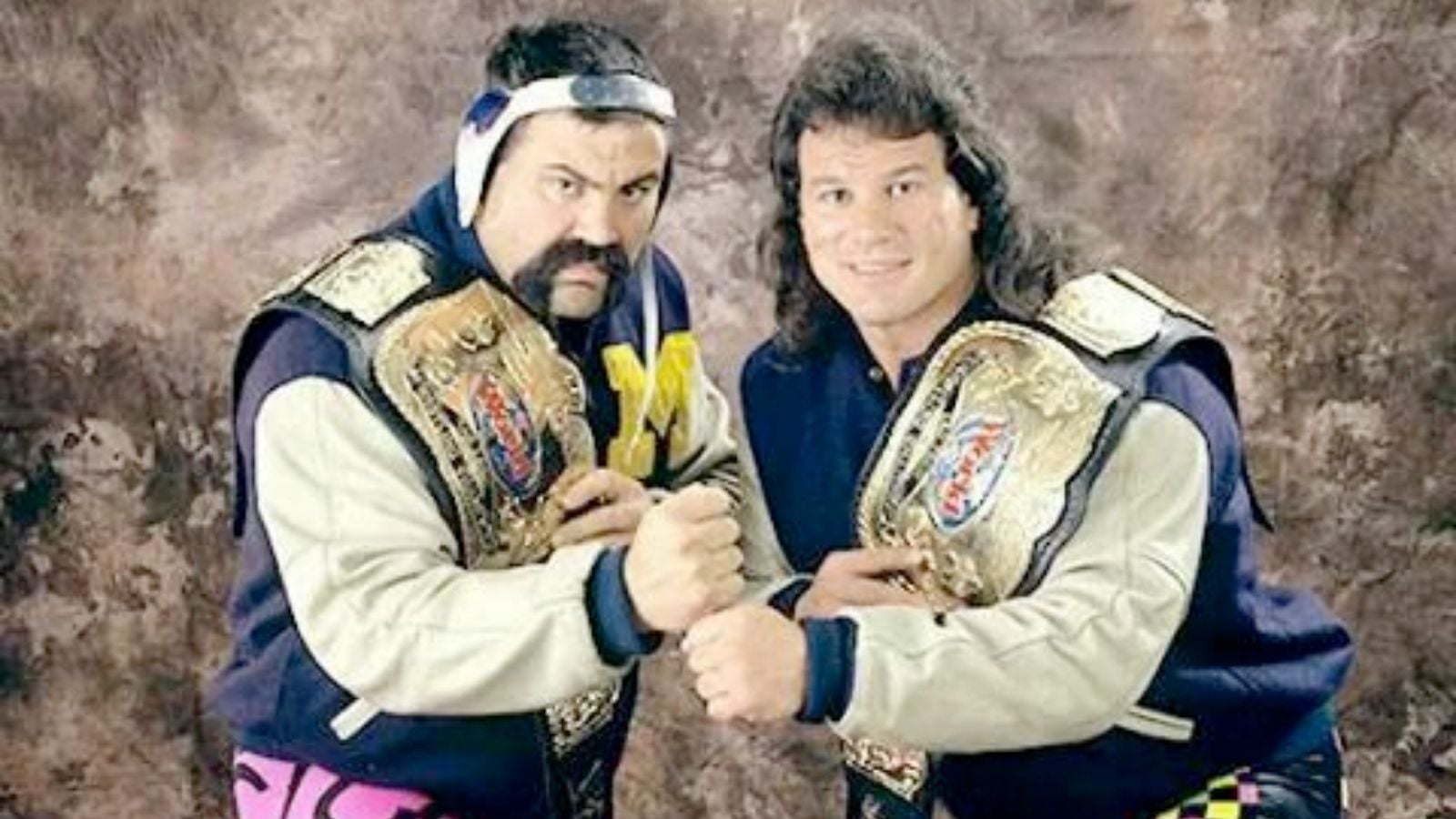
#5. The Steiner Brothers (Rick & Scott Steiner)
No team captured the early 1990s blend of realism and explosiveness like The Steiner Brothers. Combining collegiate wrestling credibility with jaw-dropping power, they were the benchmark for tag excellence.
Their Steiner Bulldog and Frankensteiner became highlights on both WCW and NJPW cards. In Japan, their matches against Misawa and Kobashi elevated them to cult legend status.
Scott once said,
“We didn’t work matches — we fought to win them.”
Their multiple reigns as WCW and IWGP Tag Team Champions solidified their cross-continental dominance. By blending American power with Japanese intensity, the Steiners became the measuring stick for technical tag wrestling in the decade’s first half.

#4. The Harlem Heat (Booker T & Stevie Ray)
Few teams defined WCW’s mid-to-late 1990s scene like Harlem Heat. Managed by Sister Sherri, their combination of raw power, athleticism, and attitude made them dominant.
Booker T said, “We weren’t just representing a city — we were representing our culture.” With ten WCW World Tag Team Title reigns, they were the most decorated team in company history. Their charisma and consistency made them icons as WCW’s golden years unfolded.
Related Reads: Harlem Heat

#3. Edge & Christian
From mysterious debut to five-time WWF Tag Team Champions, Edge & Christian blended humor and high-impact precision. Their chemistry in the TLC matches made them household names.
Edge said, “We wanted fans to laugh — then gasp.” Their mix of athleticism and entertainment value elevated the WWF tag division during the Attitude Era, balancing danger with charisma.

#2. The Hardy Boyz (Matt & Jeff Hardy)
Emerging from North Carolina’s backyard rings, The Hardy Boyz injected youth, risk, and innovation into WWF’s late-’90s revival. Their aerial artistry and daredevil courage redefined what tag wrestling could be.
Jeff once said, “We weren’t built to be safe — we were built to be remembered.” Their TLC wars with Edge & Christian and The Dudleys became instant classics. As the decade closed, they symbolized the fearless new millennium to come.

20 Tag Teams That Defined 1990s
#1. The Dudley Boyz (Bubba Ray & D-Von Dudley)
Out of ECW’s chaos came one of wrestling’s most decorated tag teams. The Dudley Boyz embodied brutality and unpredictability, using tables, chairs, and insults in equal measure.
Their cry of “D-Von, get the tables!” became an ECW anthem. Bubba Ray later recalled, “We made people love violence — and they paid to see it.”
Their multiple ECW Tag Title reigns and later success in the WWF cemented their legacy. The Dudleys’ blend of hardcore brawling and undeniable charisma reshaped tag wrestling for the extreme generation.
The 1990s were a proving ground for tag wrestling’s survival. In an age of singles superstars and shifting styles, teams like The Steiners, The Outsiders, and The Dudleys proved the art of partnership still mattered.
Japan’s technical mastery met America’s storytelling spectacle, and from ECW’s chaos to WWF’s resurgence, tag teams found ways to evolve. While honorable mention should go to teams such as The Impact Players, The Pitbulls, and The Godwins
Each tandem — from legends carrying their 1980s glory to innovators breaking new ground — contributed to a decade where wrestling redefined itself.
The 1990s may have begun in tradition, but it ended in transformation. These twenty teams weren’t just participants in that change — they were the change.