




Benny Safdie’s The Smashing Machine is quite the ride.
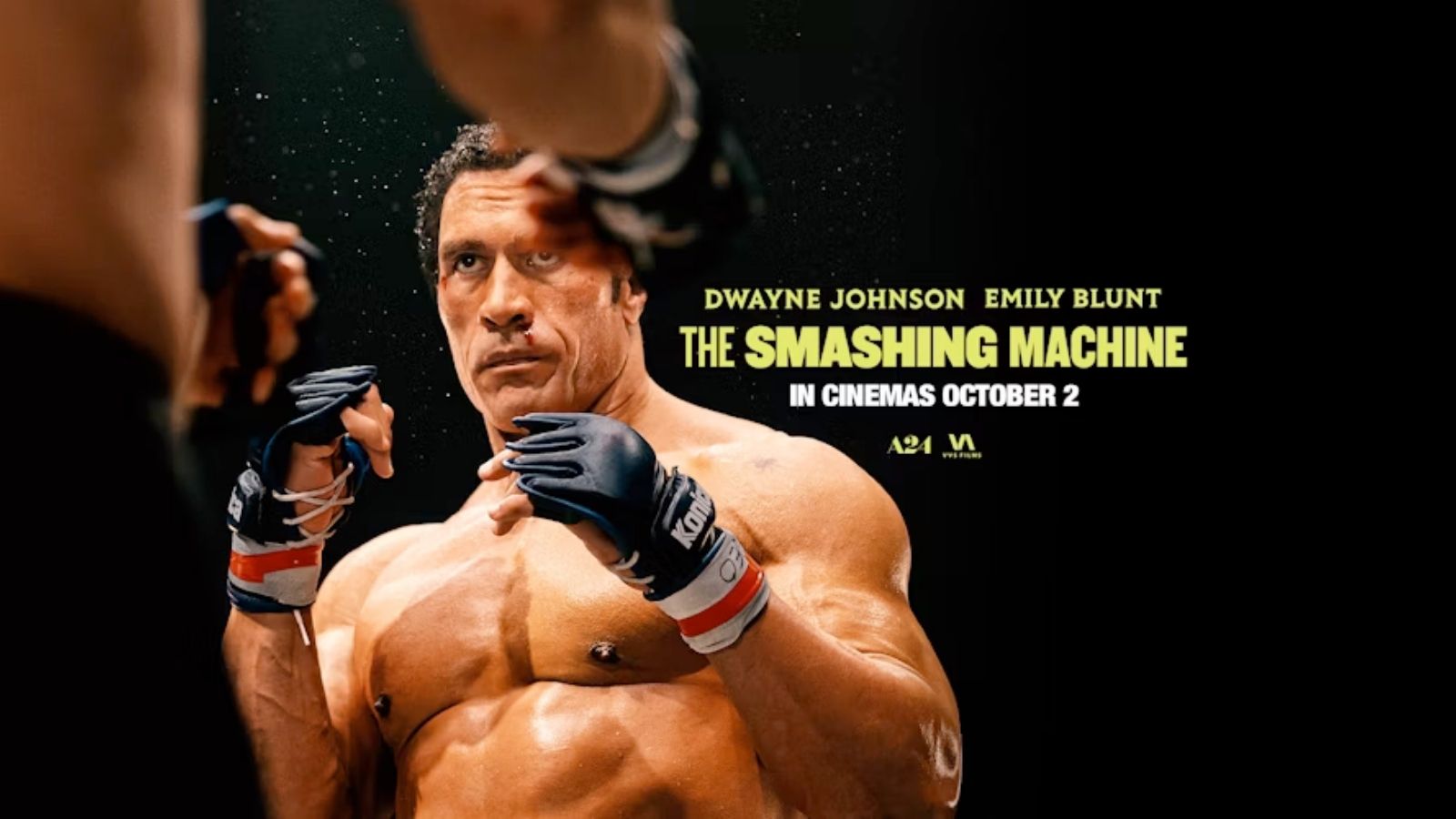
Dwayne “The Rock” Johnson gives by far his greatest performance as early MMA pioneer Mark Kerr, seamlessly transitioning from childlike to brutal- often in the very same scene or even moment.
This isn’t The Rock in charming and charismatic popcorn movie “safe mode.” This is a hurting, seething, crying, wounded, let-it-all-hang-out, “time to finally be an ACTOR” performance.
It’s raw, it’s wonderful, it’s memorable, and there’s not a door or piece of furniture that remains safe when he’s in a steroid-induced rage.
It must also be noted that Johnson is almost unrecognizable as Kerr. Yes, he’s similarly an imposing physical specimen, but facially, the various prosthetics and wigs successfully help him disappear into this ever-so memorable role.
Had he just looked silly and unconvincing —like several of the characters playing legendary wrestlers in the recent Von Erich biopic, The Iron Claw —he wouldn’t have stood a fighting chance.
And this is an incredible performance that is Oscar-worthy.
But the movie itself is a different beast.
Safdie, along with his brother Joshua, was responsible for multiple raw, low-budget triumphs, including Good Time, Daddy Longlegs, and their masterpiece, the harrowing Uncut Gems, which similarly made you realize, “Wow, Adam Sandler can act.”
But here Safdie- who also wrote and edited- makes some strange choices.
The most glaring issue is that the numerous fight sequences never quite capture the level of thrills or gravitas found in Scorsese’s Raging Bull or Stallone’s Rocky series.
Shot from mostly outside the ring, you’re getting a fan’s perspective, and it’s partly why The Smashing Machine doesn’t touch Raging Bull or Rocky as a “fight film” or movie period.
Where the film does shine is in capturing the volatile relationship between Kerr and his girlfriend and later wife, portrayed by a tremendous Emily Blunt. When they’re on screen together, anything can and will happen from the most tender moment to utter chaos.
The Smashing Machine
Rocky and Adrian, this isn’t.
Both are partying hard, with Kerr in denial of his painkiller addiction issues. He later tries to rehab, and the sparks—and furniture—fly.
These are by far the best scenes in the film, with both performers swinging for the fences. Thus, I found it disconcerting that their six-year marriage, the birth of a child, and their eventual parting are merely footnotes at the end of the film. I could have easily lived with one less fight scene and a fully told relationship story.
Interestingly and effectively, the film almost feels documentary-like, with several scenes shot with only one camera.
You feel like a fly on the wall as Kerr, nearing the end of his career (he lost 11 of his last 15 fights), faces a variety of overwhelming personal and professional issues and often makes bad choices along the way.
Safdie surrounds Johnson and Blunt with notable figures from the world of MMA, including Ryan Bader as buddy Mark Coleman, as well as Satoshi Ishii, James Moontasri, current Heavyweight boxing kingpin Oleksandr Usyk, and even Bas Rutten as himself.
They all lend authenticity to the film, and Rutten, as his trainer, is particularly effective in an understated and tender role, trying to console an often-distraught Kerr after a loss.
Like so many sports pioneers, Kerr didn’t see the big money, and one early scene has him complaining about a four-figure payoff discrepancy.
He notes that his fighting career afforded him his home, but this is a blue-collar guy who, like so many athletes, came along too soon and gave more than he got from his chosen field. The pain and injuries he suffered are duly noted in the film.
In June 2019 on a GoFundMe page, Kerr announced that he had been battling peripheral neuropathy since 2016. What a sad scenario for an athlete who sacrificed mightily for his art.
On a personal note, I saw the film in my local movie theater amidst a massive throng of six people, with a senior down the row from me snoring heavily.
While I wouldn’t call The Smashing Machine a masterpiece by any means, Dwayne Johnson’s performance is memorably great, and the film deserves better than this kind of reception and the box office dismal failure it has become. Shot on a reported 50 million, I have a few theories on why it has died a quick death.

Eastwood pulled it off. As did Bautista. Many others couldn’t break away from the action hero image they created. Simply put, for many, if they see you as an action star, you’re an action star.
Plus, MMA isn’t for everyone —and I’m far more a boxing and wrestling fan than “UFC guy” myself — it’s yet another obstacle that needed to be bridged to put this film over the finish line.
Regardless of its flaws and box office failure, The Smashing Machine is well worth a view, because you’d be hard-pressed to find two better performances than these. It also makes me want to see the documentary on which it was based.
And when the Academy Awards come around, don’t be shocked to see Dwayne Johnson get a deserved nod and maybe even a win.
Think Mickey Rourke’s Golden Globe win and Oscar nomination for The Wrestler, and you’re talking a similar soaring performance here.
Sometimes, choosing a winner of a role and eviscerating yourself on screen rather than coasting through yet another forgettable CGI-laden franchise flick really is the way to go.
Dwayne Johnson ‘cooks’ up an exceptional performance
With “The Smashing Machine,” I can most certainly “smell what the Rock is cooking.”
Hey, the man is an actor.
Bravo, Mr. Johnson.