

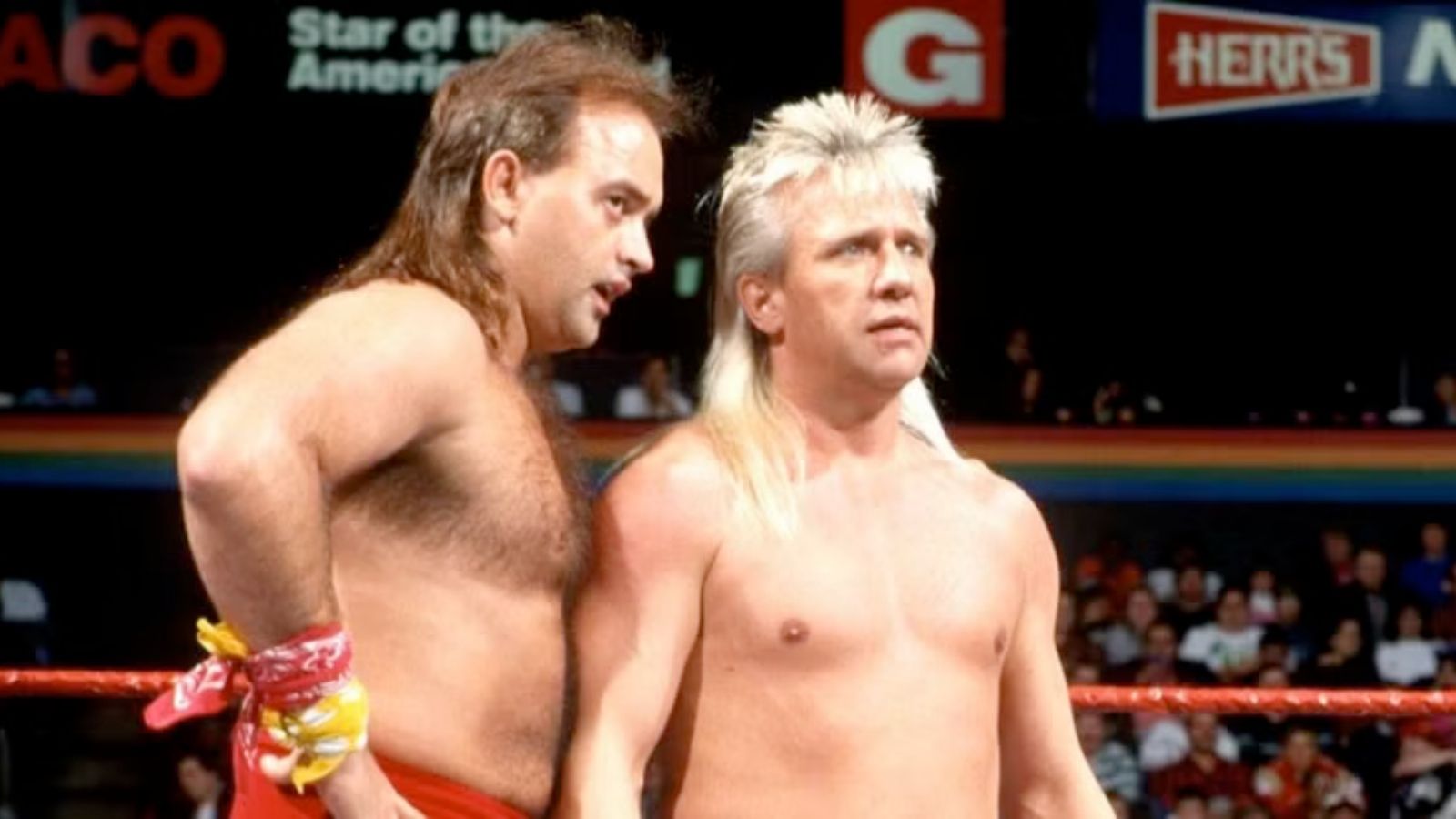
When people talk about tag-team wrestling in the 1980s, one name crops up more than most: The Rock n Roll Express.
Ricky Morton and Robert Gibson weren’t the flashiest athletes of their era, but they were the perfect combination of charisma, timing, and storytelling — a formula that made them innovators, crowd magnets, and a long-lasting touchstone for tag-team psychology.
This is their story: how they formed, the big feuds that defined them, the times they worked apart, the titles they held, and the impact they left on the business.
The Rock N Roll Express |
Formation and Early Years: Built for the Crowd
As told by Ricky Morton the reason he became a tag team wrestler was because it provided another opportunity that most wrestlers don’t see as how crucial it can be.
Back then my dad said being a single you’re never going to get over being by yourself. Because that’s the booker or that’s the owner.
They’re going to push themselves. But the business always needs a semi-main event and check it out its tag team wrestling. I went home and I said I never thought of that.
Ricky Morton and Robert Gibson first teamed up in the early 1980s. Their look (bright tights, rock-and-roll attitude) and high-energy approach were intentionally crafted to give promoters a fresh, exciting babyface duo that could draw strong reactions and sell tickets.
The team initially built heat with southern audiences in territories, eventually breaking through at larger promotions as their chemistry became obvious.
The Rock ’n’ Roll Express rose within the National Wrestling Alliance (NWA) territory system — the dominant network in the pre-national-TV era — and quickly became one of the company’s hottest babyface acts.
Their timing, especially Morton’s ability to sell and Gibson’s crisp offense, made matches feel urgent and athletic in a way that many teams of the day didn’t.
Their entrances and high-energy performances were built to get the crowd involved from the first bell, which is a big part of why the pair became a draw rather than just a novelty. (
Style, Psychology, and Why the Crowd Loved Them
The Rock ’n’ Roll Express perfected the art of tag-team psychology. Morton played the plucky, underdog babyface who would sell the offense and get the crowd behind him.
Gibson was the tougher-looking technician who could deliver clean tag-team double-team sequences and absorb punishment when the story called for it.
What made their matches special was the blend: Gibson’s solid ring work allowed Morton’s selling and charismatic reactions to shine, producing emotional peaks and believable comebacks.
They also understood pace. Instead of non-stop spot-fests, their matches used pauses, reaction shots, crowd interaction, and near-falls to make the audience invest.
That craft turned routine tag matches into memorable stories — and helped them sell out towns that previously had been difficult tickets.
Wrestling writers and peers later credited the duo’s structure and crowd connection as an influential template for tag-team wrestling in subsequent decades.
The Midnight Express: The Greatest Rivals of The Rock n Roll Express
No discussion of the Rock ’n’ Roll Express is complete without the Midnight Express. This was the rivalry that elevated both teams and defined tag wrestling in the mid-1980s.
The Midnight Express (various configurations, with Jim Cornette as manager) were the perfect foil: slick heels who got under the skin of fans and generated heat the Rock ’n’ Roll Express could exploit.
Their matches were about more than spots — there were personal animosities, manager interference, and long angles that fed week-to-week interest.
That feud produced memorable matches on TV and at house shows and helped crystalize the idea that tag-team feuds could be as compelling as singles programs.
The Midnight Express vs. Rock ’n’ Roll Express series ran across territories, and their rivalry is often cited as one of the best tag-team programs of the era because it combined psychology, promos, and in-ring execution in a way few rivalries did at the time.
To understand how their best work translated into long-term influence, dig into the Midnight Express feud. This wasn’t a single match; it was a protracted series of angles, matches, and promos across territory lines that kept fans emotionally invested for months at a time.
The Midnight Express (managed primarily by Jim Cornette in his iconic manager role) were grease-slick heels who specialized in sneaky tactics and manager-driven plot beats that increased heat organically.
The Rock ’n’ Roll Express were the perfect foil: likable, resilient, and able to turn crowd engagement into a dramatic comeback.
Those matches served as a template: use the manager to generate outside interference, sell it as injustice, build to a payoff match, and use long-term storytelling to keep the audience invested. Many teams that came after referenced this structure in their own programs.
Other notable rivals included The Road Warriors and teams that challenged them across the NWA and regional promotions.
These matches showcased the Express’s ability to work different styles: they could play the high-energy underdog against brawlers, and they could play the technical team against more methodical opponents.

Championships, Runs, and Where They Hoaned Their Craft
The Rock ’n’ Roll Express had a career defined by constant work across multiple promotions — the territories model of wrestling meant that stars moved frequently. Their time was spent across countless promotions throughout the United States.
It was as part of Jim Crockett Promotions National Wrestling Alliance in the early-mid 1980s, where the Rock n Roll Express became a major national attraction.
While there, the duo held the NWA World Tag Team Championship and were regular main-eventers on regional cards and televised shows.
After Jim Crockett Promotions transitioned out from the NWA and became World Championship Wrestling, the team appeared in WCW during its early national TV period, scoring tag title victories and participating in the company’s tag scene.
They needed to establish the tag team division, and their inclusion in WCW early on helped to, but their division on the map.
Later in their careers, the pair worked for long time on-screen adversary Jim Cornette in Smoky Mountain Wrestling (SMW), where they were staples and helped bring legitimacy and star power to the promotion.
As part of the on-screen feud between the WWF and SMW, the Rock n Roll Express would appear on the Vince McMahon-produced program featuring Ricky Morton and Robert Gibson.
Through the 1990s and into the 2000s, the duo kept working worldwide—Japan, Europe, and independent US promotions—picking up tag belts and contributing to younger talent’s development.
Even in the 2010s and beyond, Morton and Gibson returned to win tag-team gold on smaller promotions and were part of nostalgic runs and special events.
Ricky Morton’s long list of accomplishments also includes singles honors in regional promotions and later recognition in wrestling halls of fame as part of Billy Corgan’s NWA.
If you’re keeping score, the team’s championship list is long and spread across federations. That was typical of great tag teams from the territory era: they built value by traveling and defending belts in multiple markets rather than simply collecting titles in one promotion.
Time Apart: Singles Runs and Side Projects
Like many successful tag teams, Morton and Gibson spent periods working separately. Both men had singles moments that showed their individual strengths.
Ricky Morton had success as a singles competitor, holding regional and junior-heavyweight titles, and later developed a role as a veteran presence and teacher in smaller promotions.
While apart, Morton underwent the character reinvention of Richard Morton and was managed by Alexandra York. It was at this time that Morton would play the role of a heel as part of the York Foundation.
Morton opened a wrestling school and stayed active wrestling and mentoring younger talent well into his 50s and 60s.
Robert Gibson also worked singles programs and occasionally teamed with other partners in databases and smaller territories. Gibson’s in-ring glue and tag instincts made him a natural complement in many pairings.
Their sporadic splits helped the overall narrative: a reunited Rock ’n’ Roll Express carried the emotional punch of a comeback, and their separate successes reinforced their credibility when they teamed again.
This dynamic — break up, learn, return stronger — is a fundamental building block in wrestling storytelling that the Rock ’n’ Roll Express used effectively.
Recognition for the team’s career achievements came formally when WWE inducted the Rock ’n’ Roll Express into the WWE Hall of Fame (Class of 2017).
The induction was widely covered, and many in the industry celebrated their long-term influence on tag-team wrestling and the generations they inspired.
Their Hall of Fame moment was a useful cultural touchstone for how mainstream wrestling remembered the territorial era and its pioneers.
They were also inducted into the Wrestling Observer Newsletter Hall of Fame (inducted 2014), cementing their reputation among historians and critics as one of the most impactful tag teams of their generation.
Morton has spoken candidly about crowd psychology, the perils of travel, and how he and Gibson learned to coax reactions out of fans — often crediting improvisation and reaction reading over scripted sequences.
Robert Gibson’s interviews emphasize the craft behind the teamwork: timing, protective selling, and a shared sense of the match’s emotional story.
For a direct voice from the wrestlers, there are several interviews and long-form conversations where they discuss their origins, their work with promoters, and backstage anecdotes.
Those interviews show they viewed their career pragmatically: wrestling was a job, but they treated it as a craft worthy of study and continual improvement.

The Longlasting Impact Of The Rock N Roll Express
The Rock ’n’ Roll Express influenced the way promoters built tag divisions. They proved that tags could be a main-event draw, not just mid-card entertainment.
Their approach emphasized crowd psychology, serialized feuds, and a clear contrast between babyfaces and heels — elements that are central to modern sports-entertainment.
As a tag-team, their structure of fast-paced sequences, selling, and the hot tag (Morton’s return to the match) became archetypal.
The Express showed that a distinctive look and clear persona could elevate a tag unit beyond mere in-ring competence.
In later years, they worked with young teams and performed as gatekeepers, helping pass the psychology of tag work to a new generation.
Prominent tag teams and performers have cited them as inspiration. That ripple effect — from influence on match pacing to the idea that tag teams can carry main-event status — is why historians and fans place them near the top of tag-team all-time lists.
Off the mat, both Morton and Gibson invested in the industry’s future. Morton’s wrestling school and seminars are an obvious contribution — he trained younger performers and shared decades of tag-team knowledge.
Both men also engaged in conventions, talk interviews, and promotional efforts that helped keep the memory of the territory system alive and provided economic opportunities for veteran performers in the indie circuit.
Their open, often humorous interviews have also served as informal oral history for wrestling fans, filling in gaps that official records sometimes miss.
Those candid accounts are valuable to anyone trying to understand wrestling’s backstage culture and what it took to tour the territories for years.
Why the Rock ’n’ Roll Express Endures
The timing and chemistry of Morton and Gibson complemented one another. Morton’s selling and charisma amplified Gibson’s technical work, creating emotional arcs that hooked fans.
Their adaptability in how they worked in so many different promotions and against diverse opponents, proving their style translated across audiences and eras.
Instead of relying solely on flashy moves, they built matches around the narrative highs and lows story-first approach— a technique that remains central to modern, emotionally resonant wrestling.
Those qualities helped the team survive the industry’s seismic changes — from territories to national television and WWE’s era — and continue to connect with fans well past their prime in the ring.
If you want to read and hear from Morton and Gibson firsthand, here are a few notable sources and interviews worth following up on: Below is Ricky Morton sharing on how the Rock N Roll Express with Robert Gibson first came to be.

Here are Ricky and Roberts sharing about their WWE Hall of Fame induction.

The Criticisms and Counterpoints of the Rock n Roll Express
It’s important to be honest: the Rock ’n’ Roll Express’s legacy is not without dispute. Some critics argue that the team’s style has been over-glorified relative to other legacy teams, or that their success was a product of timing within a territory system that favored charisma over technical mastery.
Others point to the controversies and backstage politics common to the era (booking disputes, manager-driven angles) as complicating the narrative.
Those critiques don’t erase the practical impact they had in building tag-team psychology and mainstreaming tag-driven storytelling, but they do remind us that legacy in pro wrestling is messy: it’s part skill, part timing, part promoter belief, and part audience reaction.
The Rock ’n’ Roll Express are a working example of how tag teams can alter the business. Morton and Gibson didn’t invent tag wrestling, but they perfected a way of doing it that connected emotionally and sold tickets.
They showed how timing, crowd work, and consistent storytelling can make two performers more than the sum of their parts.
Their Hall of Fame induction and later career runs are less about nostalgia than evidence of a formula that continues to matter.
For anyone studying wrestling history, the Rock ’n’ Roll Express are essential: they illustrate how performers working within a regional, travel-heavy system can refine the craft and set patterns for future eras.
If you want to see the best of what a tag team can be, watch their classic matches against the Midnight Express and then pay attention to how modern teams borrow their rhythms and beats.