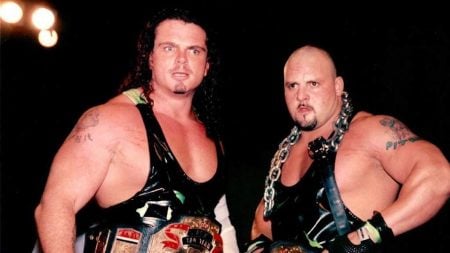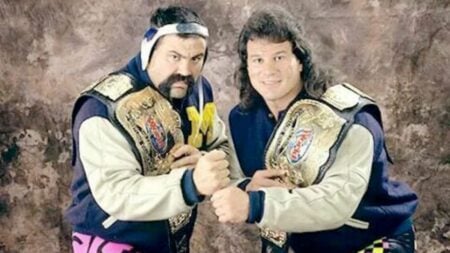


In an era defined by powerhouse tag teams and international wrestling exchanges, few duos embodied raw, athletic brutality quite like The Miracle Violence Connection—the team of Terry “Bam Bam” Gordy and “Dr. Death” Steve Williams.
Between 1989 and 1993, Gordy and Williams forged a partnership that blurred the line between American toughness and Japanese fighting spirit.
Their name—half tongue-in-cheek, half ominous—became synonymous with devastating lariats, suplexes that rattled arenas, and a synergy that made even Japan’s stoic fans rise to their feet.
The Miracle Violence Connection –
From Opponents to Partners
Before their partnership began, both men were already proven forces in professional wrestling.
Terry Gordy, the hard-hitting prodigy of The Fabulous Freebirds, had built his name in the 1980s as one of the youngest stars ever to headline arenas.
By his mid-20s, Gordy had already worked alongside Michael Hayes and Buddy Roberts as part of one of wrestling’s most polarizing and successful factions.
But while Hayes thrived on charisma, Gordy was the Freebirds’ enforcer—brutal, athletic, and deceptively agile for a man topping 290 pounds.
Steve Williams, meanwhile, carried a different pedigree. A legitimate athlete from the University of Oklahoma, Williams was a two-sport star—an All-American lineman in football and an All-American in wrestling.
His reputation for toughness was earned on the mat and in the locker room. By the mid-to-late 1980s, “Dr. Death” had established himself in the NWA and UWF as a hard-nosed competitor with an unmatched engine.

The Brutal Brotherhood of Terry Gordy and “Dr. Death” Steve Williams –
The Matches That Made Them A Considerable Force
Their paths crossed in All Japan Pro Wrestling (AJPW) in 1989. Gordy, already a respected mainstay in the promotion through his work with Stan Hansen and Bruiser Brody, found in Williams a like-minded partner who shared the same physical style that resonated deeply with Japanese fans—what Giant Baba’s AJPW called “King’s Road.”
In an interview from the early 1990s, Williams described the team’s formation plainly:
“We didn’t plan to be a tag team. Baba saw how we trained and fought in the ring and said, ‘You two together—unstoppable.’ From there, it just clicked.”
The chemistry was instant. Gordy’s raw power and brawling meshed seamlessly with Williams’s amateur wrestling base and explosive suplex arsenal. Both men were American imports who wrestled with Japanese precision.
The Rise in All Japan: Real World Tag League Dominance
By the 1990 Real World Tag League, Gordy and Williams had already made waves as a credible force in AJPW’s stacked tag division. That year, they finished near the top, showcasing the blend of speed, timing, and sheer violence that would become their signature.
Their big breakthrough came in 1990, when they captured the AJPW World Tag Team Titles for the first time by defeating Jumbo Tsuruta and Yoshiaki Yatsu. Japanese media quickly began calling them “The Miracle Violence Connection,” a name both eccentric and fitting—it was the English translation of their billing in Japanese magazines: a “miracle connection of violence and power.”
Over the next three years, they’d win five AJPW Tag League tournaments (1990, 1991, 1992) and hold the World Tag Team Titles multiple times.
Their battles with legendary duos such as Mitsuharu Misawa & Toshiaki Kawada and Kenta Kobashi & Tsuyoshi Kikuchi remain etched in Japanese wrestling history.
Wrestling historian Fumi Saito once said of the team:
“They were everything Japanese fans loved about gaijin wrestlers—intensity, realism, and respect for the fight. They didn’t treat wrestling like a show; they treated it like war.”
Their style blended the All Japan ethos with American grit. Matches weren’t just physical—they were escalating wars, a style that would later define the “King’s Road” storytelling that shaped 1990s Japanese wrestling.

Crossing Over to WCW: 1992 – A Brief American Dominance
By 1992, WCW (then under Bill Watts, Williams’s former UWF mentor) saw an opportunity to bring their success stateside.
The Miracle Violence Connection debuted in the U.S. as a team of unstoppable foreigners—legit fighters who could dominate both technically and physically.
Their WCW debut earned them instant credibility. Within months, they captured the WCW World Tag Team Titles by defeating the Steiner Brothers—arguably the most legitimate tag team in American wrestling at the time—at the Great American Bash (July 12, 1992).
The win was not just a championship victory; it was a statement. The Steiners were considered the measuring stick for physical tag wrestling in America, and Gordy and Williams beating them clean underscored just how respected they were behind the scenes.
The match was stiff, methodical, and punishing. In the Wrestling Observer Newsletter’s recap, Dave Meltzer described it as:
“An old-school clinic of intensity and realism—brutality with purpose.”
That same summer, they also unified the WCW Tag Team Titles with the NWA World Tag Team Titles by defeating Dustin Rhodes and Barry Windham.
Their momentum was unmatched—at one point, holding the unified belts across WCW and NWA while still active in All Japan. However, the WCW chapter of their story would end abruptly.

The Split: Missed Opportunities and Career Divergence
In late 1992, Terry Gordy suddenly disappeared from WCW television. Officially, it was due to “travel issues,” but reports at the time suggested otherwise.
Behind the scenes, Gordy had been dealing with substance issues that began to affect his performances. While touring Japan earlier that year, he reportedly suffered a near-fatal overdose, which left lingering effects on his coordination and cognitive ability.
Williams, ever the professional, attempted to keep the team going, but without Gordy’s full strength, the chemistry faltered.
WCW management soon lost interest, particularly as the promotion shifted toward younger talent and story-driven feuds rather than legitimate athletic contests.
Williams returned to All Japan as a singles competitor, continuing to team intermittently with other partners, while Gordy’s career became sporadic.
Though he’d continue wrestling into the late 1990s, the “Bam Bam” who once dominated Tokyo Dome crowds was never quite the same.
As Steve Williams later reflected in an interview with Pro Wrestling Illustrated:
“Terry was my brother in that ring. What we did in Japan—no one could touch it. But life caught up to him. I loved him like family, and when we couldn’t keep it going, it hurt.”
Their Legacy in Japan
The Miracle Violence Connection’s influence is perhaps best seen in the next generation of Japanese wrestling.
Their matches with Misawa, Kawada, and Kobashi between 1991 and 1993 were pivotal in shaping All Japan’s evolution from “gaijin vs. native” to “epic storytelling wars.”
The physical escalation, finishing sequences, and realism would go on to influence later tandems such as Holy Demon Army (Taue & Kawada) and Kobashi & Akiyama.
In total, Terry Gordy and Steve Williams won the AJPW World Tag Team Championship 5 times, won the Real World Tag League 3 times (1990, 1991, 1992), and were named Tag Team of the Year by Tokyo Sports in 1991 and 1992
In Japan, their matches are still analyzed for pacing and ring psychology. Unlike other American imports, Gordy and Williams were embraced not as outsiders but as equals in Baba’s world. Their offense looked painful because it was. Their bumps looked dangerous because they often were.
Life After the Connection
After the team’s split, both men continued to have significant, if divergent, careers. Steve Williams went on to become a top singles competitor in AJPW, capturing the Triple Crown Heavyweight Championship in 1994.
His match with Mitsuharu Misawa on July 28, 1994, is still regarded as one of the greatest heavyweight bouts in AJPW history. Williams’s mix of amateur technique and unrelenting power kept him relevant well into the late 1990s.
In 1998, Williams briefly joined WWF under the guidance of Jim Ross. However, his run there was derailed after the infamous Brawl for All shoot-style tournament, where he suffered a torn hamstring and knockout loss to Bart Gunn.
Despite this setback, Williams remained respected across the industry for his toughness and professionalism until his death in 2009.
Terry Gordy, sadly, never regained his full health after his 1993 medical emergency. He returned to the U.S. independents and even worked briefly for ECW and the WWF (notably under a mask as The Executioner in 1996). But his prime years had passed. Gordy died of a heart attack in 2001 at the age of 40.
The Reputation They Left Behind
Even today, the Miracle Violence Connection stands as a prototype for hybrid tag teams—men who could combine the brutality of power wrestling with the conditioning and precision of an Olympic-level athlete.
Jim Ross once summarized their appeal best on an episode of Grilling JR:
“They were believable. You didn’t have to convince fans that Gordy and Doc could beat you up—they just had to walk to the ring.”
Their influence extended beyond Japan. Teams like the Steiner Brothers, APA, and even War Machine (War Raiders/Viking Raiders) have cited the MVC as a blueprint for what a dominant tag team should look like—two men who didn’t rely on gimmicks or theatrics, only controlled violence.
A Legacy of Authenticity
While their time together was relatively short—spanning roughly four years—the Miracle Violence Connection’s impact was seismic.
In Japan, they elevated tag wrestling to near-main event status. In America, they served as a reminder of what legitimate athletic wrestling could look like when presented seriously.
They didn’t need elaborate promos or scripted storylines. Their connection—both literal and spiritual—was rooted in respect, intensity, and shared purpose.
Their story ended too soon, as so many in wrestling do. But when Terry Gordy and Steve Williams stepped between the ropes together, there was no pretense—only authenticity, power, and the kind of violence that truly lived up to their name.