

In the early 1980s, wrestling was just beginning to use real music for entrances—no licensing, just bold choices such as Ozzy Osbourne and Black Sabbath. Osbourne’s inclusion in wrestling history began as the 1980s.
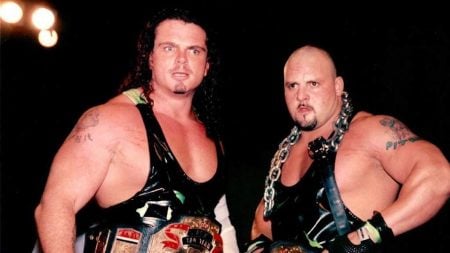
Then emerged The Road Warriors (Hawk and Animal), a tag team whose look and presence redefined what a wrestling team could be.
Their legend wasn’t just built on size, paint, and spikes—it was the moment Black Sabbath’s “Iron Man” stormed through arena speakers.
Ozzy Osbourne – He is Iron Man
As they prepared for their AWA debut in 1984, manager Paul Ellering and the duo were searching for an entrance theme. Animal later wrote that during a fast‑food run, they turned on the car radio and heard the ominous drum beat and power guitar chords of “Iron Man.” He recalled:
“We heard a familiar song… Hawk and I looked at each other and knew it was ‘Iron Man’ by Black Sabbath.
It was perfect… if Ozzy was Iron Man, Hawk and I were definitely the tag team equivalent.”
That quick moment solidified their identity: they weren’t just wrestlers—they were an unstoppable force marching to one of the most menacing riffs in rock.
For many wrestling fans, hearing “Iron Man” meant one thing: massive destruction was about to enter the ring. Reports from the time emphasize that the opening notes alone could trigger what became known in the business as the “Road Warrior pop”—a collective roar from the crowd. One fan site even says:
“When the first notes of their entrance music could be heard… the crowd came alive as one… the loudest pop of the night was all but guaranteed.”
In those pre-licensing days, wrestlers often used music without regard to rights—it was simply about impact. Road Warriors led this shift.
As one review put it: they used a bold mix of fear and thrill: “the opening of the theme with Hawk screaming… got crowds on their feet and amped up…”
Has he lost his mind?
Can he see or is he blind?
Can he walk at all
Or if he moves will he fall?
Is he alive or dead?
Has he thoughts within his head?
We’ll just pass him there
Why should we even care?
He was turned to steel
In the great magnetic field
When he traveled time
For the future of mankind
The use of the genuine “Iron Man” lasted through multiple territories. In most of their early years—in Georgia, AWA, NWA before WWE—Black Sabbath’s original was their official intro.
The moment the drums hit, fans reacted. It wasn’t until WWE (then WWF) that copyright concerns pushed them to record a sound‑alike version, “We Are Iron Men,” without Sabbath’s vocals.
Nobody wants him
He just stares at the world
Planning his vengeance
That he will soon unfurl
Now the time is here
For Iron Man to spread fear
Vengeance from the grave
Kills the people he once saved
Later, the WWF rebranded them as the Legion of Doom and adopted the in-house theme “What a Rush!” by Jim Johnston—effective, but never as raw as the original riff.
Reasonable accounts note that WWE paid homage to the original—Jimmy Hart and J.J. Maguire created “What a Rush!”—but many old‑school fans still prefer the Sabbath original.
Although this section is focused on the Road Warriors, it ties back to Ozzy Osbourne’s influence in wrestling. His song “Hellraiser” later became the theme for the Hell Raisers (Hawk paired with Kensuke Sasaki in NJPW), showing the continued synergy between his music and the violent, larger‑than‑life wrestling aesthetic.
Across decades, from Sabbath’s foundational “Iron Man” to Ozzy Osbourne’s later solo themes, metal and wrestling have been woven together.
Nobody wants him
They just turn their heads
Nobody helps him
Now he has his revenge
Heavy boots of lead
Fill his victims full of dread
Running as fast as they can
Iron Man lives again!
The Road Warriors’ emergence via “Iron Man” set the template: music isn’t just background—it’s character-defining.

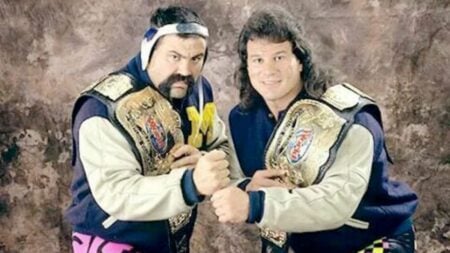
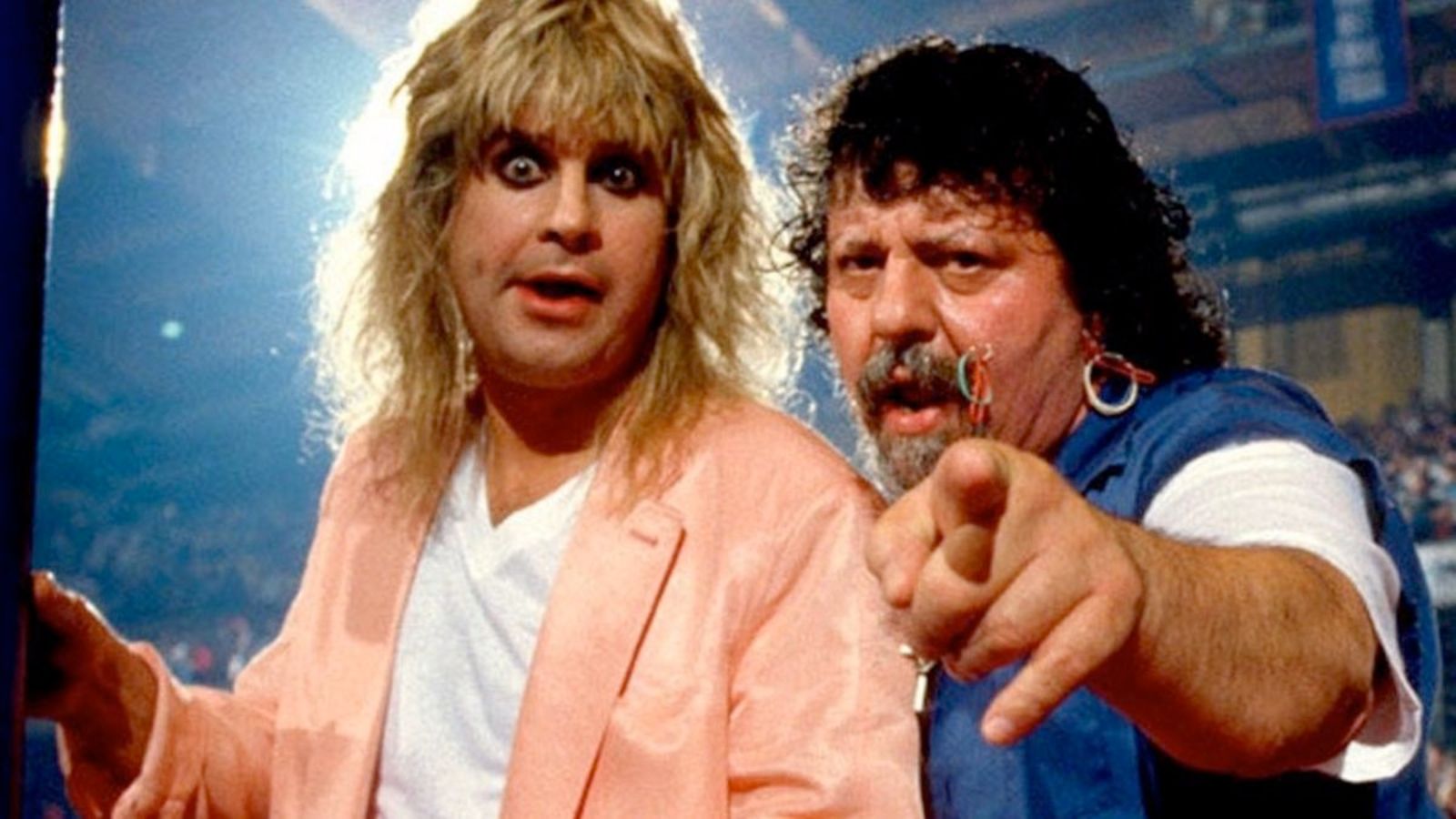
It was there where the Bulldogs were managed by Captain Lou Albano—as they challenged The Dream Team for the WWF Tag Team Championship, his relationship with wrestling was predated by the Road Warriors’ use of the song “Iron Man”.
Osbourne was dressed in a pinkish suit and sporting his trademark demeanor; he watched as the Bulldogs won the belts in front of a packed crowd.
This single appearance cemented his status as a celebrity involved in wrestling, long before crossover entertainment became routine. Ozzy recalled:
“I’m not new to wrestling. I started doing some stuff with the British Bulldogs many, many years ago.”
He also spoke warmly: “He [Andre the Giant] was such a lovely man … we used to go drinking together.”
In May 2007, Ozzy Osbourne released “I Don’t Wanna Stop” (from the album Black Rain), and WWE selected it as the official theme for the Judgment Day PPV.
One week before the event, he performed it live on SmackDown in Baltimore, at the 1st Mariner Arena, which was broadcast internationally on Sky Sports, FOX8, and The Score in Canada.
On WWE.com, Ozzy reflected on his wrestling ties:
“I’m not new to wrestling. I started doing some stuff with the British Bulldogs many, many years ago,” and
“I thought nobody could get louder than a rock concert, but was I ever wrong!” .
Over the years, multiple Ozzy Osbourne tracks have been featured as theme music. “War Pigs” was used for NXT TakeOver: WarGames in 2020 and again for Survivor Series WarGames sequences—including an in-video appearance by Ozzy, filmed in 2022, where he says, “Welcome to War Games,” followed by his signature laugh.
The next is, Straight To Hell served as the theme for the Hell In A Cell events in 2021 and 2022. Finally, Parasite (from Patient Number 9) also appeared in the 2022 Survivor Series WarGames package.
Collectively, at least four Ozzy or Sabbath songs have been used in WWE programming, making him one of the most musically recognized rock icons within the promotion.
Bruce Prichard, a longtime WWE executive, recalled Ozzy at a SmackDown taping in Baltimore in May 2007. He described Ozzy as “absolutely f***ing awesome … incredibly talented.”
On SmackDown reaction in 2007
“That crowd [at SmackDown] blew the f*** roof … it was rock ’n’ roll and then some.”

In November 2009, Ozzy Osbourne and his wife, Sharon, served as guest hosts for Monday Night Raw. Their segment featured a tongue‑in‑cheek “Raw’s Got Talent” show, fitting both their reality‑TV fame (The Osbournes) and Ozzy’s famously offbeat persona.
And Ozzy marveled at WWE crowds:
“That crowd [at SmackDown] blew the f*** roof … it was rock ’n’ roll and then some.”.
Recognizing his cultural impact and multiple contributions to WWE, Ozzy was inducted into the celebrity wing of the WWE Hall of Fame, Class of 2021.
Although the event was postponed due to COVID, his induction was broadcast in April 2021 via a taped speech rather than in‑person attendance.
He was inducted alongside notable non-wrestlers, including Mike Tyson, Snoop Dogg, and Arnold Schwarzenegger.
While inducted, Ozzy said:
“Thank you so much WWE Universe for this award. I don’t deserve it, but thank you anyway… It’s all about the fans, really. Our fans are what keep us alive…”

“Welcome to War Games,”
Generals gathered in their masses
Just like witches at black masses
Evil minds that plot destruction
Sorcerers of death’s construction
In the fields, the bodies burning
As the war machine keeps turning
Death and hatred to mankind
Poisoning their brainwashed minds
Oh, lord, yeah
It was followed by his iconic laugh. WWE had originally explored a live appearance, but Ozzy’s health and scheduling made a pre-filmed cameo the better option.
In summary, Ozzy Osbourne’s wrestling contributions span nearly four decades. He helped weave real-world rock culture directly into wrestling’s pageantry:
His first in-ring role at WrestleMania II positioned him as a legitimate presence in a major storyline. Ozzy’s live musical performance brought a genuine rock‑concert energy to WWE television.
His music (particularly War Pigs and Straight To Hell) has become integral to some of WWE’s highest-stakes events (WarGames, Hell in a Cell).
His guest hosting of Raw during the Osbournes era reflected the symbiosis between pop‑culture celebrity and wrestling‑era crossovers.
Osbourne’s Hall of Fame induction cemented his status not just as a rock icon, but as someone whose presence and music made a lasting impact on WWE’s entertainment history.
Through it all, his quotes reflect both irreverence and warmth—never overblown or overwritten—the type of no‑frills voice that real fans remember and real promoters want.
Ozzy Osbourne’s involvement in professional wrestling has been far more than cameo‑level novelty: it became a recurring thread in WWE’s tapestry.
From WrestleMania II to major PPV theme songs, guest hosting, and Hall of Fame recognition, his presence bridged hard rock with sports entertainment.
His own reflections—whether recalling Andre the Giant or marvelling at the crowd’s volume—add authenticity. His music didn’t just soundtrack events; it elevated them to a new level.