

The most effective villains in fiction are the relatable ones, the ones who have a point, unlike Muhammad Hassan. Consider the likes of Roy Batty from Blade Runner, or Killmonger from Black Panther, or arguably the king of relatable villains, Magneto from X-Men.
Their actions may be brutal and unconscionable, but the fact that we can understand and relate to their motivations makes them that much more memorable.
The same is true in pro wrestling, where wrestlers often turn heel for understandable reasons. When Bret Hart turned heel towards the end of his WWF run, he did so because he was continually getting cheated out of opportunities by outside forces.
When Lita turned heel towards her retirement, she did so because women’s wrestling was being downplayed and disrespected by both the fans and the company despite her work to raise the bar.
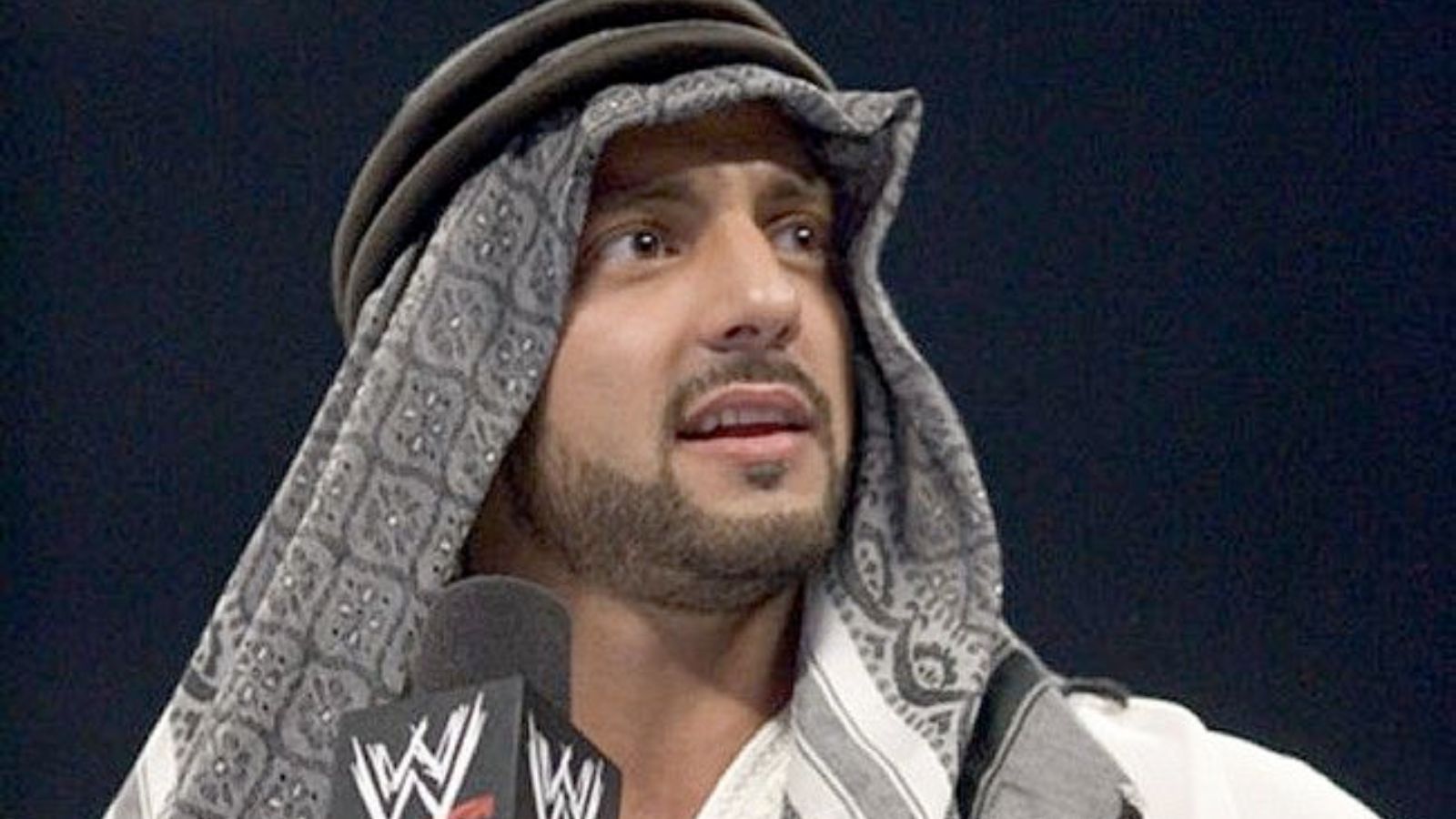
Often grouped with these “Heels Who Had A Point” is one Muhammad Hassan, a wrestler of Middle Eastern descent, who railed against the prejudice he experienced in America in the wake of the terrorist attacks of September 11th, 2001.
Today, we look back on his brief run in the WWE, so as to answer the question: Did Muhammad Hassan have a point?

Muhammad Hassan Arrives in WWE
As is the case with many wrestlers in the mid-2000’s, the WWE universe was introduced to Muhammad Hassan through a number of prerecorded vignettes in late 2004.
In these vignettes, Hassan and his manager Khosrow Daivari would explain that, for most of their lives, they had lived as ordinary American citizens.
They had gone to American schools, taken in American culture, and partook in American cuisine. The only notable difference was that most Americans were some denomination of Christian, while Hassan and Daivari were Muslim.
However, their adherence to Islam had never been a hindrance to them until 9/11. In the aftermath of those horrible attacks, other Americans had begun harassing and belittling not only Hassan and Daivari, but other Arab-Americans, too.
Most of the vignettes closed with Hassan pleading for the audience to look past his Arab heritage and judge him based on his talent as a wrestler.
Hassan and Daivari would appear in-person for the first time on the December 14th, 2004 episode of Monday Night Raw, interrupting Mick Foley as he cut a particularly patriotic promo regarding US armed forces in the Middle East.
After a brief introduction by Daivari, Hassan would rant about how he used to participate in the blind patriotism and support for the troops.
However, his experiences in the wake of 9/11 opened his eyes to the blatant falsehoods fed to the American people. He then railed against the fans for supporting the United States of America in their unjust invasion of Iraq and Afghanistan.
The next month on Raw, he and Daivari would participate in an in-ring debate against Jim Ross and Jerry Lawler as the company built anticipation for Hassan’s in-ring debut at New Year’s Revolution.
That night, Muhammad Hassan faced Jerry Lawler, and would have lost had Daivari not placed his foot under the rope during a pinning predicament. Hassan then executed his finisher, a reverse STO, on Lawler to pick up the victory.
The Road To WrestleMania
Over the coming weeks, Muhammad Hussan would defeat crowd favorites like The Hurricane, Chris Benoit, and even Sgt Slaughter, the latter earning him some serious heat.
However, his heat was unlike that garnered by other heels of the time, as even other heels didn’t like him. And so, on January 30th, at the 2005 Royal Rumble, Muhammad Hassan entered at #13, only to be dumped out near immediately by everyone else in the ring, babyface and heel alike.
Over the coming weeks and months, Hassan would continue interrupting promos to complain about anti-Arab prejudice in America, though he would phase out his praises to Allah after complaints from the Muslim community.
Hassan did not have a match at WrestleMania 21, however he did appear in a segment that saw him and Daivari attack Eric Bischoff’s storyline “special needs” nephew Eugene.
The segment culminated with the arrival of Hulk Hogan, Eugene’s childhood hero, to fend off his assailants. The following night on Raw, Hassan and Daivari would have an altercation with Shawn Michaels, leading Michaels to demand a handicap match against the duo.
Eric Bischoff would grant him a tag team match, but only if he could find a partner. To that end, Michaels called on Hulk Hogan to be his tag partner, with Hogan accepting on the April 18th episode of Raw.
Hassan and Daivari would lose their tag team match at Backlash on May 1st, with Daivari taking the pin. However, this would set up the Hogan/Michaels feud heading into that year’s SummerSlam in Toronto.
Championship Pursuits
With Daivari having taken the pin at Backlash, it seemed as though Muhammad Hassan had never been pinned since entering WWE.
This is not the same as a winning streak, as Hassan had come out on the losing end in a number of matches, but still impressive.
He managed to parlay his unpinned streak into a World Heavyweight Championship match against Batista on the May 30th taping of Raw.
During this match, however, Batista would lay into Hassan in the corner, leading referee Mike Chioda to call the DQ finish. An enraged Batista would batter Hassan and Daivari around the ring after the match, leading both to threaten GM Eric Bischoff with a lawsuit the following week.
Bischoff would then placate the two by offering a 2-on-1 handicap match with Shelton Benjamin for the Intercontinental Championship.
This match ended in some controversy, as Hassan appeared to pin Benjamin, only for the official to reverse the decision and restart the match as Benjamin was on the ropes. Benjamin would pin Daivari to retain the title.
Weeks later, Hassan would petition special guest enforcer Steve Austin for another Intercontinental Championship match.
Austin granted him the match on the grounds that both he and Hassan had been “screwed by the system.” Hassan’s second IC title match ended in disqualification when Austin entered the ring to hit the Stone Cold Stunner on both Hassan and Daivari, allowing Shelton Benjamin to walk away with the belt.
The June 23rd episode of Raw featured the beginning of that year’s brand draft, and saw WWE Champion John Cena jump from SmackDown to Raw.
That night, Hassan would interrupt Cena’s promo, again to complain about WWE “screwing” him because of his Arab ethnicity.
General Manager Eric Bischoff intervened and announced he was going to put Cena to the test by having him defend the WWE Championship against Hassan later that night. The match would prove underwhelming, as Cena defeated Hassan in under 5 minutes, bringing the “unpinned” streak to an end.
Controversy and Departure
On his first night as part of the SmackDown roster, Hassan defeated Big Show after interference from Matt Morgan.
On the June 28th episode, Hassan competed against JBL, Booker T, Christian, Chris Benoit, and The Undertaker in a 6-man elimination match to determine the #1 Contender for Batista’s World Heavyweight Championship.
He would be eliminated early in the match, but also caused Undertaker to be eliminated, beginning a program between the two. On July 4th, SmackDown General Manager Theodore Long announced that Muhammad Hassan would face The Undertaker at the 2005 Great American Bash, again over #1 Contendership.
However, Daivari would face The Undertaker later that night. ‘Taker defeated Daivari with ease, however it’s what happened after the match that would go down in infamy.
Hassan watched from the entrance ramp as Undertaker defeated his manager, before getting on his knees to utter a prayer.
Upon finishing his prayer, five men in balaclavas and paramilitary gear stormed the ring. Armed with clubs and a garotte, they assaulted The Undertaker, rendering him unconscious for Hassan to apply the Camel Clutch.
The masked men would then carry Daivari out of the arena over their shoulders as a martyr. The image of an Arab-American ordering masked men to carry out an attack on his opponent was tasteless enough as it is, but we remind you that this moment was taped on July 4th. There was absolutely no way for anybody at WWE headquarters to know what was about to happen.
On July 7th, 2005, Islamist terrorists carried out a series of four suicide attacks targeting commuters on public transit in London, England, killing 52 people and injuring nearly 800 others in the deadliest terror attack on UK soil.
While the UK mourned, employees at Titan Towers in Connecticut scrambled to figure out what to do about that night’s SmackDown, which, we hasten to remind you, was taped 3 days earlier.
WWE decided to air the episode as usual in America and Canada (albeit with additional advisory warnings around the segment) and an edited version (removing the offending material) in the European and Australian broadcasts.
However, the damage had been done, as the next morning media outlets across the globe admonished WWE for their decision to go ahead with the angle as planned.
SmackDown’s host network, UPN, issued a press release explaining that they were monitoring the storyline closely and they did not want Hassan on their network for the time being.
On the July 14th episode of SmackDown, Hassan issued a promo for the live crowd, attempting to smooth over some of the controversy, however the footage was edited out of the broadcast.
The following week, Hassan’s kayfabe lawyer (portrayed by Tommasso Ciampa) announced that his client was refusing to appear on WWE programming due to the way he had been treated by both the media and WWE head office.
The planned #1 contender’s match against The Undertaker at Great American Bash went ahead, although the ending was revised so ‘Taker would win.
After the match, he powerbombed Hassan through a rigged stage onto the concrete floor. In Kayfabe, Hassan’s injuries were so bad that he couldn’t return to TV, though in reality he and Daivari had been sent back to developmental to re-tool their gimmicks.
WWE would release Hassan from his contract that September and he would announce his retirement from pro wrestling shortly thereafter.
But Who Was Muhammad Hassan?
At the top of this article, we mentioned how compelling villains are the ones who have a valid point, and Muhammad Hassan started out that way.
In the years following 9/11, Muslim and Arab people faced suspicion, discrimination, and outright hostility in ways they hadn’t before.
However, while Muhammad Hassan spoke to the struggles those people continue to face to this day, the man behind the character could not count himself among those people.
While Muhammad Hassan claimed to be of Jordanian/Palestinian descent, the man who portrayed him was an Italian-American by the name of Marc Copani.
Born in Syracuse, New York, Marc Copani was athletically gifted, playing just about any sport that would have him.
Upon graduating high school in 1998, he would enroll at SUNY Buffalo to study history, completing three semesters before dropping out to follow his dream of becoming a pro wrestler.
In 2002, he moved to Louisville, Kentucky and began training at Ohio Valley Wrestling under Jim Cornette. He made his in-ring debut the same year under the ring name Mark Magnus, and within two years, he was feuding with Johnny Jeter (later of The Spirit Squad) and Nick Dinsmore (later Eugene) for the OVW Heavyweight Championship.
In 2004, WWE’s head office called Cornette asking if he had anybody on the roster who would be willing to portray an Arab-American heel.
Cornette then approached Copani about the opportunity, as he had dark skin and hair. Copani mulled it over, considering the foreign heels he watched on WWF television in his youth, and went ahead with it, despite his family warning him against it. Little did he know what the WWE and the locker room had in store for him.
Troubles Backstage and Onstage
When Copani took on the character, WWE encouraged him to maintain the character at all times when he was in public, to really get a feel for what Muslims and Arab-Americans were experiencing.
While in character, he noticed how the public responded to his presence, especially on airplanes. He also recalls a number of uncomfortable encounters with Arab people who could tell he was not one of them.
A particularly dark encounter in Australia gave him pause for thought about all the people he could be offending with his gimmick.
Copani would bring his concerns to WWE officials, who would remind him that his character was intended to transcend the stereotypes and throw them back in the fans’ faces. However, as time went on and the character took on a more terroristic bent, his heart sank lower and lower.
But while this was happening, he was experiencing success like never before. At just 24 years old, he was positioned against legends like Sgt Slaughter, Hulk Hogan, and The Undertaker.
On top of everything, he was penciled in to defeat Batista for the World Heavyweight Championship at the 2005 Summerslam.
His flourishing career rubbed some of the other talent the wrong way, as they had worked in the WWE for years, and never got anything close to a push like that.
As such, Copani and Daivari were often subject to hazing, including a particularly nasty instance of Wrestler’s Court.
The story begins when Kurt Angle asked Copani if he was comfortable with Eddie Guerrero using the Camel Clutch, Hassan’s finish, as a signature hold.
Copani then spoke with Guerrero about the move, only to learn that Eddie’s father, Gory Guerrero, had invented it.
The story of this encounter would go around the locker room, picking up embellishments until the locker room believed that Copani had told Guerrero not to use the move his father invented.
This got him hauled into Wrestler’s Court, where Undertaker ruled that Copani was to buy drinks for the locker room veterans.
He wound up spending over $1000 on drinks, most of which the other wrestlers didn’t even drink. In the aftermath, Eddie wound up going to Copani to say he knew Copani didn’t mean any harm.
Reaction and Post-Departure
Copani says that over the course of his run, he brought his concerns about the direction his character was taking to management, but all the suits shut him down, telling him they knew what they were doing.
When writer/producer Michael Lombardi (who had orchestrated Muhammad Hassan’s debut vignettes) went to Vince McMahon with further concerns about the character, Vince stripped Lombardi of his duties.
Unfortunately, WWE underestimated the volume of the negative reaction they would receive. Publications from the National Post to TV Guide issued harsh criticism of this characters descent into terrorism.
UPN then applied pressure for WWE to do away with the character. While the plan was initially to send Marc Copani back to OVW to develop a new gimmick, he never got the call to return to the main roster. He claims he felt betrayed by the company, as he had done everything he was told to do and now they refused to book him.
In the aftermath of his retirement from professional wrestling, he moved to Los Angeles to look for work, eventually deciding to finish college, earning a degree in education.
He would eventually move back to New York, becoming a history teacher, then assistant principal, then a principal, and eventually settling as Director of Human Resources for the Fulton City School District.
However, there was a brief period in 2018 when he returned to the ring for indie promotion The Dynasty, under the Muhammad Hassan ring name.
He would defeat Bin Hamin for the Dynasty Heavyweight Championship in June of 2018. However, he vacated the belt shortly after winning it, stating that his career in education would prevent him from defending the championship with any consistency.
In a 2019 interview with Fightful, he confirmed he would be staying in retirement. So in the end, Muhammad Hassan left the wrestling industry as the babyface he deserved to be.
Copani holds no ill will toward Vince McMahon or the WWE, as they allowed him to live his dream and share the ring with his heroes.
However, he adds the caveat that no ethnicity, nationality, or religion should be so horribly stereotyped, especially not on national television.