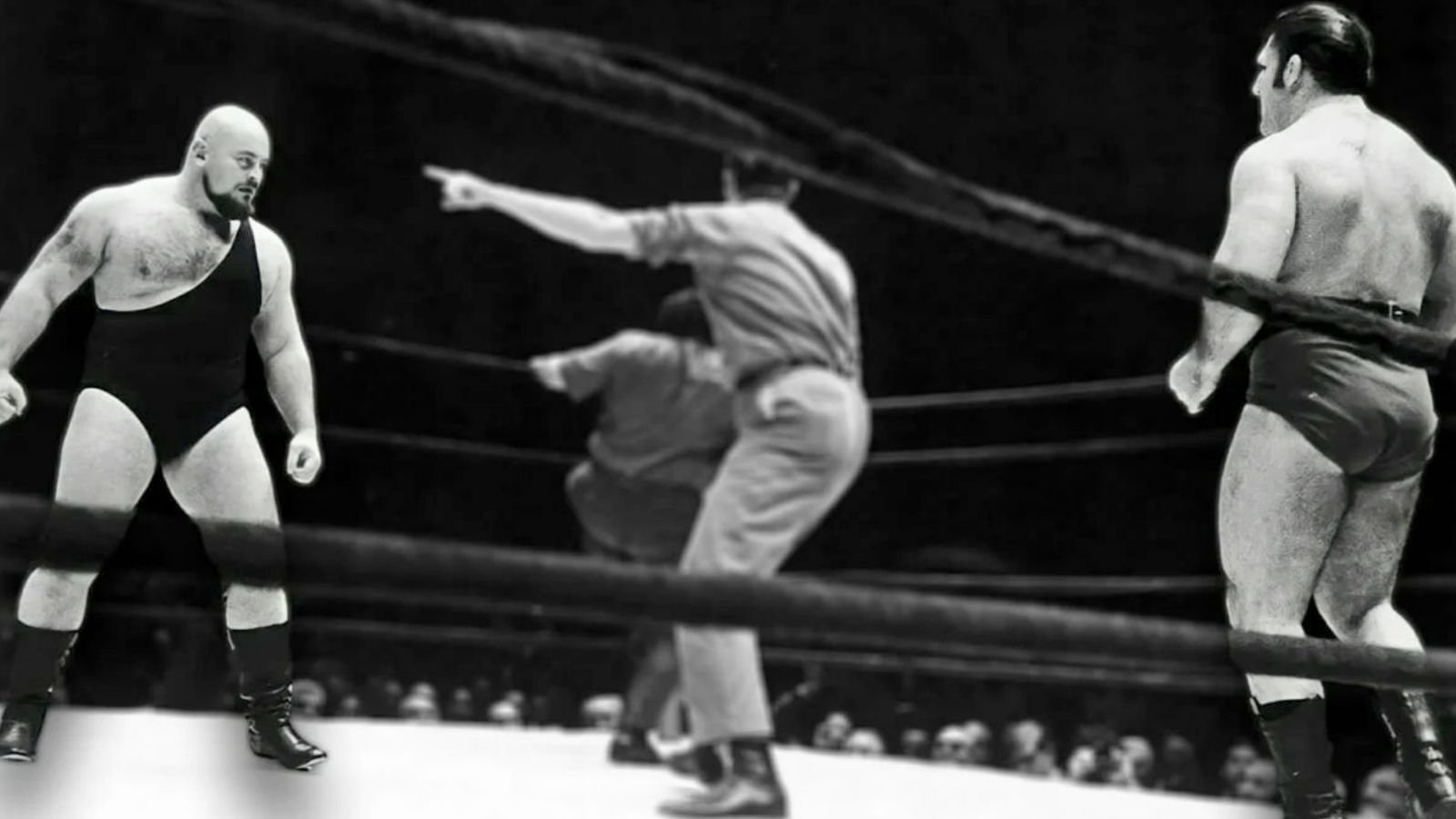
On the night of January 18, 1971, Madison Square Garden — the mecca of professional wrestling — witnessed an event that has since become one of the most haunting, emotional, and pivotal moments in wrestling history.
The evening’s main event saw Bruno Sammartino, the beloved “Living Legend,” defend his World Wide Wrestling Federation (WWWF) World Heavyweight Championship against the rugged challenger Ivan Koloff, “The Russian Bear.”
No one in attendance that night could have imagined what was about to unfold. After nearly eight years atop the wrestling world, Bruno Sammartino, the embodiment of heroism for countless fans, would lose his title.
Yet, it wasn’t just the defeat that shocked the crowd. It was the eerie silence that followed the referee’s three-count.
Bruno Sammartino and Ivan Koloff
– The Night the Garden Fell Silent
The Stakes: A Champion’s Burden
By early 1971, Bruno Sammartino had become more than a wrestling champion — he was a cultural icon. His connection with the audience, particularly immigrant families, was unparalleled.
Having first won the WWWF title on May 17, 1963, from “Nature Boy” Buddy Rogers, Bruno had carried the belt for 2,803 consecutive days — an unprecedented reign of dominance and popularity.
But behind the triumphs was a toll few understood. Bruno’s schedule was brutal, wrestling nearly every night and often twice on weekends. His body was breaking down, with nagging neck and back injuries.
Despite this, Vince McMahon Sr. (then promoter of the WWWF) was hesitant to take the title off him — not because Bruno couldn’t lose credibly, but because the fans simply couldn’t bear it.
By late 1970, Bruno insisted on stepping away.
“I told Vince (Sr), I can’t do it anymore,”
He later recalled.
“My body was hurting, and I wanted time to heal. But I also wanted to make sure whoever beat me was believable — someone the people would accept as a real threat.”
That man would be Ivan Koloff, the menacing 5’11”, 285-pound Canadian grappler from Montreal, billed as a ruthless villain from the Soviet Union.
With his stocky frame, power-based offense, and intimidating glare, Koloff fit the Cold War-era villain archetype perfectly. To fans, he was the embodiment of America’s greatest enemy — a foil that made Bruno’s heroism even more pronounced.
[Photo: WWE]
David vs. Goliath, In Reverse
As the bell rang that night in front of over 21,000 fans, the air was electric. Bruno entered to thunderous applause, the kind that shook the rafters of the Garden. Koloff, in contrast, was met with venomous boos, his stoic expression betraying no emotion.
The early minutes were classic Sammartino: power, control, and deliberate pacing. Bruno used his strength to keep Koloff grounded, working holds that forced the Russian Bear to retreat to the ropes. The crowd roared with each headlock and bearhug reversal, sensing that their hero was in command.
But Koloff was not the type to be bullied. Slowly, he began to use his own brute force, wearing Bruno down with clubbing forearms, boots to the midsection, and choking tactics that tested the referee’s patience. The challenger’s style was methodical, ugly, and mean — a perfect contrast to Bruno’s heroic resilience.
Midway through the bout, Koloff seized momentum after Bruno missed a corner charge. He capitalized with a series of knee drops and a powerful backbreaker that sent shockwaves through the crowd.
The match turned grim; Bruno appeared slower, clutching his ribs, fighting for breath. Fans began to sense that their champion was in real danger.
Then came the finish — sudden and shocking. Koloff climbed to the top rope, an unusual maneuver for a man his size. Bruno staggered to his feet, and before anyone could react, Koloff leapt off the ropes with a flying knee drop — his signature move. The blow landed flush on Bruno’s neck and chest. The referee dropped for the count.
One… two… three.
At that moment, Madison Square Garden — known for its deafening roar — fell deathly silent.
[Photo: WWE]
The Shock Heard Around the Wrestling World
For a brief moment, everyone thought it was a mistake. Some fans even believed Bruno had kicked out. But as Koloff’s hand was raised and the championship belt was handed over, disbelief swept the arena.
“I thought I’d gone deaf,”
Bruno would later say.
“There wasn’t a sound. Usually, even when a villain won, there were boos or jeers. But that night — nothing. Just silence.”
Referee Dick Kroll recalled the same eerie stillness: “
It was like the air got sucked out of the building. I’d never experienced anything like it.”
Koloff himself, standing in the middle of the ring, didn’t gloat or raise his arms high. He simply clutched the title belt and looked around in astonishment.
“I didn’t know what to do,” Koloff later admitted. “The people loved Bruno so much. I almost felt bad.”
Even in victory, Koloff’s demeanor remained respectful. He left the ring quietly as Bruno, groggy and defeated, tried to comprehend what had happened.
Ringside photographers captured the iconic image: Bruno staring into the distance, his face expressionless, as fans sat in shock, some with tears in their eyes.
In the dressing room that night, Koloff and Sammartino shared a moment that reflected the mutual respect they had built. Koloff approached the former champion, hesitant.
“Bruno, I hope you’re okay. I didn’t mean to hurt you,”
Koloff reportedly said.
Bruno, ever the professional, smiled faintly.
“Ivan, you did your job. You deserve it. Thank you.”
Other wrestlers in the back, even the heels, were in awe of what had just transpired. Gorilla Monsoon, a close friend of Bruno’s, later recalled: “
Nobody could believe it. We all knew it was time, but still… it felt like the end of an era.”
Pedro Morales, who would soon succeed Koloff as champion, remembered the reaction from fellow performers:
“Bruno was the man. We all looked up to him. For Koloff to beat him — it was huge. But you could see on everyone’s faces that it was like losing a family member.”
Mourning a Hero Loss
Outside the Garden, fans stood in stunned disbelief. Many wept openly. Some refused to leave. Others wandered through the streets of Manhattan as if trying to process a tragedy.
Bruno’s fanbase — particularly among the working-class and immigrant communities in New York, Pittsburgh, and the Northeast — had grown to view him as a symbol of pride and perseverance. His defeat felt personal.
An oft-repeated story tells of an elderly woman fainting upon hearing the result. Another fan was said to have whispered, “It can’t be true. Bruno doesn’t lose.”
Newspapers the next day ran headlines that read like obituaries:
“Bruno’s Eight-Year Reign Ends: Koloff New Champion”
[Photo: WWE]
The Transition: From Koloff to Morales
Behind the scenes, the title change was part of a carefully orchestrated plan. Bruno had agreed to drop the title to Koloff, a transitional champion who would then lose it three weeks later to Pedro Morales at Madison Square Garden.
The intent was to pass the torch from one ethnic hero to another, as Morales became the first Latino champion in WWWF history.
Bruno would soon take time off to rest and heal, though he remained active in limited appearances. His loss to Koloff only deepened the fans’ admiration for him, and when he returned to reclaim the title from Stan Stasiak in 1973, it was as though the prodigal hero had come home.
Legacy of the Match
The January 18, 1971, contest is remembered not just for its outcome but for its emotional impact — a defining moment in professional wrestling storytelling.
It marked the first time fans truly saw Bruno Sammartino as mortal, which only enhanced his legendary status.
It also elevated Ivan Koloff from a regional heel into one of the most feared villains of his era, respected by peers and audiences alike for carrying the weight of such a monumental victory with humility.
In later years, wrestlers who had grown up idolizing Bruno would cite that night as a formative experience. Mick Foley, who attended Garden shows as a boy, once described watching footage of Koloff’s win as
“gut-wrenching.” “You could feel the heartbreak through the screen,”
Foley said.
Triple H echoed similar sentiments:
“Bruno losing to Koloff was the equivalent of Superman getting beat. It showed us that wrestling wasn’t just about strength — it was about emotion.”
Even Koloff, decades later, spoke with reverence:
“That night changed my life, but it also reminded me how much Bruno meant to the people. I was the man who beat him, but I never forgot that I was part of his story.”
[Photo: WWE]
The Sound of Silence
Few moments in wrestling history have carried such emotional weight. The stunned silence that night was not the absence of noise — it was the collective gasp of an entire era ending.
Bruno Sammartino’s loss to Ivan Koloff wasn’t just a title change; it was a cultural moment. It reminded fans that even their greatest heroes could fall — and in that fall, the myth became legend.
As Bruno himself once said years later:
“The people loved me so much that night, they couldn’t even boo. That silence — that was their way of saying goodbye.”
As a wrestling enthusiast for over 30 years, my fondness for professional wrestling explores the irrational in a rational way. I will explore the details inside and outside the ring and hopefully have a laugh with you in the process. I've had the fortune to interview wrestlers from Lucha Underground, TNA, Ring of Honor, GFW, and former WWE talent as well. Feel free to follow me on Twitter @TheMarcMadison