


In the mid-1990s, Japanese professional wrestling was booming. New Japan Pro Wrestling (NJPW) and All Japan Pro Wrestling (AJPW) were drawing massive crowds and fostering some of the most physically intense matches in the world, creating something that was big, bad, and dangerous.
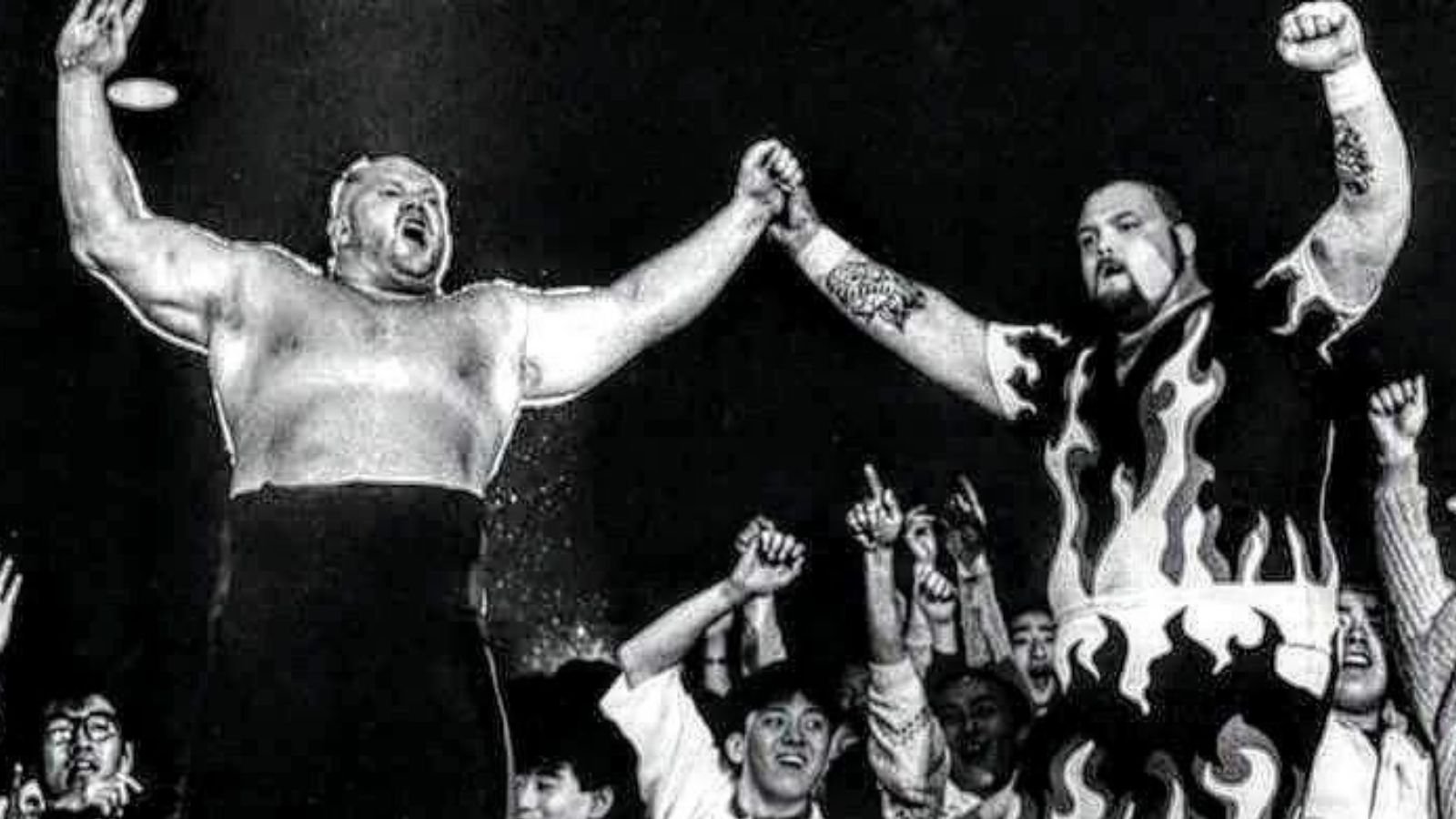
At the forefront of this movement stood two of the most intimidating foreigners ever to step foot in Japan — Bam Bam Bigelow and Big Van Vader.
Their partnership, briefly but memorably known as “Big, Bad & Dangerous,” became one of the most physically imposing tag teams in wrestling history.
They weren’t just large men — they were agile, athletic, and capable of working a hard-hitting Japanese style that combined brutality with surprising finesse.
Big, Bad & Dangerous: The Brutal Alliance of Bam Bam Bigelow and Big Van Vader
This is the story of how their paths crossed, how their partnership evolved, and how their brief run together helped shape the perception of foreign powerhouses in Japan for years to come.
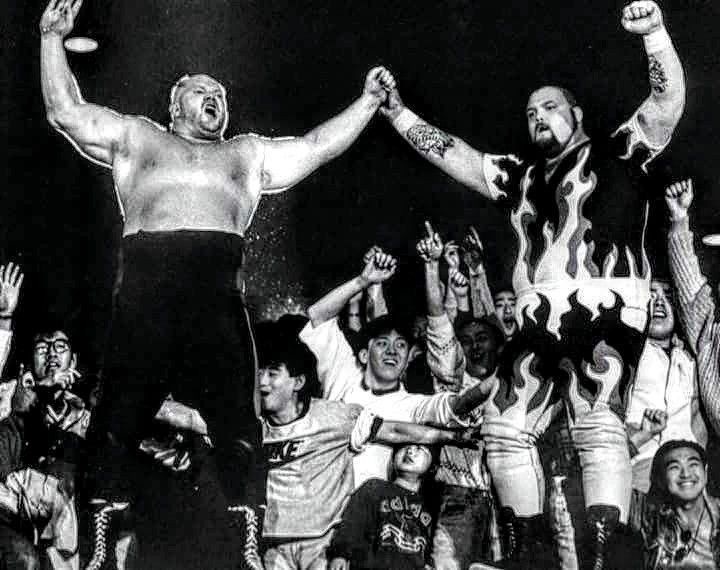
The Origins: Parallel Paths of Destruction
Before they joined forces, both Bam Bam Bigelow and Big Van Vader had already carved out reputations as dominant gaijin (foreign) stars.
Bigelow first made his name in New Japan Pro Wrestling in the late 1980s after short runs in the WWF and Continental Wrestling.
With his tattooed flame-covered skull and freakish agility, Bigelow quickly became a fan favorite in Japan. Despite weighing around 390 pounds, he could moonsault off the top rope — a move unheard of for a man his size at the time.
In contrast, Vader arrived in NJPW in 1987 under the guidance of Antonio Inoki and booker Riki Choshu. His debut was legendary: he destroyed Inoki in a squash match at the Sumo Hall, leading to an actual riot. Vader’s aura — the massive black headgear, the smoke, the cold stare — made him a monster heel overnight.
By the early 1990s, both men had cemented their status as international heavyweights who could headline in Japan or the U.S.
But it wasn’t until 1992–1993 that the two crossed paths in a way that changed the power dynamics of NJPW’s heavyweight tag division.

The Birth of a Monster Team
The concept of Bam Bam Bigelow and Vader as a team emerged organically in NJPW’s booking. Both were foreign attractions, both had prior rivalries with Japanese stars like Keiji Mutoh and Shinya Hashimoto, and both embodied the “monster gaijin” archetype — unstoppable, violent, and larger-than-life.
In late 1992, Bigelow and Vader were paired together for the Super Grade Tag League, a round-robin tournament that pitted the best teams in NJPW against one another.
Wrestling journalist Dave Meltzer described them as “a terrifying combination of size, power, and athleticism — a team that looked like it could tear through anyone.”
Their team name — Big, Bad & Dangerous — fit perfectly. Managed by Masa Saito and sometimes aligned with Riki Choshu’s faction, the duo demolished opponents across Japan, including notable teams such as Keiji Mutoh & Hiroshi Hase, Shinya Hashimoto & Masahiro Chono, and The Steiner Brothers.
Their chemistry was immediate. Vader often worked as the enforcer — landing stiff lariats and crushing body avalanches — while Bigelow displayed surprising agility, hitting slams, dropkicks, and even a top-rope moonsault.
In a 1993 interview with Weekly Pro Wrestling Japan, Vader said:
“When Bam Bam and I teamed up, it wasn’t just about winning. It was about showing what two big men could do when they didn’t slow down.
We could fly, we could fight, and we could work the Japanese style. That made us dangerous.”
(Weekly Pro Wrestling Japan, June 1993 issue)

The 1993 Super Grade Tag League: A Showcase of Power
The team’s greatest run came during the 1993 Super Grade Tag League, one of NJPW’s most prestigious tournaments.
The competition that year was fierce — it included the likes of The Hell Raisers (Hawk Warrior & Power Warrior), The Steiner Brothers, and Keiji Mutoh & Hiroshi Hase.
Bigelow and Vader’s dominance was on full display. Their combination of brute force and unexpected speed overwhelmed opponents.
Highlights included their match against the Steiners, where Vader and Rick Steiner traded belly-to-belly suplexes that drew a standing ovation.
They ultimately won the 1993 Super Grade Tag League, defeating Hase and Mutoh in the finals. The victory cemented their reputation as the most dominant foreign tag team in NJPW history.
In a post-match interview translated by NJPW commentator Hiroshi Tanaka, Bigelow said:
“This is what happens when you take two monsters and let them loose. Japan has the best wrestlers in the world — and tonight, we proved we belong at the top of that mountain.”
(NJPW Archives, December 1993)
Their win marked a rare moment when two foreign wrestlers stood atop New Japan’s heavyweight division — a testament to how over they were with Japanese audiences.
Big, Bad & Dangerous clashed with several major teams during their run. The Hell Raisers (Hawk & Power Warrior): The duo came together after Road Warrior Hawk and Road Warrior Animal had a falling out.
Upon an excursion to Japan, Hawk united with Kensuke Sasaki, forming The Hell Raisers. While together, they had battles with Bigelow and Vade.
These matches were legendary for their physicality. The two teams pushed the boundaries of big-man wrestling, with lariats and suplexes that looked bone-crushing.
Their feud against Keiji Mutoh & Hiroshi Hase: This feud highlighted the contrast between Japanese technique and foreign power. Their final Tag League match remains one of the most rewatched bouts from 1993.
But finally, their battles against The Steiner Brothers were short-lived yet explosive. The sheer power exchanges between Vader, Bigelow, and the Steiners are still cited in wrestling discussions as the pinnacle of heavyweight tag team wrestling.
Wrestling historian Chris Charlton noted in Eggshells: Pro Wrestling in the Tokyo Dome:
“When Bigelow and Vader teamed up, New Japan saw record interest in tag team wrestling again. Their matches weren’t just fights — they were spectacles of strength and athleticism.”
Life After Big, Bad & Dangerous
By 1994, both men began moving in different directions. Vader returned to the U.S. to reestablish himself in WCW, where he feuded with Sting and Ric Flair.
Bigelow would later make his way to the WWF, becoming one of the promotion’s top heels during the New Generation era.
Their partnership may have lasted barely over a year, but its influence was long-lasting. In Japan, their dominance set the standard for how tag team wrestling involving foreigners could be presented — not as comic relief, but as legitimate headline material.
In an interview with Sports Illustrated in 1999, Vader reflected on his partnership with Bigelow:
“Bam Bam was one of the few guys who could match me in intensity. We pushed each other. We weren’t trying to hurt people — but we wanted fans to believe it was real. Japan was the right place for that.”
(Sports Illustrated Archive)
While their careers in North America speak for themselves, these two massive gaijins combined size, strength, agility, and intensity.
These were qualities rarely seen anywhere in the world at the time. However, for a short time, Bam Bam Bigelow and Big Van Vader showed the Japanese faithful why they were big, bad and dangerous.